
How an AI Agent Manages Google Shopping at the SKU Level
A campaign can hit its target while making the wrong product decisions underneath. SKU-level management makes those tradeoffs visible.
A Google Shopping campaign can look healthy while one mature product carries most of the return, a new launch spends without enough traffic to prove itself, and a low-margin SKU absorbs budget because it converts efficiently. At the campaign level, those differences collapse into an average.
Someone still has to decide which products deserve more exposure, which should be contained, and which need a fair test. This is the product-level work MAI's Google Shopping Agent is built to handle. It evaluates advertising evidence alongside business inputs such as margin, inventory, demand, lifecycle stage, promotions, and product priority when those inputs are available.
The result is not a separate optimization system for every item. It is a practical way to stop treating every SKU as if it has earned the same decision.
One campaign can contain three different decisions
Consider three products in the same Shopping program. One has sold consistently for months, has enough conversion history to trust, and still has healthy inventory. A second is a recent launch with weak early ROAS but very little traffic. A third has received substantial exposure and continues to miss its target.
A campaign average can hide all three. At the SKU level, the likely treatments are different: give the proven product more room, protect a controlled test for the launch, and limit the persistently weak product. That distinction is a valid expansion of the broader Google Ads management problem: Shopping requires product decisions that campaign-level automation cannot make from an aggregate result alone.
The evidence behind scale, test, or constrain
A high ROAS is useful, but the number needs support. Five conversions at 5.0 ROAS do not carry the same confidence as hundreds of conversions at 3.8. Recent performance can also be misleading when a promotion, stock position, or traffic mix changes.
MAI can evaluate clicks, conversion behavior, ROAS, add-to-cart activity, and conversion-rate trends. When the advertiser supplies them through a supported source or workflow, business inputs can change the decision as well. Two products with identical platform ROAS may have very different margins, inventory positions, or strategic roles.
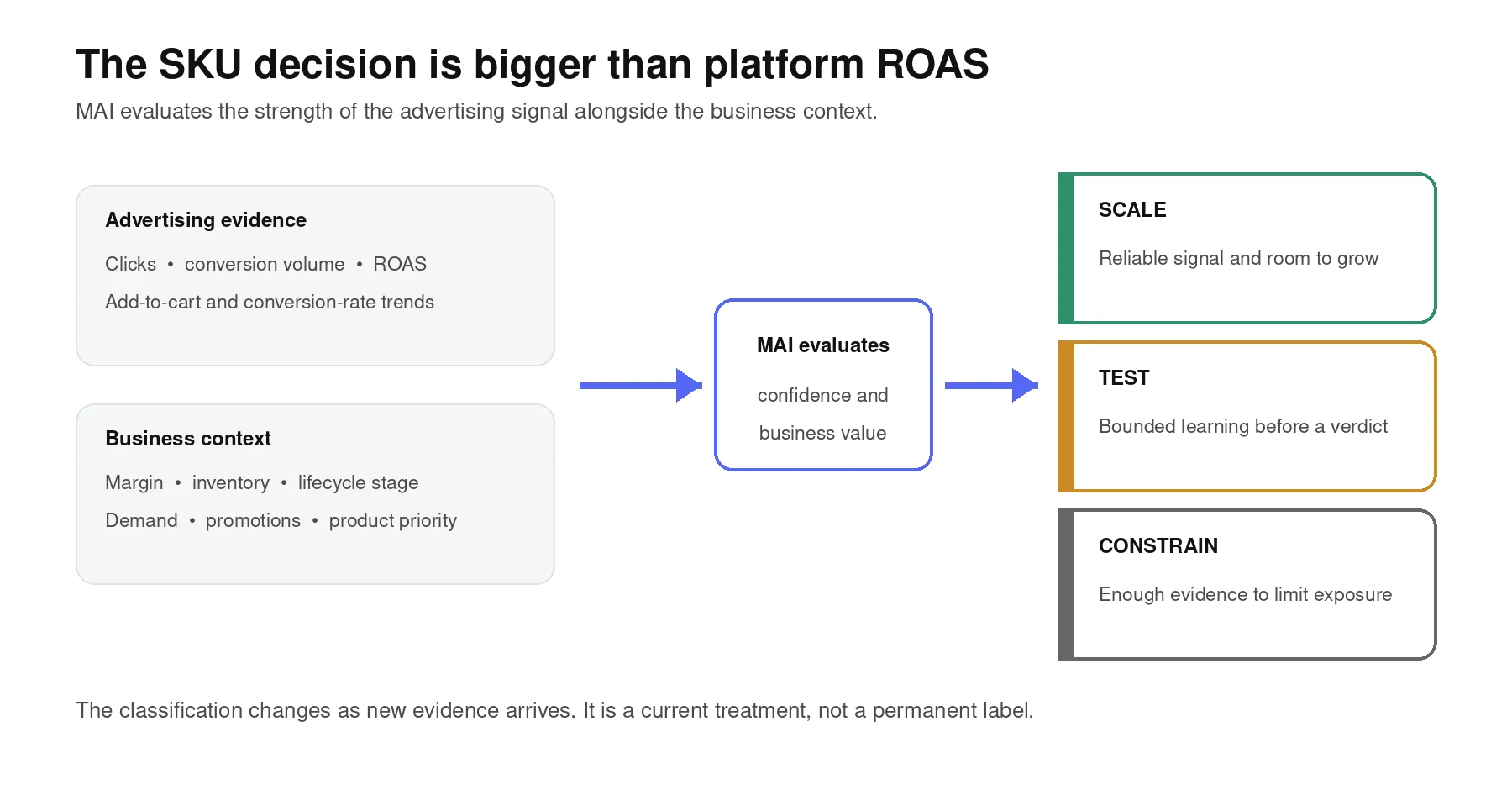
A practical SKU decision framework
| State | Evidence pattern | Business check | Treatment |
|---|---|---|---|
| Scale | Enough volume and consistent performance | Margin, inventory, and demand support growth | Increase exposure within the plan |
| Test | Promising or too early to judge | The product deserves a bounded learning budget | Collect evidence without crowding out proven demand |
| Constrain | Meaningful exposure with persistent weakness | No current business reason supports more spend | Limit exposure while continuing to monitor |
Strong SKUs still need a business case
A reliable advertising signal is only half of a scale decision. A high-ROAS product may be nearly out of stock, carry weak contribution margin, or sit outside the business's current priorities. More exposure would improve the ad report while creating a worse operating outcome.
The reverse can also be true. A product slightly below target may deserve support because it is a strategic launch, a high-margin item, or part of an active promotion. This is why business economics belong in the media decision, not only in a report after the budget has already moved.
Durability matters too. A product that has performed across enough spend and conversion volume is different from one that had a strong few days. MAI uses the evidence available to decide whether the SKU has earned a stronger treatment. The advertiser still defines what good economics look like and supplies the context the platform cannot see.
New products need protected learning
New SKUs are easy to judge too early. Compared directly with an established bestseller, a recent launch will almost always look less efficient because the mature product has more history and stronger delivery signals. If every early result is treated as a verdict, proven products keep absorbing budget and the catalog stops discovering new winners.
The alternative is a controlled test. MAI can keep an uncertain product in a learning state, with enough exposure to collect useful evidence but clear limits on how much budget it can consume. Improving conversion behavior and economics can earn the product more room. Persistent weakness after meaningful spend can move it toward a constrained state.
This preserves two jobs that Shopping accounts have to perform at the same time: fund proven demand and keep a deliberate path open for discovery. The amount reserved for learning should come from the approved Media Plan, rather than being recreated whenever a new SKU appears.
Weak products should not all be paused
Some SKUs have enough evidence to show that they are not earning their current exposure. Shoppers may click without adding to cart, or the product may convert too inefficiently to justify the spend it receives. That is different from a product that simply has not been tested long enough.
MAI can separate weaker SKUs and contain them behind a budget cap. Limited exposure may still be useful when the product has some demand, supports a promotion, or could improve as seasonality changes. A constrained state also leaves room for the evidence to change. If performance strengthens consistently, the product can earn another test; if it continues to deteriorate, exposure can be reduced further.
Scale, test, and constrain are current treatments, not permanent labels. The point of an agent is to keep revisiting the decision as evidence accumulates.
What MAI can change in the account
Once the evidence supports a decision, MAI can carry supported actions into the account. Depending on the campaign and configuration, that can include introducing selected products into testing, containing weaker SKUs behind a budget cap, moving stronger SKUs into a better-performing campaign structure, and tuning supported budgets or bidding targets. MAI can also create or update supported Shopping campaigns when the workflow calls for it.
Those actions operate inside a Shopping Media Plan. The plan defines the account and products in scope, budget and performance targets, and the actions MAI is allowed to take. Supported actions can run automatically, require review, or remain paused. A team may allow routine SKU movement and budget tuning while reviewing larger campaign changes before they happen.
The operating loop is simple: MAI monitors product performance, evaluates the evidence and available business context, updates the SKU's treatment, carries out or proposes the supported change, and watches what happens next. New evidence feeds the next decision.
The marketer still sets the commercial priorities
SKU-level management involves a lot of recurring review. Someone has to keep checking which products carry the account, which consume spend without enough return, and which launches still need a fair test. Automated bidding does not remove that work because the platform does not automatically know which demand the business wants.
MAI can keep those product-level decisions moving and surface the cases that deserve closer attention. The marketer still owns product priorities, acceptable economics, inventory constraints, launch support, and the account's appetite for exploration. Those inputs give the agent a useful boundary for the recurring work.
A practical starting point is one product set where proven, weak, and uncertain SKUs already create significant manual work. Define the inputs and controls, let the classifications change with the evidence, and review whether the account is making better product decisions than the campaign average allowed before.
See how MAI handles SKU-level Shopping decisions
Connect a Google Ads account, choose a Shopping Media Plan, and see how MAI separates products to scale, test, or constrain within the controls you set.
Similar articles
What Happens When an AI Agent Starts Tuning Your Campaigns?
- AI Media Buying
- AI Agents
- Campaign Optimization
- Paid Media
- Marketing Automation
See how an AI media buyer evaluates campaign evidence, tunes bids, budgets, keywords, SKUs, and creative, and works inside marketer-defined controls.
How an AI Agent Decides Which Search Terms to Scale, Test, or Block
- Google Ads
- AI Agents
- Campaign Optimization
- Paid Media
- Search Marketing
See how an AI agent evaluates intent, conversion evidence, landing-page fit, and account history before scaling, testing, or blocking search terms.
How a Google Demand Gen Agent Gives New Creative a Fair Test
- Google Ads
- AI Agents
- AI Media Buying
- Creative Optimization
- Campaign Optimization
See how a Google Demand Gen agent moves eligible creative through controlled testing, scaling, and rotation inside a Media Plan.
The Agentic Media Buying Playbook for DTC Brands
- AI Media Buying
- DTC
- Performance Marketing
- Creative Optimization
- Incrementality
A practical agentic media buying playbook for DTC brands covering SKU economics, creative testing, exploration, incrementality, and controls.