What Happens After the Media Plan Is Approved?
The approved plan sets the direction. The account still needs to adapt as performance, demand, and business conditions change.
You can spend weeks building a media plan. The team agrees on the budget, channel roles, acquisition target, launches, promotions, and the amount of spend reserved for testing.
Then the month starts.
A large campaign paces ahead of plan. Search uncovers demand you did not forecast. A high-margin SKU sells faster than expected and inventory tightens. The Meta creative carrying acquisition volume begins to fatigue.
These changes do not automatically invalidate the plan. They create a more practical question: which decisions can the team make inside the approved boundaries, and which ones require the plan to be reopened?
A useful media plan should answer that question long after the planning meeting ends.
What approval should carry into execution
An approved plan should give the people and systems operating the account enough context to make good decisions without treating the document as a rigid set of instructions.
At minimum, that context includes the business objective, total budget or spending boundary, efficiency target, campaigns and markets in scope, known promotions or inventory constraints, protected testing budget, and the decisions that require review.
Those inputs matter because the same performance signal can lead to different actions. A campaign below its CPA target may still need to slow down if the promoted product is almost out of stock. A new campaign may deserve more time even when its first few days are weak because the plan deliberately reserved budget for learning. A mature campaign that is spending ahead of plan may need to give budget back before its monthly average looks alarming.
The plan does not make those decisions on its own. It supplies the operating context for making them.
Most plans drift through reasonable decisions
Plan drift rarely begins with one dramatic change. It happens through a series of sensible account moves that are evaluated one at a time.
Imagine a month that starts with a $500,000 paid-media budget and an agreed acquisition target. Two weeks in, one large campaign is spending ahead of plan and has missed its target for several days. Another campaign is below plan and continues to hold its target as volume increases.
The team has several defensible options. It could wait for more evidence, reduce the first campaign and give the second more room, or protect the remaining budget until it understands why performance moved.
Any one of those decisions might be reasonable. The risk is losing sight of their cumulative effect. By the end of the month, the account can be materially different from what the team approved even though nobody consciously decided to change the strategy.
Separate tuning the plan from changing the plan
Use one operating boundary: does the decision preserve the approved business commitment, or change it?
Routine tuning works inside the plan. It adjusts supported bids, budgets, keywords, products, or creative while keeping the objective, total budget, scope, and protected tests intact. A plan change alters what the business is betting on: more total spend, a different target, a new strategic priority, a reduced learning commitment, or a move beyond the approved scope.
| Decision test | Tune within the approved plan | Reopen the plan |
|---|---|---|
| Objective | Keeps the approved objective and target | Changes the objective or primary target |
| Total spend | Stays inside the approved budget or cap | Materially changes the total commitment |
| Allocation | Moves spend inside an approved, supported budget pool | Changes channel roles or strategic priorities |
| Exploration | Protects the agreed testing commitment | Cancels, expands, or repurposes protected testing |
| Scope and authority | Uses eligible campaigns, products, assets, and approved actions | Adds new scope or exceeds the agreed approval level |
This distinction is more useful than a fixed dollar threshold. A 10% campaign-budget adjustment may be routine inside one plan and consequential inside another. The decision depends on what was approved, how reversible the action is, and how much evidence supports it.
Use the plan in daily account work
Once execution starts, the plan should stay present in recurring account work.
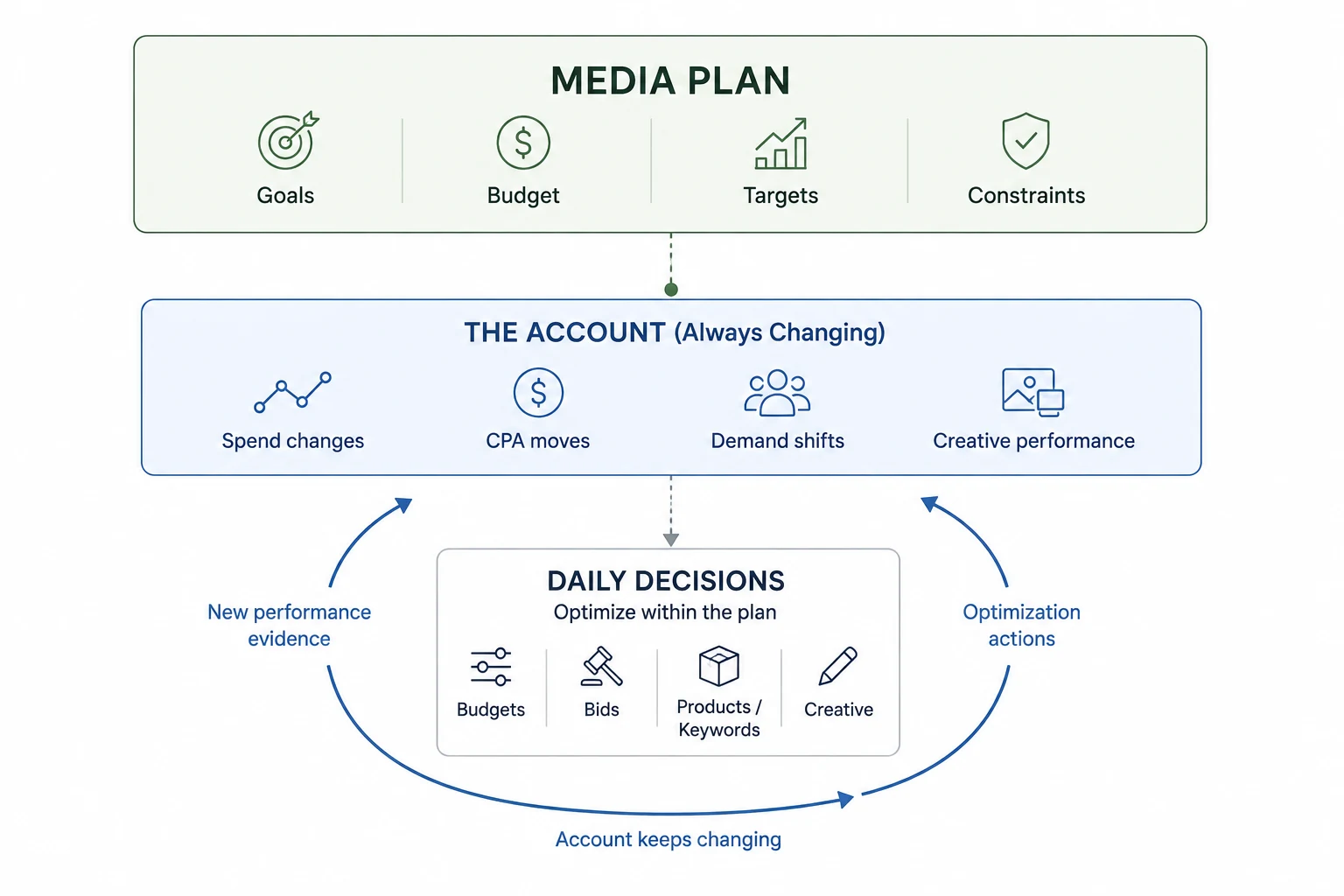
The operator watches pacing, efficiency, conversion quality, search terms, product performance, creative, and landing-page behavior. When something moves, the next step is to investigate the change in the context of the plan. Is the signal persistent? Did traffic mix, inventory, pricing, promotion, or conversion tracking change? Can another eligible campaign or product use the budget productively?
A threshold can tell you that CPA crossed a number. As the article on why AI agents are replacing rules-based media buying explains, the appropriate response still depends on context.
Routine decisions can then be executed inside the approved scope, prepared for review, or held until the evidence improves. The outcome should feed the next decision, along with a record of what changed and why.
Figure 1 shows the relationship: the Media Plan carries the approved intent forward while live account evidence drives recurring optimization.
Keep the evidence proportional to the decision
Use the evidence standard that fits the decision. A reversible bid adjustment inside an approved range can rely on recent account evidence. A material increase in total spend, a change in the primary target, or a large cross-channel reallocation deserves stronger evidence and human judgment.
That evidence may include recent campaign history, marginal performance, incrementality testing, or marketing mix modeling, depending on the question. The article Where Should the Next Dollar Go? covers how marginal returns and saturation change allocation decisions. The practical point here is narrower: as a decision moves farther from the approved plan, the standard of evidence and review should rise with it.
Too much control sends every small optimization to a meeting. Too little lets a run of modest changes quietly become a new strategy.
How MAI carries Media Plans into execution
In MAI, a Media Plan defines the scope and operating settings for a supported workflow. Depending on the platform and configuration, it can include budgets or caps, targets, bidding strategy, eligible campaigns, products, audiences, creative, landing pages, and review settings.
Once the plan is active, MAI can monitor the relevant account, investigate performance movement, and work through supported decisions involving bids, budgets, keywords, search terms, products, and creative. Some actions can run automatically inside the configured plan; others can remain reviewable or paused.
This is where the plan becomes operational. A Shopping workflow can use the products and business inputs in scope when tuning eligible campaigns. A Meta workflow can evaluate eligible creative and manage supported testing and budget actions. Search workflows can act on supported bidding, budgeting, keyword, and search-term decisions. The exact actions depend on the platform, Media Plan, and current configuration.
The marketer still owns the business objective, total commitment, priorities, and operating constraints. The guidance on how much autonomy to give an AI media buyer is useful here: routine, reversible work can have a different approval path from a consequential or poorly supported decision.
MAI also keeps the work reviewable through proposals, changelogs, pause and resume controls, and configured approval settings. If certain changes are made directly in a managed ad account, the relevant workflow may pause and alert the user so conflicting instructions can be reviewed before it resumes.
Reopen the plan deliberately
A plan should be revisited when new evidence changes the commitment the business should make.
That can happen when a campaign continues to hold performance at higher spend, a protected test earns a larger role, inventory or margin changes, a promotion shifts near-term priorities, or updated measurement changes the team’s view of channel contribution.
Cross-channel allocation is a good example. MAI can support analysis, scenario planning, MMM, and Cross-Media-Plan recommendations. Moving budget automatically across platforms is not the default. The team should review the evidence and decide whether the approved channel commitments need to change.
When that decision is made, update the plan rather than letting a collection of account-level exceptions become the new strategy. The next round of execution should start from the new target, budget, scope, or constraint.
Keep the approved plan active through the month
The plan sets the direction. Execution should keep it visible as the account adapts to current evidence.
Keep a clear boundary around routine tuning, raise the evidence and review bar for consequential changes, and record how account decisions affect the original commitment. The team can then move quickly without letting a month of reasonable optimizations quietly replace the approved strategy.