
What Should an AI Media Buyer Actually Do Every Day?
Judge an AI media buyer by the recurring work it carries from detection to resolution—not by the polish of its demo.
Give an AI media buyer access to a live account and you find out pretty quickly how useful it is.
Paid-media accounts generate work all day. Spend drifts off plan. Campaigns stop serving. Search terms deteriorate. New creative needs testing. A landing page breaks. A campaign that looked healthy yesterday starts missing its target. Someone has to notice, investigate, decide what deserves action, and then check what happened afterward.
That is a better standard for an AI media buyer than the number of recommendations it can generate: how much recurring account work can it actually carry through?
What the system should carry through
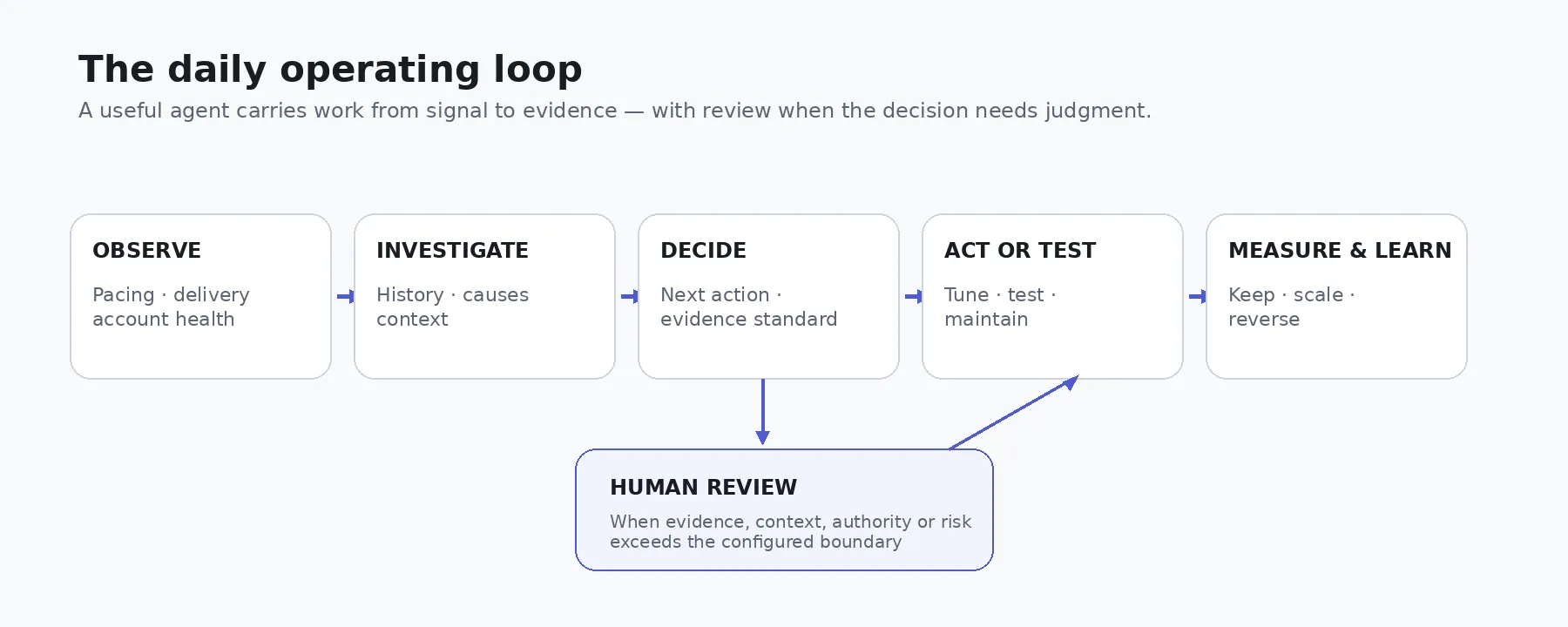
The loop is straightforward: observe, investigate, decide, act or test, then measure what happened. When the evidence, context, authority, or risk is not sufficient, the system should package the decision for review instead of forcing an answer.
Watch the account, then investigate before acting
A useful system starts by keeping watch over the things a media buyer would otherwise have to check manually: pacing, efficiency, delivery, campaign status, funnel performance, landing-page health, and unusual account behavior.
Detection is only the first step. A weak Tuesday does not automatically justify a budget cut. A strong afternoon does not prove that a campaign deserves more money. The system needs enough account history and business context to work through plausible causes before it proposes a change.
That investigation might include where the movement is concentrated, whether tracking or configuration changed, whether a manual platform edit conflicts with the operating plan, whether demand shifted, or whether creative performance is fading. The useful output is not an alert by itself. It is a better-prepared next decision.
Do the routine media-buying work
Once the evidence is strong enough, the system should be able to move from analysis into supported campaign work.
In MAI, the exact levers depend on the platform, campaign type, Media Plan, permissions, and current configuration. Supported workflows can include bid and budget tuning, keyword and search-term decisions, SKU treatment, campaign status changes, creative testing, asset rotation, and selected landing-page or campaign-structure actions. A finding may remain a recommendation, become a reviewable proposal, or move into controlled execution.
That distinction matters. A recommendation that sits in a queue until Friday has not removed the Friday optimization meeting. At the same time, an automated change without a visible record of what changed and why creates a different operating problem.
The useful bar is whether routine work can move from signal to action inside the team’s controls, with proposal status, notifications, tuning history, and change history available afterward.
Keep the account learning
A live account cannot spend all of its time defending yesterday’s winners. New keywords, products, landing pages, audiences, and creative need enough delivery to produce evidence.
This is where controlled exploration matters. Promising opportunities should get enough room to learn. Stronger performers can receive more investment once the evidence is convincing. Weak performance that persists should lead to a pullback. The system should not chase every daily spike or dip, and it should not starve every uncertain idea before it has a fair test.
MAI’s tuning workflows are designed around that stronger / weaker / still-uncertain distinction. Depending on the platform, that can mean introducing a promising search term, testing a new asset, quarantining a weak SKU behind a budget cap, scaling a sustained winner, or pausing a weaker ad or campaign.
Use stronger evidence for bigger decisions
Not every media decision deserves the same evidence standard. A small keyword adjustment does not require an incrementality study. A major budget reallocation may deserve more than platform-reported ROAS.
This becomes especially important across channels. A channel can still report the best average ROAS while having little marginal headroom left. A shift in upper-funnel spend can change search behavior. A creative winner on Meta may be worth testing in Demand Gen, but the result still needs to be evaluated in the receiving channel.
For larger allocation questions, marginal-return analysis, incrementality, or MMM may be more useful than simply comparing platform dashboards. MAI’s MMM and Cross-Media-Plan capabilities can support contribution estimates, diminishing-return analysis, scenario planning, and cross-channel comparison. Automatic cross-channel execution is not the default and should be confirmed for the customer’s configuration.
This is also why autonomy should expand with evidence and control. Routine actions can run automatically where supported and configured; higher-consequence decisions can remain reviewable.
Escalate decisions that need judgment
Some decisions should come back to a person. Large budget shifts, changes to optimization objectives, conflicting manual edits, missing business context, or decisions with material tradeoffs may warrant review.
A useful escalation should not be a vague notification. It should arrive with what happened, what was checked, the recommended next step, the relevant tradeoffs, and the approval still needed.
The team continues to own strategy, goals, budgets, targets, scope, and operating constraints. The Media Plan gives MAI a defined control boundary for ongoing work, and supported actions can be automatic, manual-review, or paused.
Evaluate the work log, not the demo
A representative work log might look like this. It shows whether the system completed useful account work, preserved the evidence behind each decision, and involved a person when the decision exceeded its authority.
| Account condition | What the AI did | Evidence / outcome | Human involvement |
|---|---|---|---|
| Spend pacing moved off plan | Investigated the change and adjusted within the configured Media Plan boundary | Pacing returned toward plan; change logged | None |
| Search term began wasting spend | Reviewed query and conversion evidence, then constrained or negated the term | Waste reduced; decision recorded | None |
| New creative needed a fair test | Added eligible creative to a controlled test | Enough delivery accumulated to evaluate it | None |
| Performance shifted sharply after an account change | Checked configuration and recent edits, narrowed the likely cause, and proposed the next action | Relevant change surfaced; next step documented | Review if consequential |
| Large allocation decision | Compared the available evidence and prepared a recommendation | Tradeoffs and supporting evidence packaged | Human approval |
This is a useful way to separate product categories. Reporting tools surface movement. Copilots make analysis and planning faster. Workflow automation executes predefined rules. An AI media buyer should be judged by how much recurring media-buying work it can carry through to a controlled outcome.
What this looks like in MAI
MAIOS keeps connected account data, history, business context, goals, and controls available across the operating loop. Monitoring can surface account-health and performance issues. Analytics and Execution can investigate likely causes and turn findings into recommendations or supported campaign work. Media Plans define the scope MAI is allowed to manage. Tuning handles recurring optimization inside that scope, with automatic, manual-review, or paused modes where supported.
The same operating context carries into creative, product, and budget decisions. The Asset Library can feed eligible creative into supported campaign-creation and tuning workflows. Shopping workflows can use SKU-level evidence plus supplied context such as margin, inventory, promotions, lifecycle stage, and business priority. Within a single platform, the Budget Allocation skill can recommend how an approved pool should be distributed across compatible Media Plans and can manage future allocations when Agent managed mode is enabled.
The practical gain is more recurring account work handled without the team rebuilding account context from scratch each time.
For an existing account, that context can start with a structured ad account audit that separates foundation problems, supported actions, test opportunities, and open questions before recurring work begins.
The evaluation standard
Your own account backlog is a good product-evaluation checklist. Take a representative week of the recurring work that waits, drifts, or repeatedly pulls the team back into Google, Meta, or Microsoft.
Then ask a vendor to show what happens to each item: what the system notices, how it investigates, what it can complete inside your controls, what evidence it preserves, and what it sends back to the team for judgment.
If the software is marketed as an AI media buyer, ask to see the media buying it actually gets done.
See how MAI could take on more of your team’s recurring media-buying workload
Similar articles
What Is an AI Performance Marketing Agent?
- AI Agents
- AI Media Buying
- Performance Marketing
- Paid Media
- Marketing Automation
An AI performance marketing agent continuously monitors paid media, works out what changed and why, and can carry decisions through to action within defined permissions.
How Much Autonomy Should You Give an AI Media Buyer?
- AI Media Buying
- AI Agents
- Marketing Automation
- Media Buying
- Performance Marketing
The right level of AI autonomy depends on a decision’s consequence and the business context available to the agent.
When Should You Let AI Change Your Ad Budgets?
- AI Media Buying
- Budget Allocation
- AI Agents
- Performance Marketing
- Paid Media
Learn which budget changes AI can automate, when human review is needed, and how to set practical guardrails.
How AI Agents Simplify Google Ads Management for Performance Marketers
- Google Ads
- AI Agents
- Campaign Optimization
See how AI agents coordinate Google Ads campaigns around the business signals that platforms cannot see on their own.