
What Is an AI Performance Marketing Agent?
A practical guide to the systems that observe, reason, and act across paid media—with humans defining the goals and guardrails.
Quick answer: An AI performance marketing agent continuously monitors paid media, works out what changed and why, and can carry decisions through to action within defined permissions. The practical difference is what happens after the recommendation: an agent stays involved and can carry the decision through.
Disclosure: MAI is a performance marketing agent. The same criteria in this guide should apply to any product you evaluate, including ours.
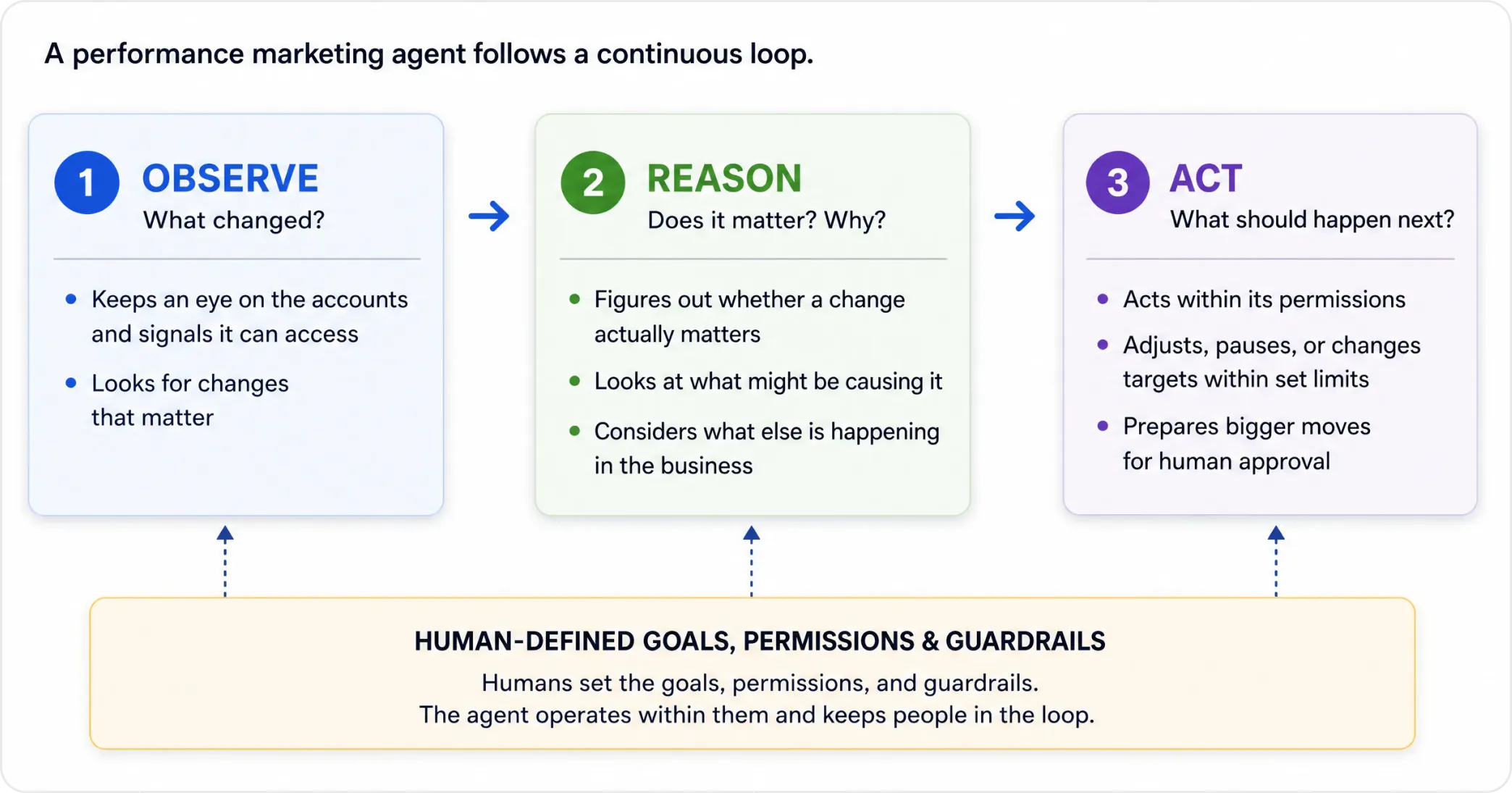
“AI agent” now covers everything from chatbots to automated bidding. But answering a question, recommending a change, and managing toward an outcome are different jobs. A useful test is whether the product can observe what is happening, reason about what it sees, and act on that reasoning.
The three tests: Observe, Reason, Act
1. Observe what changed
A performance marketing agent does not wait for someone to open a dashboard. It monitors the accounts and signals it can access and looks for changes that deserve attention. That might be a conversion-rate drop, creative fatigue, a shift in search demand, a broken landing page, or a campaign that has started spending differently.
2. Reason about whether it matters
A change in a metric is only the start. The agent should determine whether the move is meaningful, investigate likely causes, and factor in the business context it has access to. A rising CPA may call for a budget change, a landing-page fix, more time for a test to mature, or no action at all.
3. Act within its permissions
An agent should be able to carry the decision past the recommendation stage. Depending on the product and the permissions you set, that can mean adjusting a budget, pausing or re-enabling a campaign, changing a target, or preparing a larger move for review.
The team still controls the operating boundaries. MAI supports reviewable proposals, execution controls, changelogs, pause/resume behavior, and workflows that can be configured for review or scheduled execution. Significant decisions can carry stronger review requirements than routine account work.
How a performance marketing agent differs from other tools
Capabilities vary by product, and the categories overlap. The most useful comparison is where each tool’s job typically stops.
| Dimension | Analytics | Rules-based automation | AI assistant / copilot | Ad-platform AI | Performance marketing agent |
|---|---|---|---|---|---|
| Primary job | Explain what happened | Execute predefined rules | Help analyze and decide | Optimize inside one platform | Manage toward outcomes across paid media |
| Runs continuously | Yes | Yes | Usually when prompted | Yes | Yes |
| Reasons from context | Limited | No | Yes, with supplied context | Within its platform | Yes |
| Decides next action | No | Predefined | Recommends | Yes | Yes |
| Can execute | No | Yes | Usually no | Yes | Yes |
| Uses business context | Can surface it | Limited | If provided | Limited to available signals | Yes |
| Works across ad platforms | Can report across them | Sometimes | Can analyze them | No | Yes, when connected |
| Human controls | N/A | Predefined rules | User-driven | Platform controls | Goals, guardrails, permissions, review |
Analytics is built to explain performance. Rules-based automation is useful when the response is known in advance. Copilots help a person analyze and decide. Ad-platform AI is extremely good at optimizing inside its own environment. A performance marketing agent is designed to connect ongoing monitoring, broader business context, decision-making, and execution across paid media.
What does a performance marketing agent actually do?
When performance changes unexpectedly
Suppose conversion rate drops sharply. A useful agent should do more than surface the alert. It can investigate where the drop is concentrated, whether traffic quality changed, whether a landing-page or tracking issue appeared, and whether the movement looks like a real shift or normal variation. The output should be a reasoned next step, not another chart for the marketer to interpret.
When new creative enters the account
New creative needs enough room to generate evidence. An agent can support that testing process, continue collecting data, scale an asset when the evidence is strong enough, and pull back as performance weakens. For MAI, cross-channel creative performance can also be used as a testing signal rather than leaving learnings trapped inside one platform.
When the business changes
A promotion, inventory constraint, product launch, or margin change can alter what deserves budget. That information often sits outside the ad platform. A performance marketing agent becomes more useful when those business changes can affect the next media decision instead of showing up later in a report.
What humans still control
Giving software more responsibility does not remove human ownership of the business. The team should keep strategy, priorities, constraints, and consequential tradeoffs while the agent handles more of the continuous operational work inside those boundaries.
| The team owns | The agent can handle |
|---|---|
| Business goals and priorities | Continuous monitoring |
| Brand and creative direction | Investigating performance changes |
| Commercial priorities and tradeoffs | Continuous optimization |
| Risk tolerance and guardrails | Testing discipline and follow-through |
| Consequential decisions | Execution within approved limits |
The exact split should depend on consequence and available context. A routine bid or budget adjustment inside an approved range can carry different controls from a large cross-channel reallocation or a change to the account’s optimization objective.
How to evaluate an AI performance marketing agent
Once every vendor uses the word “agent,” feature lists become less useful. Ask to see how the system behaves on an actual decision.
| Ask the vendor | Evidence to request |
|---|---|
| Can you show me a decision it made and why? | A concrete decision trace showing what the system observed, concluded, proposed or did, and why. |
| What happens between an insight and an action? | A visible path from investigation through recommendation, approval or execution, and follow-up. |
| How does it know when not to act? | A documented threshold, guardrail, evidence standard, or escalation behavior. |
| Can business context change the decision? | An example where margin, inventory, a promotion, or another first-party signal changed the recommendation. |
| Which actions require human approval? | A clear permission model plus action history showing proposed, approved or rejected, and executed changes. |
The best answers are concrete. You should be able to see the signal the system noticed, the context it used, the reasoning behind the recommendation, the action that followed, and what happened next. For higher-consequence decisions, you should also understand where review, escalation, and execution controls apply.
Where MAI fits
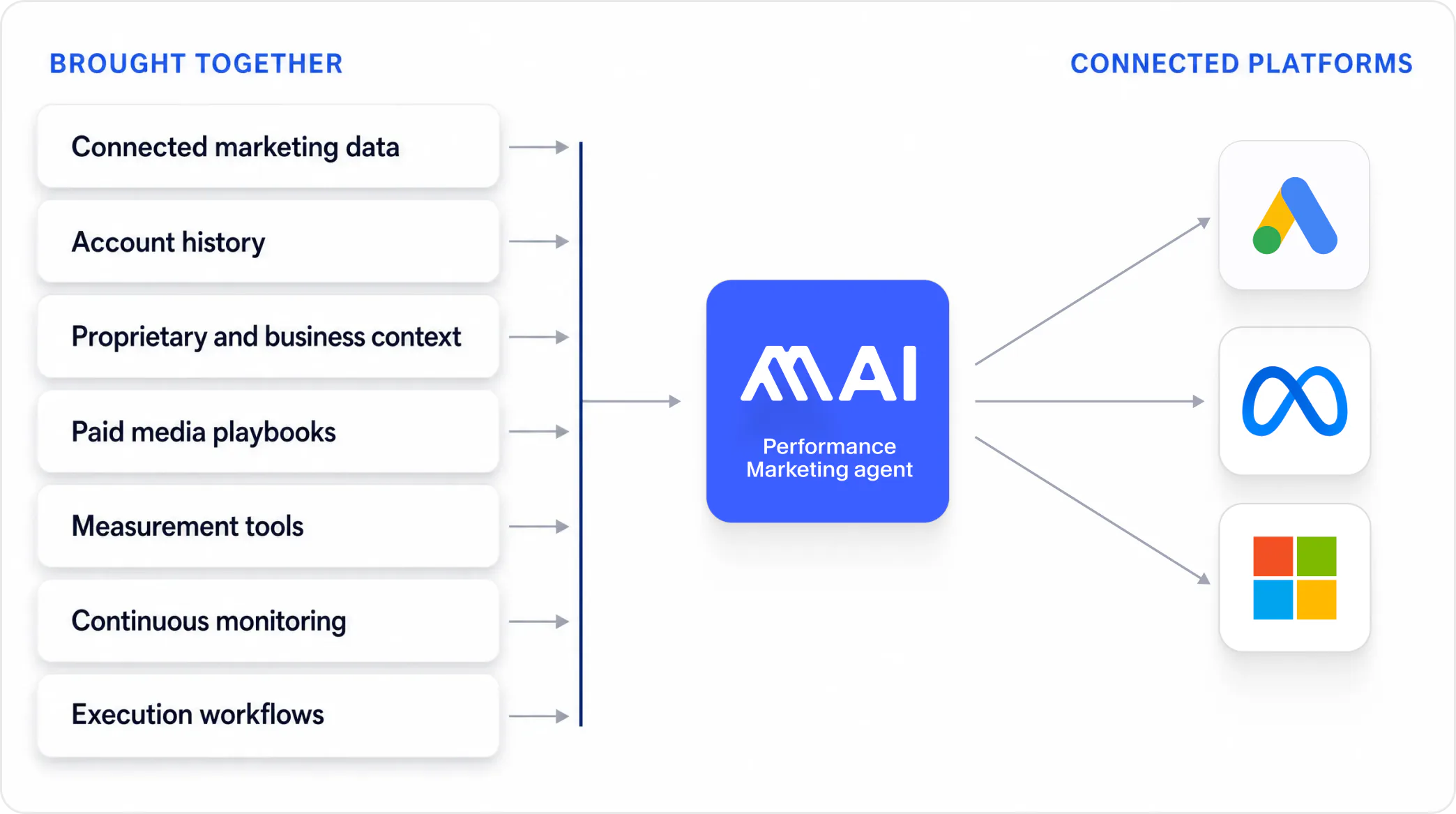
MAI is a performance marketing agent for media buying and optimization across ad platforms. It combines connected marketing data, account history, first-party and business context, performance-marketing playbooks, measurement, continuous monitoring, and execution workflows.
MAI works across Google Ads, Meta Ads, and Microsoft Ads. It can monitor performance, investigate changes, surface recommendations or proposals, and carry approved actions into execution depending on the workflow and configuration. The team remains responsible for the objectives, constraints, and judgment that determine how the account should run.
The practical definition
A performance marketing agent is a system that stays involved after the insight. It watches the account, interprets what changed using the context available to it, decides what should happen next, acts within the permissions it has been given, and then checks the result.
If your team can already see performance but still spends substantial time diagnosing changes, deciding what to do, and implementing the response, that is the part of the job an agent is designed to take on.
Frequently asked questions
What is the difference between an AI agent and marketing automation?
Rules-based automation executes logic defined in advance: when a condition occurs, it applies the predefined response. An agent evaluates the situation and available context before deciding which response is appropriate.
Does an AI performance marketing agent replace media buyers?
No. It changes which parts of media buying require a person’s time. Marketers still own business goals, creative direction, constraints, tradeoffs, and consequential decisions. The agent can take on more of the monitoring, investigation, routine optimization, and follow-through.
Is Google Performance Max an AI performance marketing agent?
Performance Max has agent-like characteristics because it uses AI to make decisions and optimize delivery across Google’s inventory. It still operates inside Google’s ecosystem and with the signals available there. A cross-platform performance marketing agent is designed to work from the advertiser’s side across connected systems and broader business context.
Do I need an AI agent if I already use analytics and automation?
It depends on where the work is getting stuck. If analytics already tells you what happened and automation handles the responses you can define in advance, an agent may add little. It becomes more relevant when the team still spends meaningful time investigating changes, deciding what to do, and carrying those decisions through.
Can an AI performance marketing agent manage multiple advertising platforms?
It can if the required integrations and permissions are available. Cross-platform operation should be evaluated product by product. MAI works across Google Ads, Meta Ads, and Microsoft Ads.
See what an AI performance marketing agent could do in your accounts
MAI can show how monitoring, business context, recommendations, and execution controls come together in a live media-buying workflow.
Similar articles
How Much Autonomy Should You Give an AI Media Buyer?
- AI Media Buying
- AI Agents
- Marketing Automation
- Media Buying
- Performance Marketing
The right level of AI autonomy depends on a decision’s consequence and the business context available to the agent.
Why AI Agents Are Replacing Rules-Based Media Buying
- AI Agents
- Media Buying
- Automation
- Performance Marketing
Use rules when the action is already known. Use an agent when the situation requires interpretation across signals and business context.
How AI Agents Simplify Google Ads Management for Performance Marketers
- Google Ads
- AI Agents
- Campaign Optimization
See how AI agents coordinate Google Ads campaigns around the business signals that platforms cannot see on their own.