
Why AI Agents Are Replacing Rules-Based Media Buying
The limits of static automation and what agentic media buying does differently.
Every mature ad account has a graveyard of rules
Pause ads if CPA exceeds $40. Increase budgets every Monday. Launch new creative after seven days.
None of these rules are inherently wrong. Most solved a real problem when they were created, and for years they were the best way to manage more campaigns than any team could watch manually.
The problem is that performance marketing does not stand still. Customers change. Competitors react. Margins shift. Creative fatigues. Rules do not. They keep repeating yesterday’s decision after the conditions that justified it have changed.
Rules are useful when the correct action is already known. Media buying gets harder when the job is to decide what the situation means first.
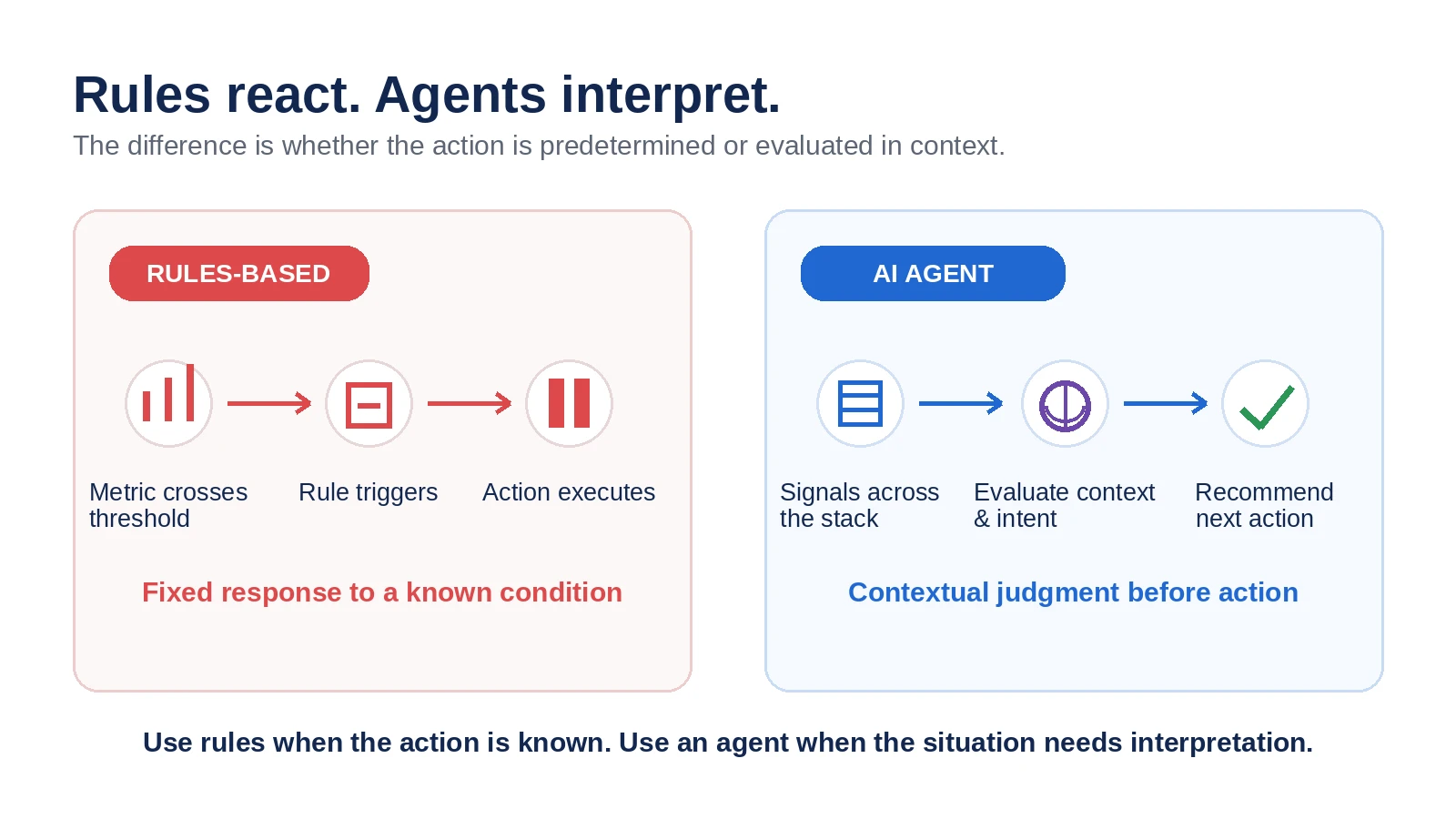
The difference shows up when the account stops behaving as expected.
A CPA increase might mean performance is deteriorating. It might also mean demand shifted, margins improved, or a campaign needs more time to learn. A rule has already decided what to do. An agent first has to work out which situation it is looking at.
Here are three signs your account has outgrown a rules-only approach.
Where rules-based media buying breaks down
Static automation usually fails in three predictable ways.
Rules see metrics, not context
Rules assume the same metric always deserves the same response. Real businesses do not work that way.
A rising CPA might justify cutting spend. It might also be worth tolerating because margins improved, inventory needs to move, a promotion changed demand, or a market is behaving differently. The metric is only part of the decision.
When the surrounding conditions change, a fixed response can become the wrong response even while the rule is working exactly as designed.
Rules preserve yesterday’s judgment
Every rule captures a decision someone made in the past. It reflects what made sense at that moment, under those conditions.
When conditions change, teams usually add another rule. Over time the account collects exceptions across campaigns, products, and markets. The automation becomes another system to maintain, and the team spends more time managing rules than improving the decisions behind them.
Rules protect performance but do not discover growth
Rules are good at protecting what already works. They pause underperforming ads, cap budgets, and defend existing winners.
What they cannot do is decide when an unproven campaign deserves more time or budget. The result can be an account that becomes efficiently smaller: anything outside the established rules gets cut before it has enough time to learn.
Growth requires two jobs at once: scale what is working and give new ideas enough room to prove themselves. Balancing those jobs takes judgment, not another threshold.
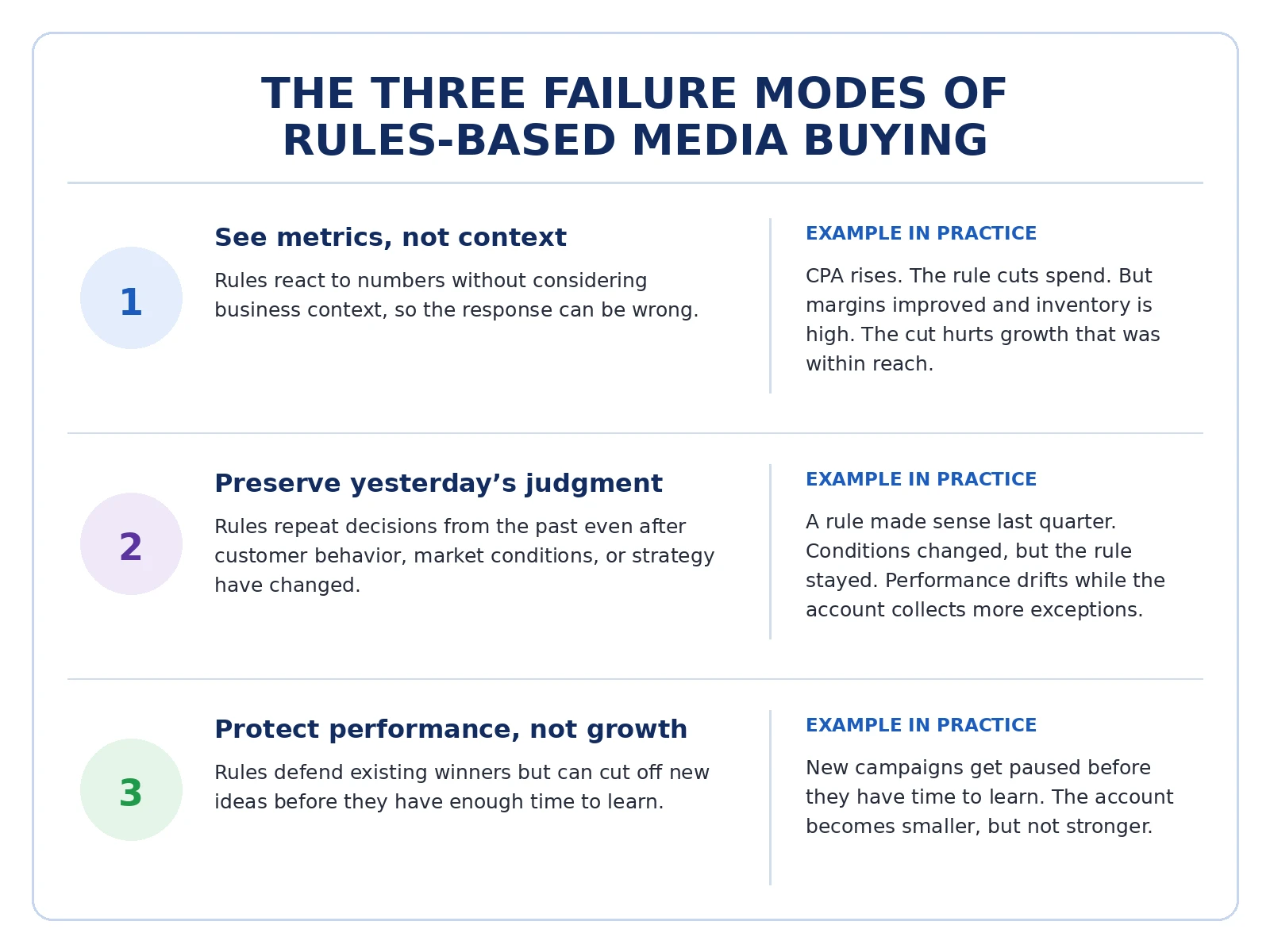
Figure 2 is the diagnostic. If an account shows one or more of these patterns, the issue may not be poor rule construction. The task itself may require judgment.
Use rules for certainty and agents for judgment
Replacing rules does not mean deleting every rule in the account.
Deterministic tasks still belong in rules: hard budget caps, naming conventions, notifications, and other cases where the intended action is known in advance. The rules worth reconsidering are the ones trying to make judgment calls about campaign performance.
Use a rule when the action is already known.
- Enforce a hard cap.
- Apply a naming convention.
- Send a threshold notification.
Use an agent when the situation needs interpretation.
- Decide whether a CPA increase is deterioration or a worthwhile growth opportunity.
- Decide whether an unproven campaign needs more time.
- Choose an action using signals across the marketing stack and business context.
That gives teams a practical migration path. Keep deterministic automation. Move contextual decisions into a workflow that can evaluate the conditions first.
How agentic media buying changes the operating model
Rules repeat the same decision every time. Agentic media buying evaluates the situation before deciding what to do next.
Instead of reacting to a fixed threshold, an agent can validate whether a signal is meaningful, consider business context such as margins, inventory, promotions, and traffic patterns, and recommend an action based on current conditions rather than an old assumption.
MAI follows that approach. Recommendations include the reasoning behind them, significant changes are reviewed before execution, and decisions can use signals across the marketing stack rather than relying on a single advertising platform.
The operating loop is straightforward:
- Observe the performance signal and surrounding business conditions.
- Evaluate whether the change is meaningful and what may explain it.
- Recommend the next action with the reasoning exposed.
- Review significant changes before execution.
- Observe the result and use the new evidence in the next decision.
Rules cannot do that on their own. The right action can change when the interpretation changes.
The advantage is faster judgment
Rules helped marketers scale campaign management. Agentic media buying helps teams adapt when the conditions change.
The advantage is recognizing when an old assumption no longer holds, interpreting the evidence, and getting to a sound decision faster.
If your account is accumulating exceptions, preserving old decisions, or cutting off experiments before they can learn, the constraint may no longer be automation coverage. It may be the amount of judgment the automation cannot supply.
Common Questions
What is rules-based media buying?
Rules-based media buying automates a fixed action when a predefined condition is met, such as pausing ads above a CPA target or increasing budgets after a ROAS threshold is reached. It works well for repetitive, deterministic tasks but cannot adapt the response when business conditions change.
Should I delete my automated rules?
No. Keep rules for deterministic tasks such as budget caps, naming conventions, and notifications. Reconsider the rules that try to make judgment calls about campaign performance.
See which decisions have outgrown rules
MAI can help your team identify where static rules still make sense, where they are constraining the account, and which decisions are better suited to an agentic workflow.
Similar articles
What Is an AI Performance Marketing Agent?
- AI Agents
- AI Media Buying
- Performance Marketing
- Paid Media
- Marketing Automation
An AI performance marketing agent continuously monitors paid media, works out what changed and why, and can carry decisions through to action within defined permissions.
Ad Platforms Solve for Volume. Who Solves for Your Margin?
- Performance Marketing
- Paid Media
- AI Media Buying
- Media Buying
- Profitability
Google and Meta optimize advertising performance at scale. Profitable growth requires bringing business economics into each media decision.