
Ad Platforms Solve for Volume. Who Solves for Your Margin?
Ad platforms optimize the signals they can see. Profitable growth depends on connecting those signals to the economics only your business knows.
Google, Meta, and Microsoft are very good at predicting clicks, conversions, and the next likely action inside their own systems. But the ad account is still an incomplete picture of profitability.
A campaign can hit its ROAS target while pushing spend toward lower-margin products, repeat buyers who may have converted anyway, or inventory the business does not need to move. The platform may be doing its job well while the business gets a weaker result.
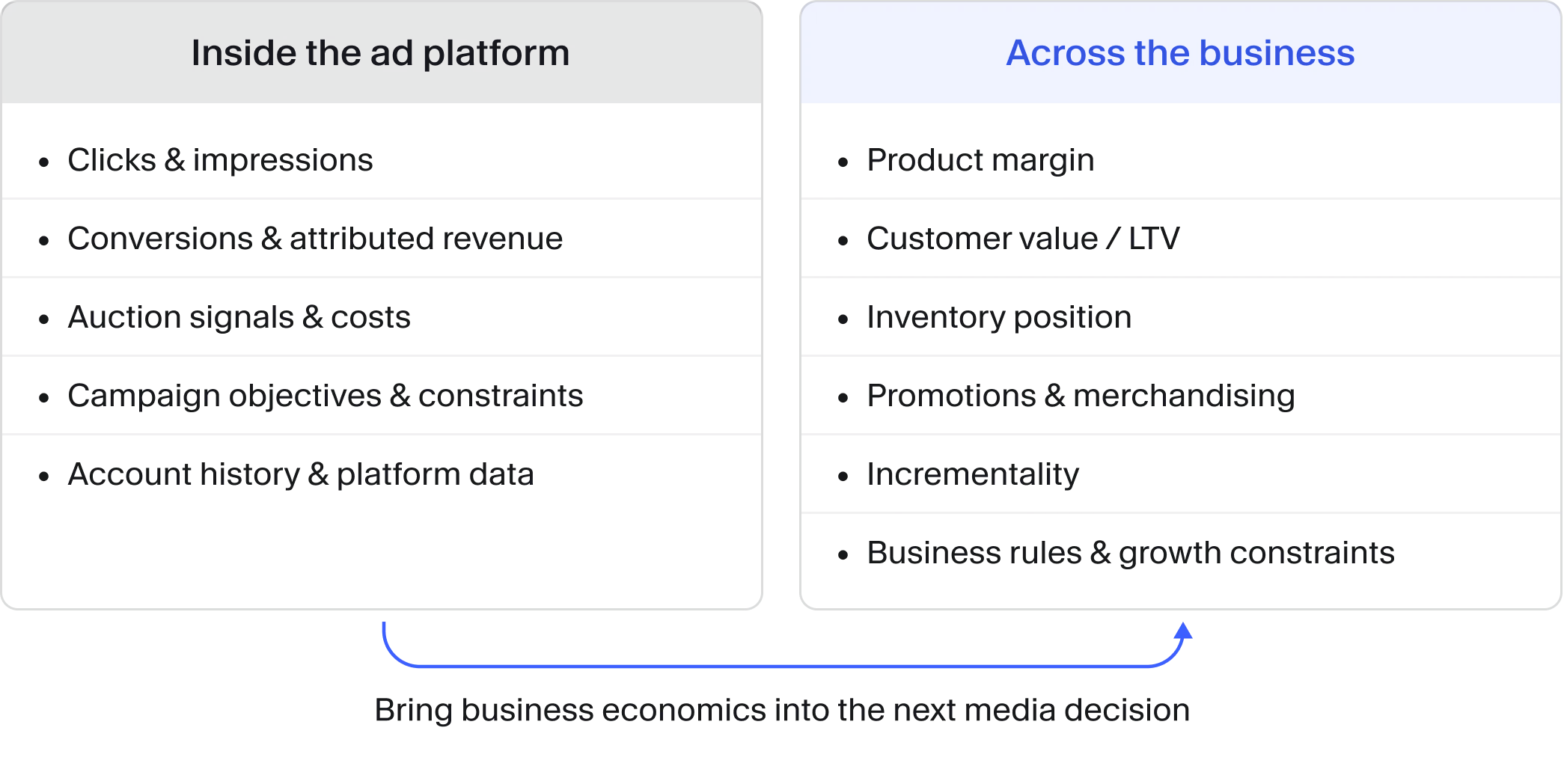
What the platform sees vs. what the business
Two information sets shape the same media decision.
The platform has a different job
Ad platforms decide which ads to show, which people to reach, and what price to pay inside their own systems. Their optimization is bounded by the objectives, data, and feedback available there.
The business has a broader job. Paid media has to produce profitable growth across products, customers, and channels. That means someone has to connect account performance to information that may sit in finance, merchandising, operations, or the customer data stack.
A conversion is not always worth the same amount
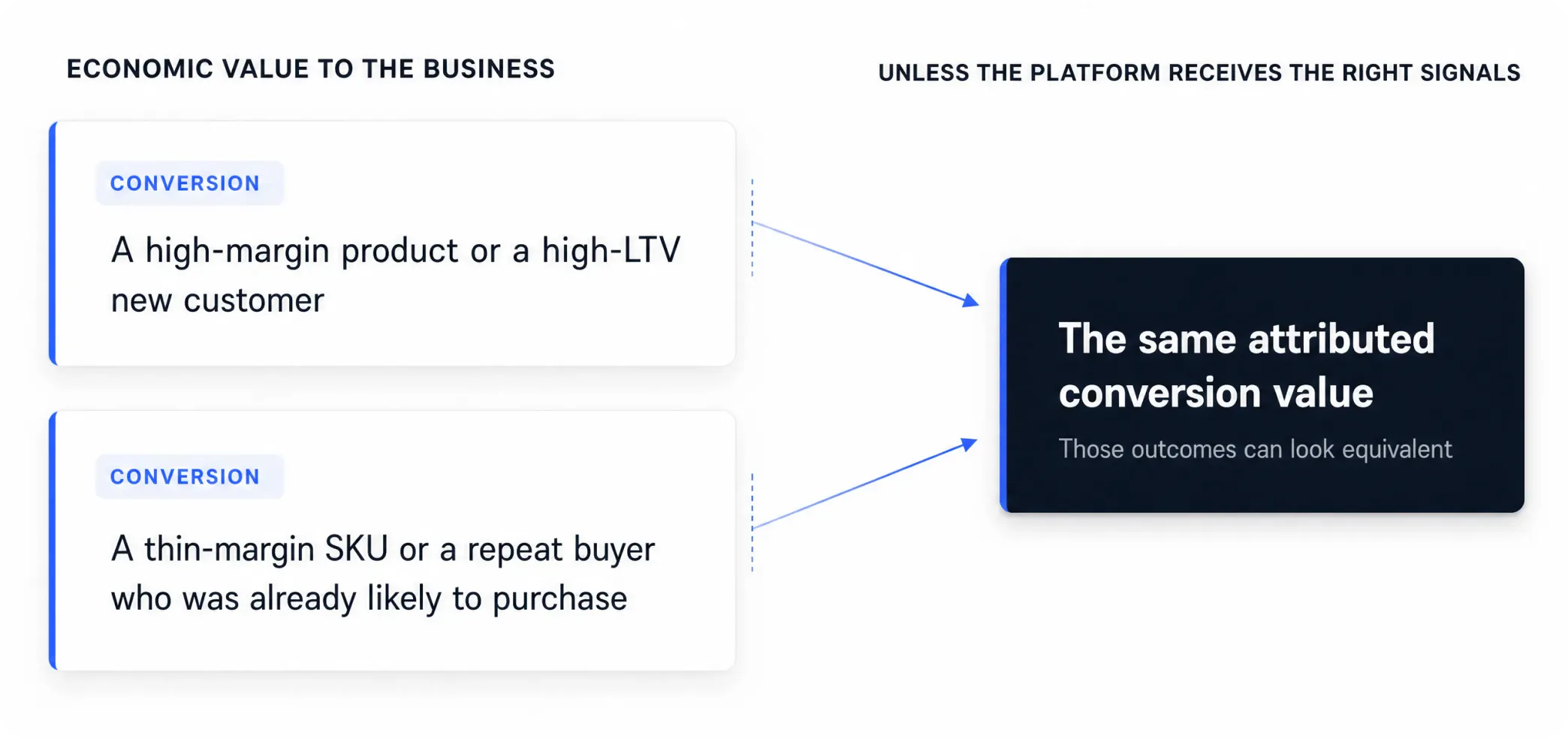
An attributed conversion value is useful, but it is not necessarily the economic value of that conversion to the business. One order may come from a high-margin product or a high-LTV new customer. Another may come from a thin-margin SKU or a repeat buyer who was already likely to purchase.
Unless the platform receives the right signals, those outcomes can look equivalent. And because optimization compounds, a partial definition of value can keep steering spend toward the same economic mix.
This is why measurement matters before the budget moves, not only after the reporting period. Incrementality asks whether the spend caused additional business outcomes, while attribution records where credit was assigned. Those are different jobs, and both can affect a margin-aware decision.
When good ROAS hides bad economics
You can hit your target ROAS and still make less profit.
Suppose two campaigns report the same ROAS. Campaign A is driving higher-margin products, more valuable new customers, inventory the business actively wants to move, and a stronger incremental contribution. Campaign B is producing the same reported efficiency while leaning toward thinner-margin products, repeat demand, and outcomes with less incremental value.
The account-level metric can look identical even though the next budget decision should not.
Same reported ROAS. Different business

Bring the economics into the decision
Margin-aware media buying means adding the business signals that change what a conversion is worth while there is still time to act on them. The most common inputs are product margin, customer value, inventory position, promotions, incrementality, and operating constraints.
Those inputs usually live with different teams. Marketing sees what is happening in the accounts. Finance understands contribution margin. Merchandising and operations know what needs to move. The decision improves when that context meets before the next dollar is spent rather than in a spreadsheet after the fact.
A practical margin-aware budget decision
The sequence is straightforward:
- Start with the advertising signal. What is performing inside each account?
- Add the economic signal. What margin and customer value sit behind those outcomes?
- Add the operating signal. What do inventory, promotions, and current constraints require?
- Challenge attribution with incrementality where it matters. How much of the reported result was caused by the spend?
- Make the allocation decision. Where should spend increase, decrease, or move?
For the allocation itself, average ROAS is only part of the picture. The more useful question is what the next dollar is likely to return against the business outcome you actually care about. That is the logic behind marginal-return based budget allocation.
Where MAI fits
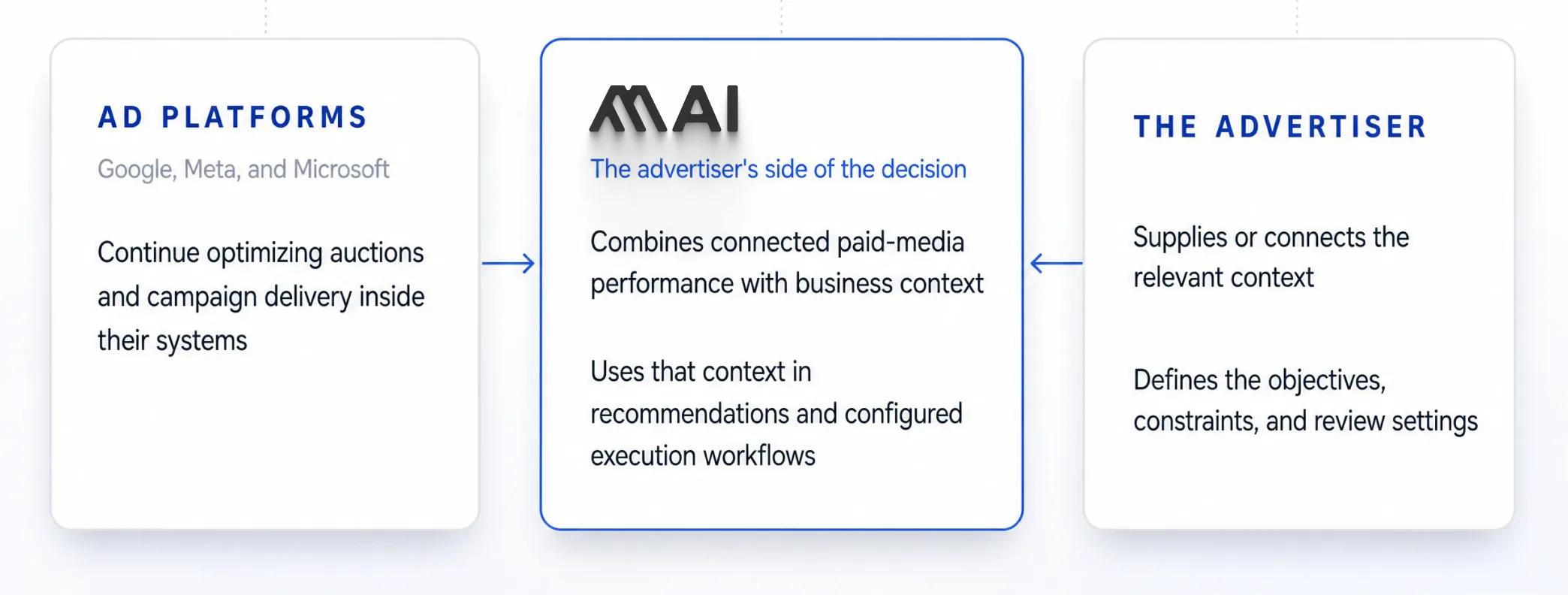
MAI works from the advertiser's side of the decision. It can combine connected paid-media performance with business context such as margins, customer value, inventory, promotions, goals, and efficiency targets, then use that context in ongoing analysis and optimization.
That does not mean the ad platforms stop doing what they are good at. Google, Meta, and Microsoft can continue optimizing auctions and campaign delivery inside their systems. MAI adds the broader advertiser context and cross-channel view that individual platforms may not have.
The boundary matters. MAI does not magically know a company's margins, LTV, inventory position, or operating rules. The advertiser has to supply or connect the relevant context and define the objectives, constraints, and review settings. MAI can then use that context in recommendations and configured execution workflows.
For important budget moves, measurement can also challenge a superficially strong platform signal. Incrementality testing is useful when the question is whether more spend is creating new demand or simply receiving credit for demand that would have happened anyway.
Who owns the margin?
At the next budget review, identify who is connecting account performance to bottom-line economics before allocations change.
If that ownership is unclear, or if the connection happens only after spend has already moved, the process has a gap. A material budget decision should be informed by both media performance and the business economics behind it.
If your team is already reviewing margin, customer value, inventory, and incrementality after the fact, the next step is to bring those signals into the decision cycle itself.
See how MAI can bring business economics into ongoing performance-marketing decisions
Similar articles
Where Should the Next Dollar Go?
- Budget Allocation
- Marketing Mix Modeling
- Marginal ROAS
Measure what your spend drives, compare the return on the next dollar, and validate the decision with incrementality experiments.
Incrementality Testing in Practice: From Investment Case to Proof
- Incrementality Testing
- Geo-Lift Testing
- Brand Search
- Media Budget Allocation
- Performance Marketing
See how a conservative Brand Search investment case was validated with A/A and geo-lift incrementality testing before additional budget was funded.
What Is an AI Performance Marketing Agent?
- AI Agents
- AI Media Buying
- Performance Marketing
- Paid Media
- Marketing Automation
An AI performance marketing agent continuously monitors paid media, works out what changed and why, and can carry decisions through to action within defined permissions.