
What Happens When an AI Agent Starts Tuning Your Campaigns?
Campaign tuning shows whether an AI media buyer can take recurring work off the team's plate.
Most paid-media accounts do not run out of things to optimize.
A Search campaign picks up new queries. One landing page starts converting better than the others. A product has room to absorb more spend while another is running low on inventory. A creative that carried the account for two weeks begins to fade. The budget and bidding targets that made sense on Monday may look different by Friday.
This is normal account work, and it never really stops. Someone has to keep checking, decide whether a change is meaningful, make the adjustment, and come back later to see what happened.
MAI's Tuning skill is designed to handle more of that recurring optimization inside a defined Media Plan. Depending on the platform and configuration, that can include bids, budgets, keywords, search terms, SKUs, landing pages, creative, and campaign status.
A team will care more about how the agent decides when to act, when to wait, and when to ask for review.
Tuning begins after the campaign launches
Campaign launches attract attention. Most of the work comes afterward.
Consider a Google Search account. New queries appear every day. Some look promising but have barely spent. Others have generated enough clicks to show that they are unlikely to convert. A landing page starts outperforming its peers. The campaign itself may be pacing too slowly or moving away from its CPA target.
A media buyer works through these signals by asking practical questions. Is the movement large enough to matter? Is there enough data to trust it? Does it fit the campaign's objective? How easy would the decision be to reverse?
An agent running a tuning workflow needs to do the same work. Finding an unusual number is only the beginning.
For Google Search, MAI can evaluate search terms, keywords, landing pages, bids, budgets, and conversion performance against the Media Plan. Supported actions can include adding promising terms as keywords, constraining weaker terms, testing eligible landing pages, adjusting budgets or bidding targets, and changing campaign status. Other platforms expose different levers: SKU treatment in Shopping, for example, or creative testing and rotation in Demand Gen and Meta.
One signal can lead to three different decisions
Suppose a Search campaign is working toward an $80 target CPA.
One search term has started converting at $54. A second has spent enough to settle at $132. A third sits at $76, but that result comes from a handful of clicks and one conversion.
The current CPA alone does not tell you what to do.
| Account evidence | Likely treatment | Reasoning |
|---|---|---|
| $54 CPA with enough history to establish a pattern | Give it more exposure or promote it into a keyword | Performance is strong and the evidence is reasonably mature |
| $132 CPA after meaningful spend | Constrain it or add a negative | The weak result has persisted long enough to justify action |
| $76 CPA from one conversion | Keep testing inside a controlled limit | The result is promising, but the evidence is too thin for a confident decision |
MAI's tuning logic separates opportunities that are strong enough to scale, weak enough to constrain, and still uncertain enough to keep testing. That last category matters. A system that reacts to every early winner and loser will churn the account rather than improve it.
New keywords, products, landing pages, audiences, and creative also need enough delivery to produce evidence. Protecting today's winners at the expense of every unproven idea eventually leaves the account with nowhere new to grow.
The same principle sits behind rules-based automation versus agentic media buying. Static thresholds can execute a predefined instruction. Tuning requires judgment about whether the current situation still fits the instruction.
Account context can change the answer
A Shopping SKU with strong ROAS may look ready for more spend. The answer changes if the item has a weak margin, limited inventory, an upcoming promotion, or a lower business priority than another product. When those inputs are available, MAI can use them alongside account performance.
A Meta ad with one strong day presents a similar problem. The agent needs to consider how much delivery it has received, how it compares with the rest of the set, and whether the improvement is holding. Context helps the agent make a better-prepared decision and recognize when something important is missing.
What happens after MAI identifies an opportunity
A useful tuning workflow carries a decision beyond the recommendation.
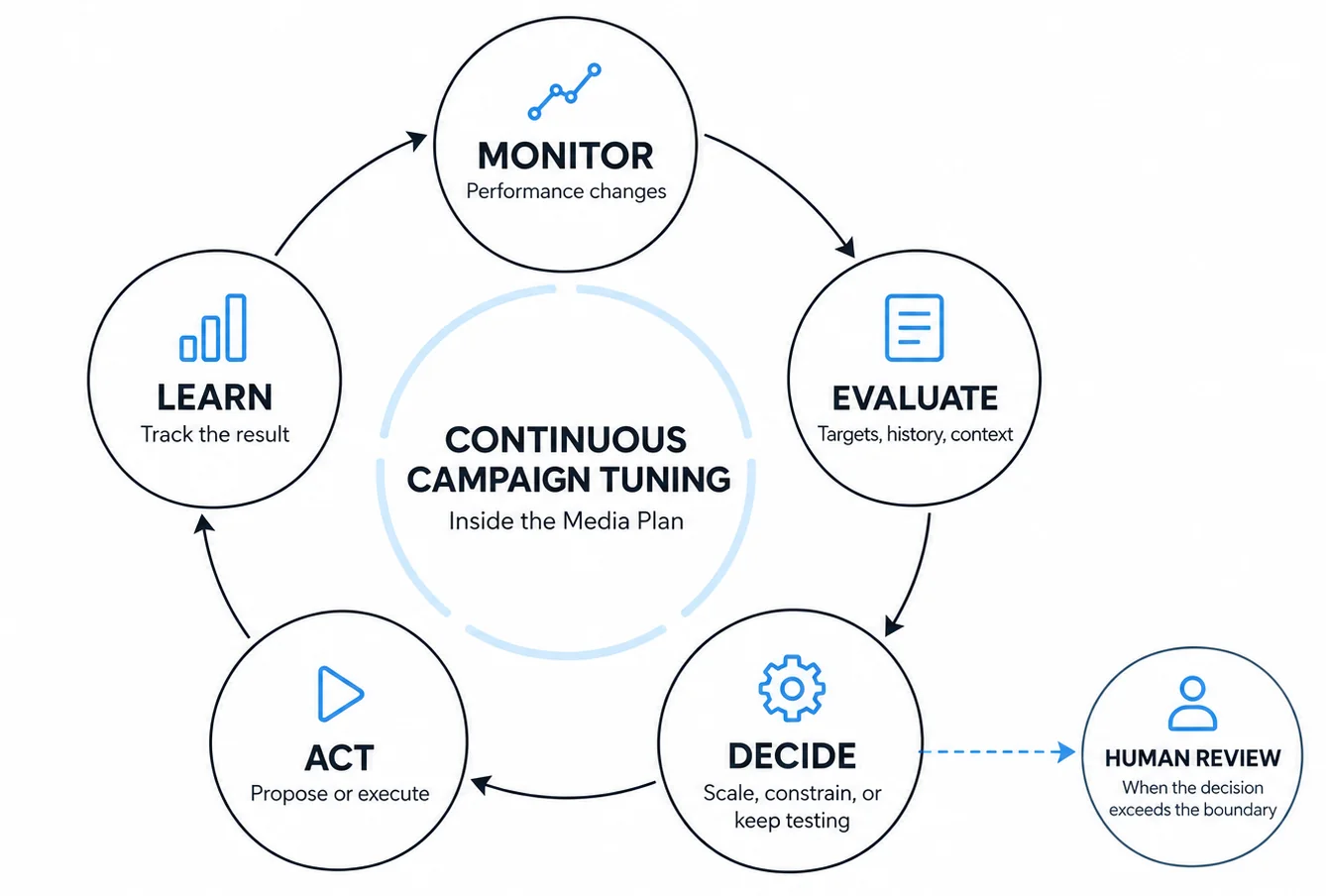
Within a supported configuration, the loop works like this:
- MAI monitors performance within the Media Plan.
- It evaluates the change against the target, account history, available business context, and strength of evidence.
- It classifies the opportunity as something to scale, constrain, or keep testing.
- It proposes or executes a supported account change according to the workflow settings.
- It records the activity and continues monitoring the result.
If every recommendation waits for a marketer to rediscover the context, make the change, and track the result manually, much of the operating burden remains. A useful AI media buyer should show what it noticed, what evidence it considered, what it changed or proposed, and what happened afterward.
The Media Plan sets the operating boundary
The Media Plan defines the scope of a tuning workflow: the account and campaign type, budget or cap, bidding strategy, goals, eligible inputs, and other constraints. Supported actions can be configured to run automatically, require review, or remain paused, depending on the workflow and account setup.
A team might allow a routine adjustment inside an established budget and target while keeping a larger change reviewable. The right setting depends on the consequence of the decision and whether the agent has enough context to make it well. We cover that framework in more detail in How Much Autonomy Should an AI Media Buyer Have?
MAI keeps tuning and change history for supported workflows, making it easier to inspect the reasoning, review the result, or pause the workflow. The team still owns the growth target, budget, product priorities, operating constraints, and decisions that require broader judgment.
What continuous tuning changes for the team
A search term can be evaluated while it is still relevant. A product with room to scale does not have to sit untouched until Friday. A weakening creative can be reviewed before it absorbs another week of spend. An uncertain opportunity can keep gathering evidence without being promoted too early or shut down before it has had a fair test.
Sometimes the right tuning decision is to leave something alone because the evidence is weak or the current setup is working.
Fewer recurring decisions have to begin from a blank screen. MAI keeps the account context, targets, and prior activity attached to the work, then carries supported decisions forward inside the boundaries the team has set.
The clearest way to evaluate that promise is to start with a real slice of account work. Choose one Media Plan, define what MAI may change and what still needs review, and examine the tuning history after the workflow has had time to operate. You should be able to see the evidence behind each decision, the action taken, and what happened next.
See what MAI can take off your campaign-management queue
Connect an account, define the first Media Plan, and review how MAI handles recurring tuning decisions inside your controls.
Similar articles
How an AI Agent Decides Which Search Terms to Scale, Test, or Block
- Google Ads
- AI Agents
- Campaign Optimization
- Paid Media
- Search Marketing
See how an AI agent evaluates intent, conversion evidence, landing-page fit, and account history before scaling, testing, or blocking search terms.
How a Google Demand Gen Agent Gives New Creative a Fair Test
- Google Ads
- AI Agents
- AI Media Buying
- Creative Optimization
- Campaign Optimization
See how a Google Demand Gen agent moves eligible creative through controlled testing, scaling, and rotation inside a Media Plan.
How AI Agents Simplify Google Ads Management for Performance Marketers
- Google Ads
- AI Agents
- Campaign Optimization
See how AI agents coordinate Google Ads campaigns around the business signals that platforms cannot see on their own.
How an AI Agent Manages Google Shopping at the SKU Level
- Google Ads
- AI Agents
- AI Media Buying
- Campaign Optimization
- Performance Marketing
See how an AI agent evaluates Google Shopping SKUs using performance evidence, margin, inventory, and product priorities to scale, test, or constrain spend.