
How a Google Demand Gen Agent Gives New Creative a Fair Test
Producing more ads is easier than ever. The operating challenge is getting each eligible asset into a useful test and making a decision before the opportunity passes.
A performance team may have ten new videos ready for Demand Gen, another batch that performed well on Meta, and several older winners still carrying most of the spend. The files exist. The account work has only started.
Someone has to make the assets eligible, connect them to the right landing pages, give new creative enough exposure to learn from, and notice when a winner starts to weaken. A new ad can otherwise sit unused, collect too little evidence to judge, or lose to an incumbent before it receives a meaningful test.
MAI's Google Demand Gen Agent is built around that operating problem. It works from a Demand Gen Media Plan, evaluates eligible creative over time, and can propose new ads, increase investment behind stronger assets, reduce weaker ads or campaigns, and rotate in fresh candidates. The team still creates the work and sets the boundaries.
The creative bottleneck moved into the account
AI has made creative production faster, but more files do not automatically create more learning. Every new asset creates a series of media-buying decisions: where it belongs, how much exposure it should receive, how long the team should wait, and what evidence is strong enough to change spend.
This broader shift is covered in When Everyone Has the Same Algorithms, Creative Matters More. Demand Gen adds a specific operating question: how does a steady stream of new creative move through the Google account without requiring someone to rebuild the workflow each time?
The Media Plan defines the eligible creative pool
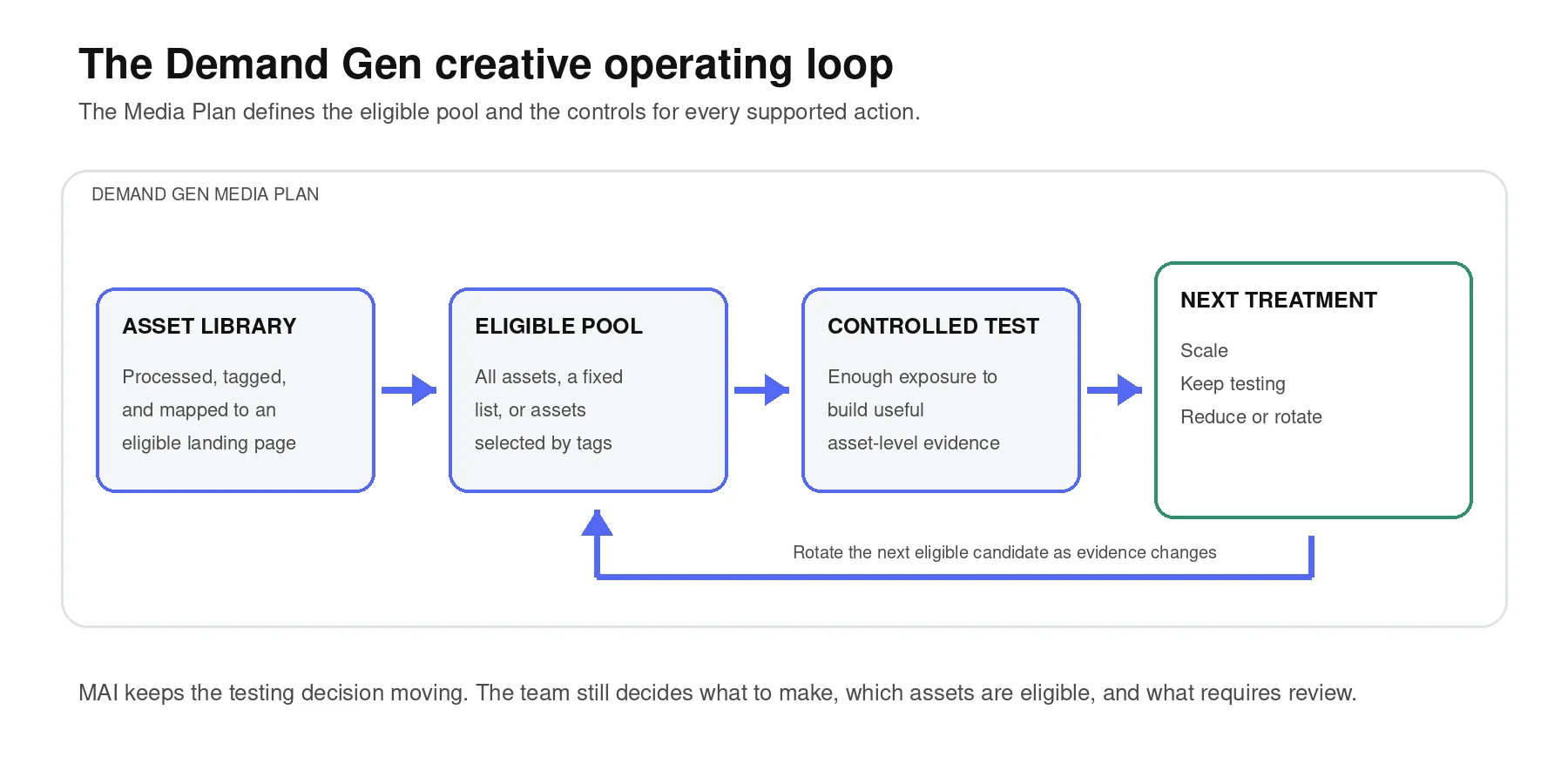
Creative enters the workflow through MAI's Asset Library. Teams can upload files, add supported YouTube links, or synchronize assets from Google Drive. After an asset is processed, tagged, mapped to an eligible landing page, and available to Google, it can become a candidate for Demand Gen.
The Demand Gen Media Plan determines what the agent may use. It can allow all eligible assets, select a fixed list, or use tags that dynamically include newly synchronized creative. The plan also carries the budget, target, audience, landing pages, timing, and review settings for the campaign.
This turns “the file is ready” into a repeatable path: Asset Library, eligibility, controlled test, and a supported next action. It also keeps the workflow tied to the approved Media Plan, rather than letting each new asset create a separate operating decision.
A fair test needs a useful middle state
A new asset can look weak after limited spend. Another can collect a few early conversions and look unusually strong. Neither result necessarily supports a confident decision. The relevant issue is whether the asset has received enough opportunity for the comparison to mean something.
MAI evaluates asset-level evidence against the Media Plan target, the amount and consistency of performance data, and the other eligible creative in the pool. It can distinguish assets that are ready to scale, clearly weak or declining, and still uncertain.
The uncertain state matters. It protects a bounded amount of learning rather than forcing an early choice between “winner” and “loser.” A promising asset can keep testing while evidence develops. A weak asset can be reduced after meaningful exposure. A sustained winner can receive more investment while MAI continues monitoring it.
Teams do not need to force identical spend across every asset. They need a defined learning allowance and a consistent standard for what happens afterward. The comparison also has to respect the setup around the ad. A video paired with the wrong landing page or placed against a different audience is not a clean read on the creative alone. The Media Plan keeps those inputs visible when MAI evaluates the result.
How the agent changes an asset’s treatment
| State | What the evidence says | Agent treatment | What changes it |
|---|---|---|---|
| Scale | Strong and sustained | Increase investment behind the supported winner | Performance weakens or the plan changes |
| Keep testing | Promising, mixed, or still too thin | Preserve bounded exposure | Evidence supports scaling or reduction |
| Reduce or rotate | Enough exposure; weak or declining | Pull back and test another eligible asset | Performance recovers or a new test is warranted |
Rotation should begin before a winner collapses
A strong creative rarely stops working in a single moment. Efficiency may soften while the asset still produces conversions. The audience has seen it more often, a competing asset starts to improve, or the offer becomes less relevant. Waiting for a severe decline leaves the team reacting after the damage is obvious.
Suppose one video has carried most of a Demand Gen campaign for several weeks and three new videos enter the eligible pool. The incumbent does not need to be shut off immediately. The new assets can receive controlled exposure while the winner still contributes. If one builds stronger evidence, investment can move gradually. If none does, the existing asset can continue while another round enters testing.
This changes rotation from occasional account cleanup into normal campaign operation. The next candidate begins gathering evidence before the account urgently needs a replacement.
What the Demand Gen Agent can do
MAI's Demand Gen Agent evaluates eligible creative, audiences, landing pages, bids, budgets, and campaign performance. For the creative workflow, it can prepare reviewable ad proposals using eligible Asset Library content, increase investment behind supported winners, reduce weaker ads or campaigns, rotate fresh creative, and tune supported bids and budgets. Approved tuning runs daily.
Creative performance from Meta or another connected channel can help identify candidates for Demand Gen. That signal is a starting point, not proof that the asset will perform the same way on Google. It still needs a Demand Gen test. This is one example of how an agent can coordinate specialized Google campaign work around broader evidence while Google continues handling platform delivery.
MAI does not automatically create an entirely new campaign merely because budget becomes available. The current workflow begins with the team configuring the Media Plan and reviewing the campaign proposal. New ad and campaign proposals can remain reviewable before launch.
The team owns the creative judgment and the boundaries
MAI does not decide what the brand should say or what the next concept should be. The team supplies or connects creative, maintains useful tags and landing-page mappings, defines which assets are eligible, and sets the budget, audience, target, and timing.
Supported actions can run automatically, require review, or remain paused. A team may allow routine tuning while keeping every new ad proposal reviewable. Another may begin with a smaller eligible pool until the workflow has earned more trust. The setup should reflect the consequence of the action and the account context available to the agent.
That division gives the marketer more time for the work that still requires judgment: deciding what to make next, which products need support, and whether the current goal still fits the business. The agent keeps the eligible creative moving through testing, investment, and rotation.
Start with one Demand Gen Media Plan
Choose a campaign where the team already produces creative regularly but new assets are tested inconsistently or older winners remain active too long. Define the eligible assets and landing pages, set the budget and performance target, and choose which supported actions require review.
Then watch whether each asset receives a clear treatment: scale, keep testing, reduce, or rotate. Producing more creative becomes useful when the account can learn from it fast enough to change the next decision.
Give your next Demand Gen assets a defined path to a decision
Connect a Google Ads account, configure one Demand Gen Media Plan, and see how MAI moves eligible creative through controlled testing and reviewable action.
Similar articles
How an AI Agent Decides Which Search Terms to Scale, Test, or Block
- Google Ads
- AI Agents
- Campaign Optimization
- Paid Media
- Search Marketing
See how an AI agent evaluates intent, conversion evidence, landing-page fit, and account history before scaling, testing, or blocking search terms.
What Happens When an AI Agent Starts Tuning Your Campaigns?
- AI Media Buying
- AI Agents
- Campaign Optimization
- Paid Media
- Marketing Automation
See how an AI media buyer evaluates campaign evidence, tunes bids, budgets, keywords, SKUs, and creative, and works inside marketer-defined controls.
How AI Agents Simplify Google Ads Management for Performance Marketers
- Google Ads
- AI Agents
- Campaign Optimization
See how AI agents coordinate Google Ads campaigns around the business signals that platforms cannot see on their own.
How an AI Agent Manages Google Shopping at the SKU Level
- Google Ads
- AI Agents
- AI Media Buying
- Campaign Optimization
- Performance Marketing
See how an AI agent evaluates Google Shopping SKUs using performance evidence, margin, inventory, and product priorities to scale, test, or constrain spend.