
How an AI Agent Decides Which Search Terms to Scale, Test, or Block
The difficult search-term decisions sit between the obvious winners and obvious waste.
Search terms create work long after a campaign launches. New queries appear, performance accumulates unevenly, and yesterday's inconclusive term can become today's best source of demand, or an expensive distraction.
Consider three terms in the same Search campaign. One has generated 18 conversions below the campaign's target CPA. Another has spent steadily without converting. A third has two conversions at an attractive CPA, but only eight clicks.
The first may deserve more room. The second may need to be blocked. The third needs more evidence.
Across hundreds or thousands of queries, making these calls consistently becomes a substantial operating job. MAI's Google Search Agent can evaluate search terms against the Media Plan and support actions such as adding keywords and negatives, testing eligible landing pages, and adjusting campaign settings. The useful part is deciding when the evidence is mature enough to justify each move.
Search term decisions need more than a CPA ranking
A sorted search-term report makes the account look cleaner than it is. The lowest CPA is not automatically the best term to scale, and a term with no conversions is not automatically waste.
The decision depends on several pieces of evidence:
- Intent: Does the query describe demand the business actually wants?
- Maturity: Has the term received enough clicks, spend, and conversions to establish a pattern?
- Relative performance: How does it compare with the Media Plan target and similar terms in the account?
- Landing-page fit: Is the query weak, or is it being sent to the wrong destination?
- Cost of the decision: What happens if the agent scales too early or blocks a term that could have developed?
No single input settles every case. Strong commercial intent may justify additional testing even when early conversion performance is weak. A good CPA based on one conversion may say very little. A term that looks acceptable in isolation may still be a poor use of budget compared with the opportunities around it.
The same report can support three different actions
Suppose a campaign has an $80 target CPA. The following examples are hypothetical, but the decision pattern is common.
| Account evidence | Likely treatment | Why |
|---|---|---|
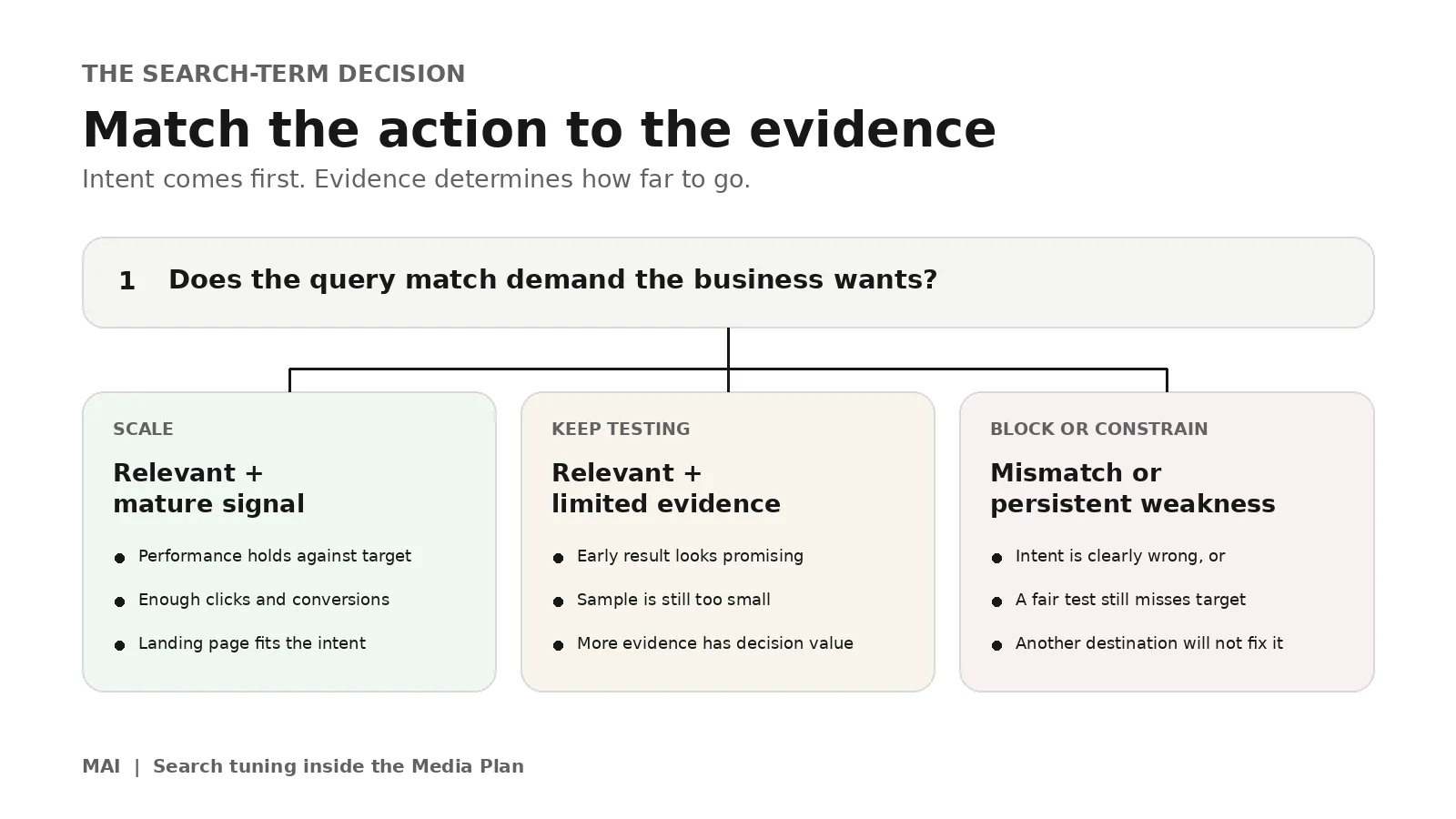
| 18 conversions at a $52 CPA, with aligned intent and stable performance | Scale | The result has enough history to support more exposure |
| 2 conversions at a $45 CPA from 8 clicks | Keep testing | The early result is encouraging, but too thin to treat as settled |
| Meaningful spend, no conversions, and a clear intent mismatch | Block or constrain | Both the traffic quality and performance evidence point away from further investment |
This middle state matters. A system that promotes every early winner will chase noise. A system that blocks anything uncertain will gradually narrow the account to the demand it already knows.
Rules-based automation can handle decisions where the answer is known in advance: block a prohibited term, enforce a hard spend limit, or flag a defined condition. Search-term tuning becomes more useful when the workflow can interpret the evidence before choosing the response.
When a term has earned more exposure
A strong early result is a reason to investigate, not a reason to immediately raise the budget. Before scaling, the agent needs to know whether the performance has held, whether enough conversions support the estimate, and whether the query's intent matches the customers the campaign is meant to find.
The next action also matters. Scaling a search term does not always mean increasing the entire campaign budget. The term may first be added as a keyword so it can receive more deliberate coverage and cleaner measurement. Its landing page may be tested. Broader budget or bidding changes may make sense only after the evidence shows that the opportunity can absorb more traffic.
Within a supported Search Media Plan, MAI can evaluate the term alongside keywords, landing pages, bids, budgets, and conversion performance. Depending on the workflow settings, the agent can propose or take the supported action and continue monitoring what happens afterward.
When blocking is the better use of budget
Waiting for perfect certainty has a cost. A term that repeatedly attracts the wrong intent or keeps spending after a fair test can take budget from stronger demand and useful experiments.
Intent can sometimes settle the decision quickly. A query for a free solution may be irrelevant to a campaign selling a paid enterprise product, even before it accumulates extensive conversion history. Other cases need performance evidence: sustained inefficiency against the target, repeated low-quality visits, or meaningful spend without a useful downstream result.
Landing-page fit should be checked before blaming the term. A relevant query may underperform because it points to a generic page that does not answer the search. If another eligible page better matches the intent, a landing-page test may be more informative than adding a negative.
Once the evidence supports the decision, MAI can use negatives to constrain weak terms within supported workflows. That turns negative-keyword management from periodic cleanup into an ongoing allocation choice: stop funding demand that has had a fair chance and use that budget where the evidence is better.
Testing protects the account from premature decisions
Many search terms arrive with too little data to classify confidently. They are relevant enough to keep, but not mature enough to scale.
Controlled testing gives those terms room to develop without letting them consume an open-ended share of the budget. As clicks and conversions accumulate, the agent can compare the term with the campaign target, account history, related terms, and the landing pages available to serve that intent.
The term may eventually be promoted into a keyword. It may prove that its first conversion was misleading and be constrained. Some terms will remain inconclusive for longer than anyone would like. The point of testing is to make that uncertainty manageable while preserving a path to new demand.
This is one concrete example of the broader explore-and-exploit problem in media buying. Proven terms need protection, but an account that never funds discovery eventually runs out of new places to grow.
The Media Plan keeps the workflow bounded
Search-term tuning takes place inside the Search Media Plan. It defines the relevant campaigns, targets, budgets, eligible landing pages, and other operating inputs that shape the decision.
The team also controls how supported actions are handled. Depending on the workflow and configuration, a routine action may run automatically, require review, or remain paused. MAI keeps tuning and change history for supported workflows so the team can inspect what the agent noticed, what it proposed or changed, and what happened next.
Those controls should match the consequence of the action. Adding a negative for a clearly irrelevant query is different from making a material budget or bidding change. Autonomy works better as a decision-by-decision setting than as one switch for the entire account.
What changes for the performance marketer
Search-term management is easy to postpone. New queries keep accumulating while the team handles launches, reporting, creative reviews, and larger budget decisions.
With an agent running the workflow, the report no longer has to wait for someone to work through it row by row. MAI can keep evaluating new terms as the evidence develops, surface the decisions that deserve attention, and carry supported actions forward inside the boundaries already set.
The marketer still owns the target, business priorities, eligible destinations, appetite for exploration, and review requirements. The recurring work of checking whether each term should scale, keep testing, or stop spending can continue without starting from a blank report every few days.
Put your search term queue to work
Connect a Google Ads account, define the first Search Media Plan, and see how MAI evaluates new demand inside your controls.
Similar articles
What Happens When an AI Agent Starts Tuning Your Campaigns?
- AI Media Buying
- AI Agents
- Campaign Optimization
- Paid Media
- Marketing Automation
See how an AI media buyer evaluates campaign evidence, tunes bids, budgets, keywords, SKUs, and creative, and works inside marketer-defined controls.
How a Google Demand Gen Agent Gives New Creative a Fair Test
- Google Ads
- AI Agents
- AI Media Buying
- Creative Optimization
- Campaign Optimization
See how a Google Demand Gen agent moves eligible creative through controlled testing, scaling, and rotation inside a Media Plan.
How AI Agents Simplify Google Ads Management for Performance Marketers
- Google Ads
- AI Agents
- Campaign Optimization
See how AI agents coordinate Google Ads campaigns around the business signals that platforms cannot see on their own.
How an AI Agent Manages Google Shopping at the SKU Level
- Google Ads
- AI Agents
- AI Media Buying
- Campaign Optimization
- Performance Marketing
See how an AI agent evaluates Google Shopping SKUs using performance evidence, margin, inventory, and product priorities to scale, test, or constrain spend.