
When Should You Let AI Change Your Ad Budgets?
Let AI tune an approved plan inside clear limits. Raise the evidence and control bar when a change alters what the business is betting on.
Budget changes can look nearly identical in an account history while representing very different decisions.
Raising a campaign from $4,000 to $4,300 a day because it is underpacing is routine tuning. Moving $100,000 from Meta to Google is a change to the media plan. Pulling spend after a sustained conversion-rate decline is different again from cutting a new audience after two days of learning.
The useful test is simple: has the team already delegated this decision, and does the proposed change stay inside that authority?
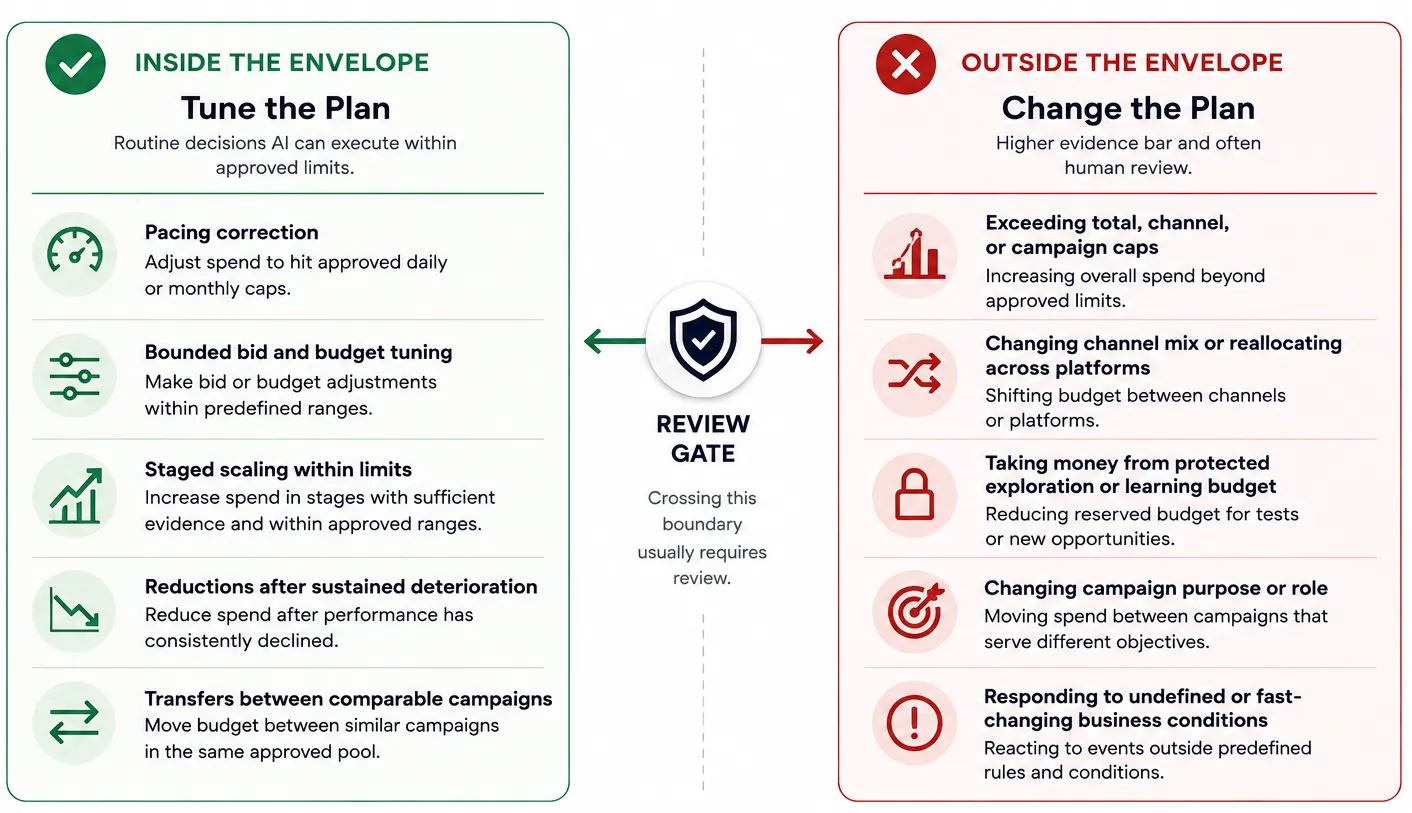
Define the budget envelope
A Media Plan already contains choices: the objective, campaigns in scope, budget, bidding approach, performance target, and the areas the team intends to protect or test. Together, those choices form a practical boundary for delegation.
Inside that boundary, an AI media buyer can improve execution without changing what the team chose to fund. Outside it, the system is proposing a different bet.
Before automation begins, define:
- Account, channel, campaign, or Media Plan caps.
- Approved bid and budget ranges.
- Campaigns allowed to share or transfer budget.
- Protected exploration reserves and minimum learning periods.
- Maximum step changes and staging requirements.
- Business conditions allowed to change the plan.
- Decisions that always require review.
Experienced buyers already work this way. Someone may be free to shift daily spend among prospecting campaigns while still needing approval to move money into branded search or exceed the monthly acquisition budget.
What AI can change automatically
Routine, bounded changes inside an approved plan are the strongest candidates for automatic execution. That includes correcting pacing toward an approved cap, making bid or budget adjustments inside defined ranges, responding to sustained performance movement when the campaign’s role is established, and reallocating budget across compatible Media Plans in an approved single-platform budget pool.
MAI supports this operating model through Media Plans, tuning controls, recommendation-only or managed modes where supported, reviewable proposals, and change history. The exact levers and execution depth still depend on the platform, campaign type, and configuration.
Scaling deserves a higher bar
Correcting pacing toward an approved $300,000 monthly budget is not the same decision as increasing the plan to $350,000. The second move creates new exposure and may run into diminishing returns.
Small, staged increases can stay inside the envelope when the ranges and evidence requirements were defined in advance. Larger jumps are closer to planning and deserve more scrutiny.
For a scale decision, look at four things:
- The size of the increase relative to recent spend.
- Marginal performance rather than average ROAS alone.
- Historical evidence of saturation or response at higher spend.
- How quickly downside could accumulate if the signal is wrong.
Protect exploration
Reducing spend after sustained deterioration is often easier to delegate because it limits exposure and is usually reversible. Cutting too early can destroy information.
New creative, audiences, keyword clusters, or product campaigns may have an explicit learning budget. Early results can trail mature campaigns simply because the test has not had enough time or volume to produce useful evidence.
Treat exploration spend as protected capital. Reserve a defined amount for learning, set a minimum delivery period or evidence requirement, define stop conditions before launch, and do not compare a young test with a mature campaign as though they serve the same role.
Campaign role changes the decision
A $5,000 transfer can be routine or strategic.
If two campaigns serve the same objective and draw from the same approved pool, moving money toward the stronger opportunity may be normal tuning. The same transfer deserves more scrutiny when the campaigns have different jobs.
Moving spend from prospecting into branded search may improve reported efficiency while weakening demand creation. Taking money from a product launch may conflict with a commercial priority that is not yet visible in conversion data.
Before transferring spend, verify that the campaigns share the same business objective, stay inside the same approved pool, do not have protected strategic or learning roles, can be compared with the same measurement logic, and remain below the predefined review threshold.
Cross-channel changes need stronger evidence
Platform-reported ROAS is not a neutral cross-channel scoreboard. Channels can create and capture demand in different ways.
Cross-channel allocation may need evidence such as MMM, marginal-return analysis, or incrementality instead of a direct comparison of platform averages. MAI’s MMM and Cross-Media-Plan capabilities can support allocation guidance and scenario planning, but automatic cross-channel application is not the default and must be confirmed for the current configuration.
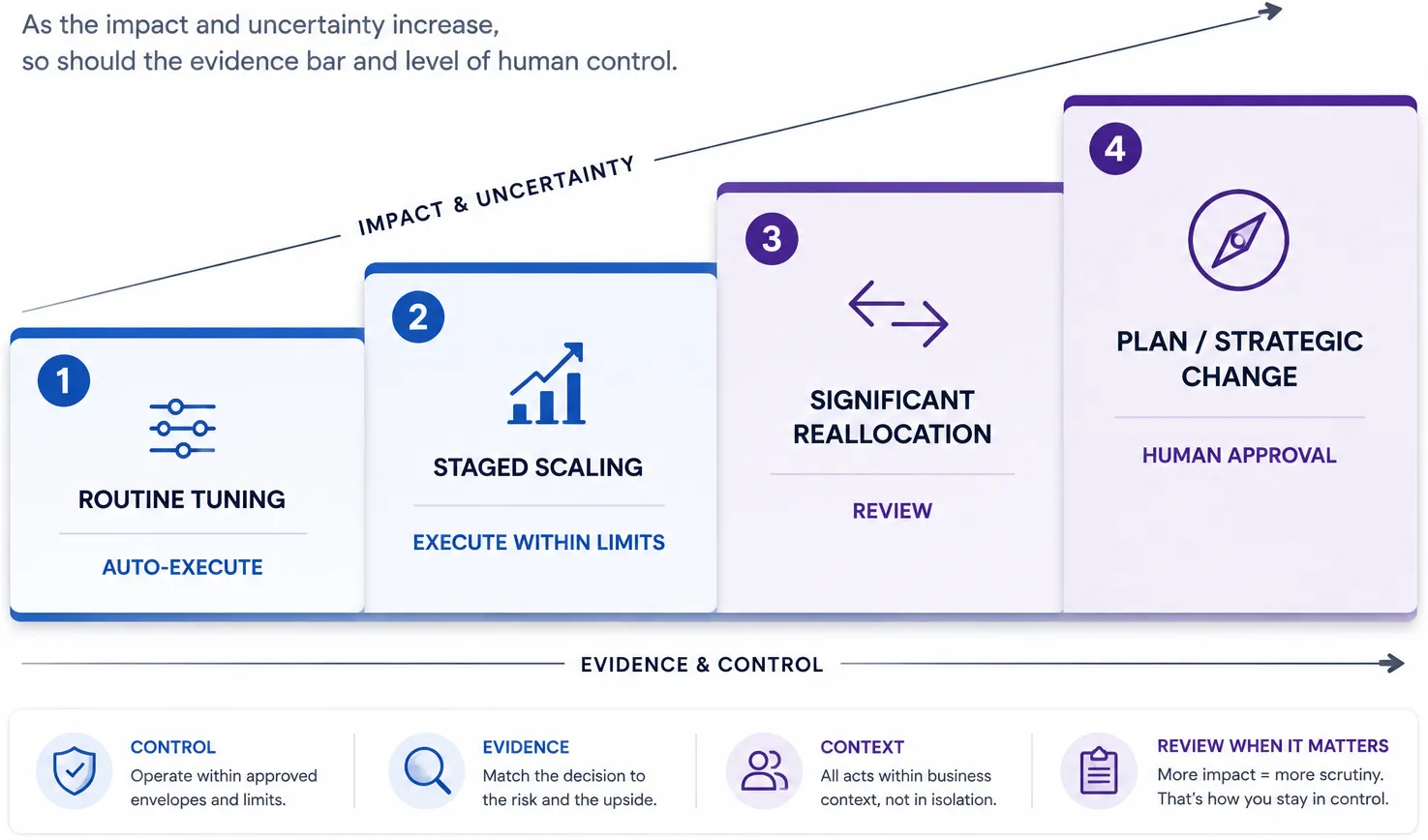
Business context can change the answer
Performance data can be internally consistent and still point to the wrong action when the business has changed.
A promotion can lift conversion rate while compressing margin. A high-performing SKU may not deserve more spend when inventory is constrained. A product launch may warrant funding before it has the history of an established line because the business deliberately chose to buy learning.
MAI can use business context such as margin, LTV, inventory, promotions, conversion quality, growth targets, and operating constraints when those inputs are supplied through a supported source or by the team. When the relevant business input is available and the action is supported and configured, MAI can use that context in recommendations or tuning. Decisions requiring additional business judgment should remain reviewable.
What to automate versus review
| Budget decision | Sensible default | Boundary conditions |
|---|---|---|
| Correct pacing within an approved cap | Usually automatic | Spend target, remaining runway, efficiency conditions |
| Small tuning inside a Media Plan | Usually automatic | Defined ranges, sustained evidence, current context |
| Scale after sustained performance | Stage it; review larger jumps | Increase size, marginal performance, saturation history |
| Reduce spend after sustained deterioration | Usually automatic within limits | Confidence, reversibility, minimum viable spend |
| Protect exploration budget | Keep reserve intact until test rules are met | Learning period, minimum evidence, stop conditions |
| Reallocate across compatible Media Plans in one approved single-platform pool | Can run automatically in Agent managed mode after pool approval | Shared objective, same plan, transfer limits |
| Transfer between different strategic roles | Often review | Demand creation vs. capture; launch or promotion priority |
| Reallocate across channels | Proposal and review first | Broader measurement, incrementality, size of mix change |
| Respond to business changes | Depends on predefined inputs and responses | Data freshness, explicit constraints, tradeoff size |
| Make a large change on incomplete evidence | Review | Dollars exposed, uncertainty, recovery time |
Set authority before the account needs it
The worst time to decide whether a budget change needs approval is after the system has already found the opportunity.
Define the envelope, transfer pools, protected spend, step sizes, business inputs, and review triggers before execution pressure arrives.
Use one final test. If a change improves execution inside a plan the team already approved, it is a strong candidate for delegation. If it changes what the team is betting on, require stronger evidence and usually a review before money moves.
Where MAI fits
MAI is designed to give the existing performance team more operating leverage, not replace its judgment. The team still sets the goals, priorities, budgets, targets, scope, and constraints. MAI can monitor, investigate, recommend, prepare proposals, and execute supported actions inside those boundaries depending on the workflow and configuration.
Within one advertising platform, MAI’s Budget Allocation skill can manage a shared budget pool across compatible Media Plans. Teams can keep proposals recommendation-only or, after approving the pool, enable Agent managed mode so MAI reallocates budget toward the pool objective and records the resulting decisions in tuning history. Cross-channel allocation remains a separate capability with stronger configuration and review requirements.
See how MAI can apply budget controls inside your Media Plan
Similar articles
Where Should the Next Dollar Go?
- Budget Allocation
- Marketing Mix Modeling
- Marginal ROAS
Measure what your spend drives, compare the return on the next dollar, and validate the decision with incrementality experiments.
How Much Autonomy Should You Give an AI Media Buyer?
- AI Media Buying
- AI Agents
- Marketing Automation
- Media Buying
- Performance Marketing
The right level of AI autonomy depends on a decision’s consequence and the business context available to the agent.
Your Ad Platforms Don't Talk to Each Other. Your AI Agent Should.
- AI Media Buying
- Cross-Channel Marketing
- Paid Media
- Media Buying
- AI Agents
Google and Meta optimize their own ecosystems. An AI agent connects cross-channel signals to better creative and budget decisions.
Ad Platforms Solve for Volume. Who Solves for Your Margin?
- Performance Marketing
- Paid Media
- AI Media Buying
- Media Buying
- Profitability
Google and Meta optimize advertising performance at scale. Profitable growth requires bringing business economics into each media decision.