
Your Ad Platforms Don’t Talk to Each Other. Your AI Agent Should.
Customers move across channels. Your media decisions should be able to follow the signal with them.
Google is very good at Google. Meta is very good at Meta. Neither platform is responsible for understanding your full media mix.
That sounds obvious, but most accounts are still operated platform by platform. Search is managed as search. Social is managed as social. The customer moves across both, and the most useful signal may show up somewhere different from the final conversion.
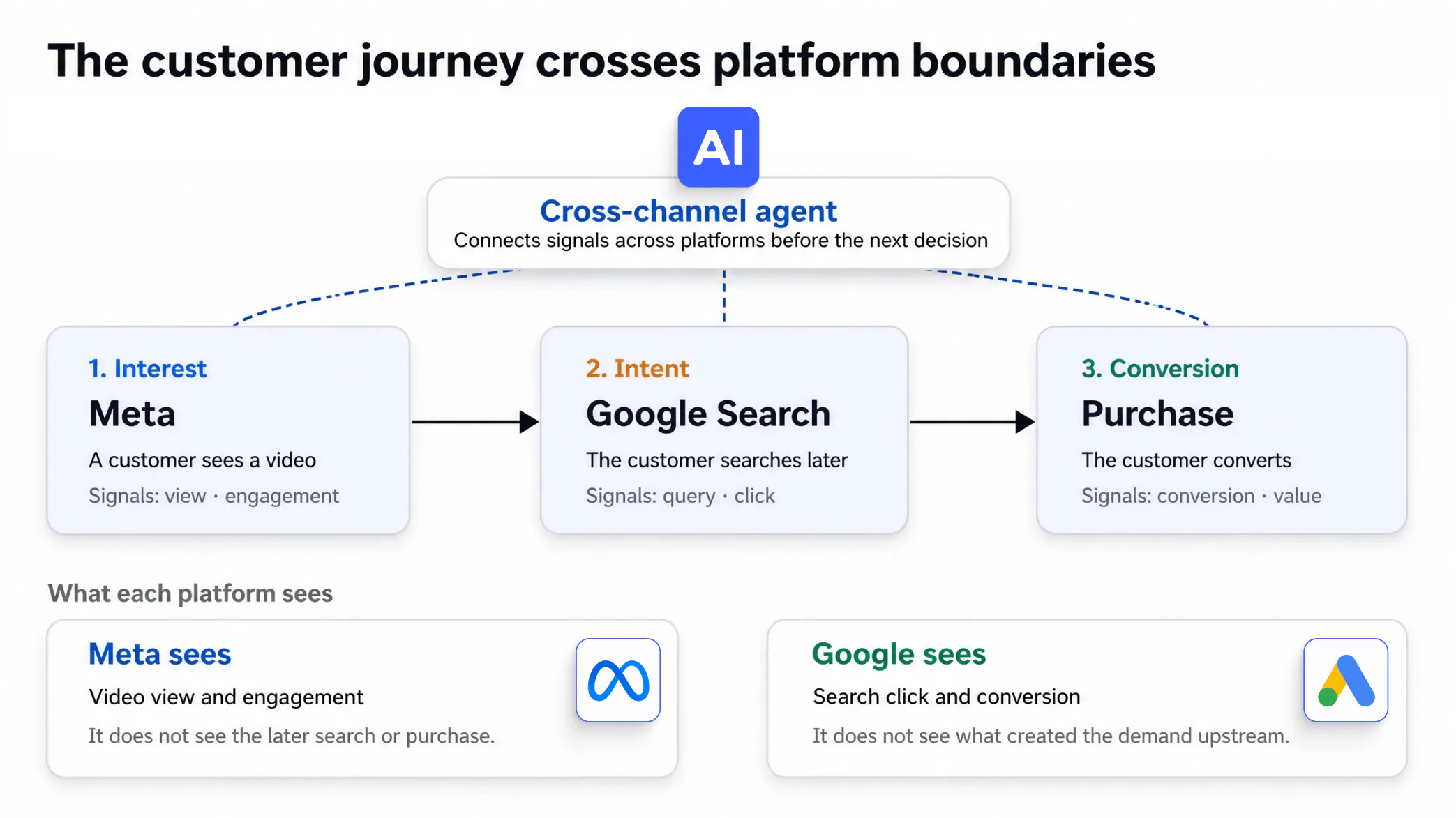
What gets lost between platforms
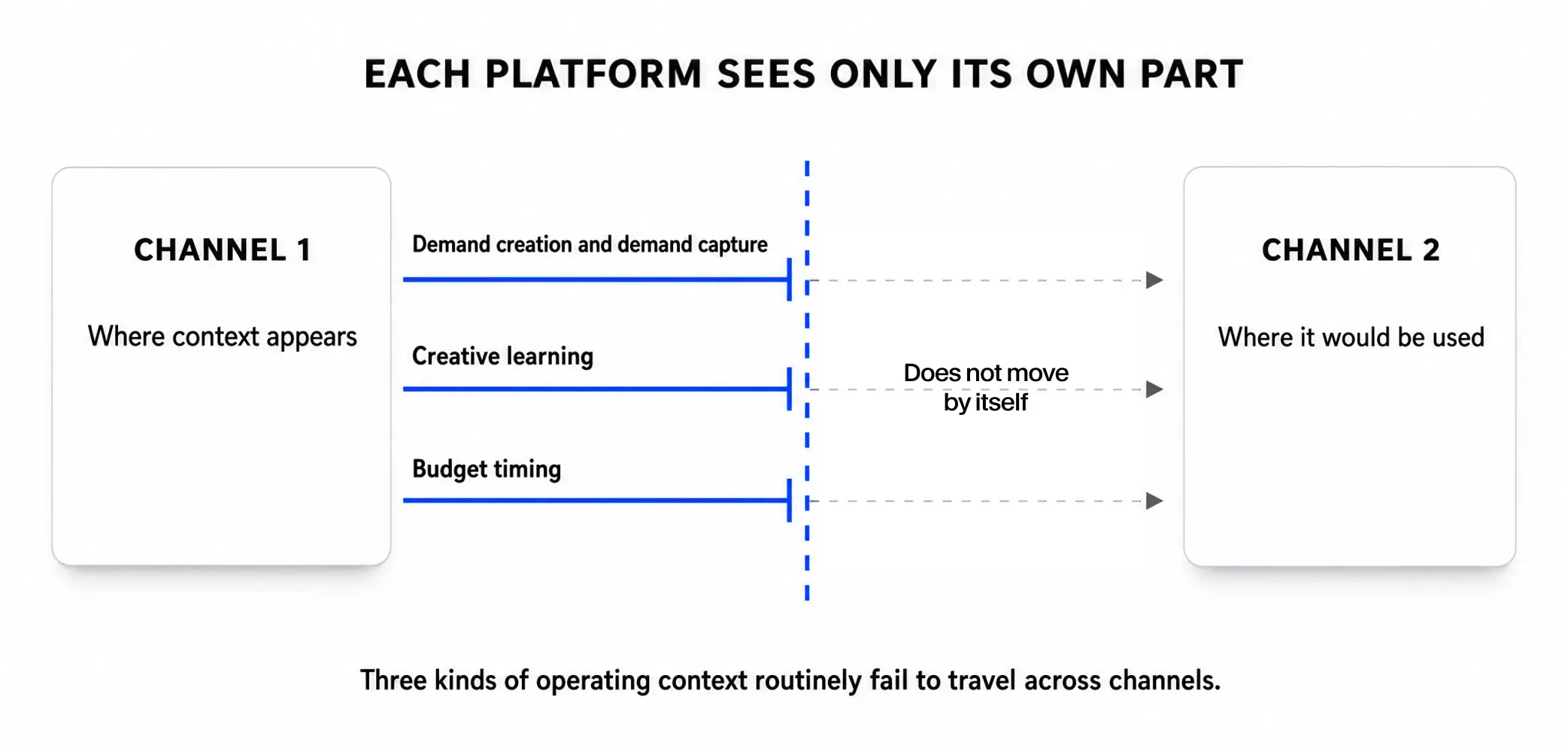
The problem goes beyond attribution. Three kinds of operating context routinely fail to travel across channels.
Demand creation and demand capture
Someone may watch a video on Meta and search for the brand on Google later. Meta helped create the demand; Google captured the conversion. Each platform sees its own part of the journey. The operator still has to decide what that combined journey means for both channels.
Creative learning
A video can begin outperforming other creative on Meta. That may be a useful signal to test the underlying idea on YouTube or Demand Gen, but the learning does not move by itself. Someone—or a system working across connected channels—has to notice the pattern and decide whether it deserves a test elsewhere.
Budget timing
Search demand can spike while a Meta audience starts converting unusually well. Those shifts can happen quickly, while cross-channel budget decisions are often made on a slower cadence. By the time the money moves, the opportunity may have changed.
Why dashboards are not enough
A cross-channel dashboard improves visibility by putting information in one place. That is useful, but the operator still has to interpret the signal, decide whether it matters somewhere else, and choose what to do next.
A cross-channel agent can sit one layer above the individual platforms, connecting what Google and Meta are seeing to decisions across the wider media mix.
From visibility to cross-channel decisions
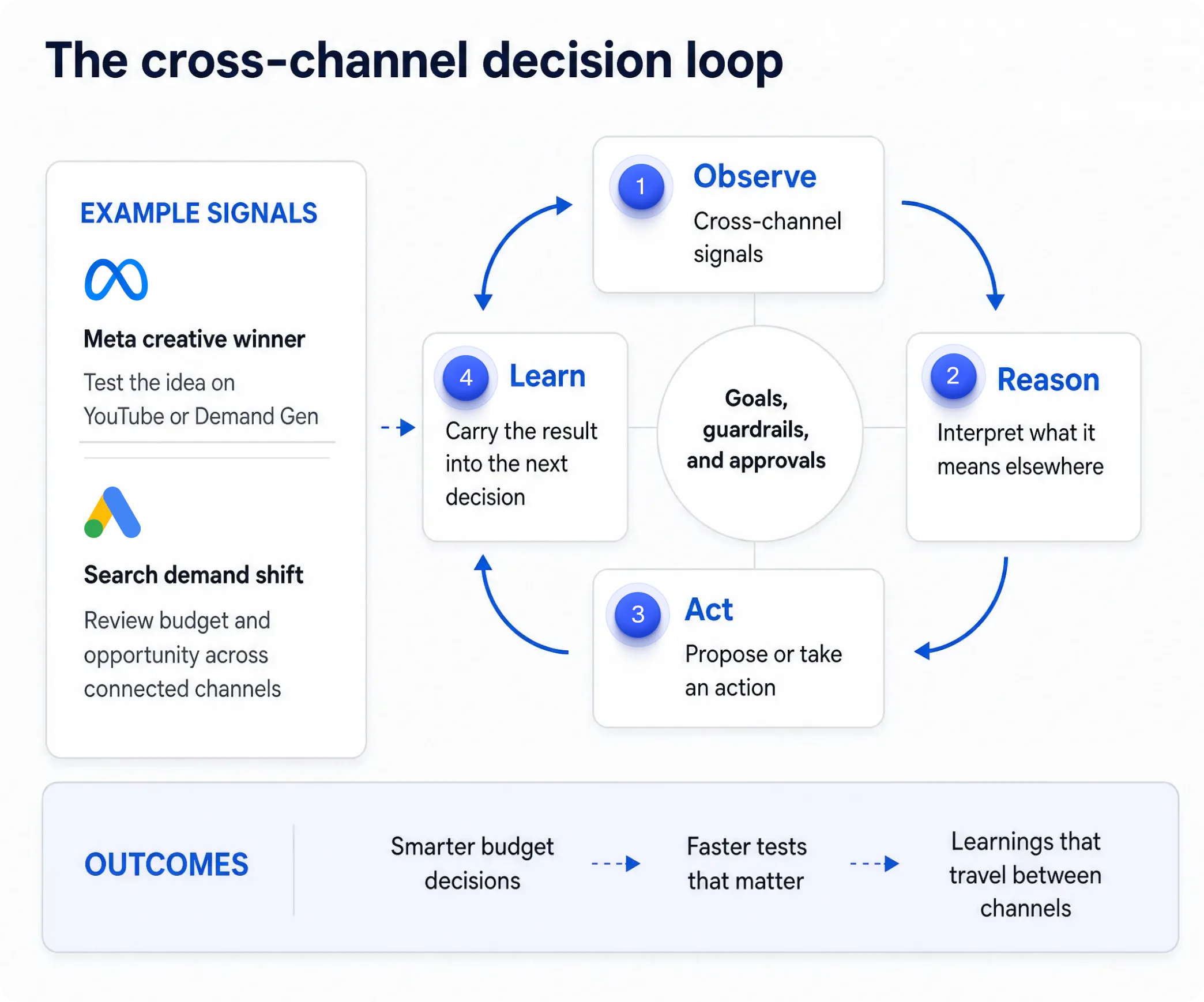
The operating model is simple:
- See: combine relevant signals from multiple connected platforms.
- Reason: interpret what a change in one channel may mean for another.
- Act: propose or take an action inside the team’s configured controls.
A dashboard mostly helps the team see. An AI performance marketing agent can go further by connecting observation to a decision and carrying the result into the next round of learning.
What this changes for the media buyer
A creative winner on Meta can inform what gets tested on YouTube. A change in search demand can influence how budget is evaluated elsewhere. Useful evidence should be able to inform the next decision without simply copying the same tactic across platforms.
The media buyer still owns goals, priorities, constraints, and the decisions that need judgment. The agent improves the cross-channel context available for the next decision and can handle more of the continuous operating work inside defined boundaries.
You decide what the agent can do
Cross-channel action needs a clear control model. MAI supports reviewable proposals, workflow controls, logging, and configured manual or automatic modes. Significant changes can be reviewed before execution, and the team decides where approval is required.
- Recommend: the agent identifies a cross-channel action; a person decides.
- Approve before execution: the agent prepares the action; a person authorizes the change.
- Operate within guardrails: the agent acts inside predefined goals and constraints, with activity logged and reversible where supported.
That control boundary matters because cross-channel reasoning is only useful if the team trusts how decisions are made and what the system is allowed to change. For a deeper framework, see How Much Autonomy Should You Give an AI Media Buyer.
Where MAI fits
MAI can compare performance and creative learning across connected channels, combine that with broader business context, and surface cross-channel recommendations. A strong creative pattern on Meta, for example, may become a candidate for a Demand Gen or YouTube test rather than remaining a Meta-only learning.
Customer story See how Cloaked grew Google acquisition 6× at a stable CAC.
Automated cross-platform deployment depends on the workflow and permissions in use, so the safer operating model is to separate learning transfer from execution authority. The team defines objectives and constraints; MAI can handle more of the continuous analysis and configured execution inside those boundaries.
Cross-channel budget decisions are a related problem. Once the signal says spend may belong somewhere else, the next question is how to evaluate that move against marginal return rather than average platform efficiency.
Bring your channels into one decision loop
If your team already has cross-channel reporting but still depends on someone manually connecting every signal to the next action, the next step is to connect the reporting layer to a governed decision process.
See how MAI can connect signals and decisions across your media mix
Similar articles
What Is an AI Performance Marketing Agent?
- AI Agents
- AI Media Buying
- Performance Marketing
- Paid Media
- Marketing Automation
An AI performance marketing agent continuously monitors paid media, works out what changed and why, and can carry decisions through to action within defined permissions.
When Everyone Has the Same Algorithms, Creative Matters More
- Creative Strategy
- Performance Marketing
- AI Advertising
- Creative Optimization
- Paid Media
As media-buying mechanics become automated, the advantage moves to creative judgment and how quickly teams learn what works.
Where Should the Next Dollar Go?
- Budget Allocation
- Marketing Mix Modeling
- Marginal ROAS
Measure what your spend drives, compare the return on the next dollar, and validate the decision with incrementality experiments.
How Much Autonomy Should You Give an AI Media Buyer?
- AI Media Buying
- AI Agents
- Marketing Automation
- Media Buying
- Performance Marketing
The right level of AI autonomy depends on a decision’s consequence and the business context available to the agent.