
The Agentic Media Buying Playbook for DTC Brands
Six practical plays for connecting product economics, creative learning, measurement, and day-to-day media decisions.
A DTC account rarely has one clean optimization target. The same campaign may be selling a high-margin bestseller, clearing slow inventory, and introducing a product with almost no conversion history. A promotion can change the economics for a week. A new creative concept needs enough spend to prove itself. Meta and Google report what happened inside their own systems, but neither platform has the full operating picture by default.
This is where media buying becomes difficult to manage through account-level ROAS alone. The number can be healthy while budget is leaning toward low-margin products, a winner is running out of stock, or branded search is receiving credit for demand created elsewhere.
Agentic media buying is useful when it carries those details into recurring account decisions. The team defines the goals, priorities, budgets, and limits. The agent keeps watch, investigates what changed, and handles supported work inside that boundary. For most DTC brands, the best place to begin is one recurring decision that is already consuming too much time or being made too late.
Choose the first play from the account
A brand does not need to launch all six plays at once. Start with the condition that is creating the most operational drag.
| Account condition | Start with | First recurring decision |
|---|---|---|
| Uneven product economics | SKU-level management | Which products deserve more or less Shopping budget? |
| Persistent creative fatigue | Controlled creative testing | Which assets receive test spend, scale, or retire? |
| External business inputs | Company context | Which inputs should change bids, budgets, or product treatment? |
| New ideas are starved | Protected exploration | How much budget is reserved for learning? |
| Channels disagree on credit | Incrementality-informed allocation | Should the evidence change the next budget move? |
| Routine execution keeps slipping | Controlled delegation | Which actions can run without daily review? |
The diagnostic is deliberately practical. It gives the agent a specific job and gives the team something observable to evaluate after a few weeks of account work.
The six plays work as one system
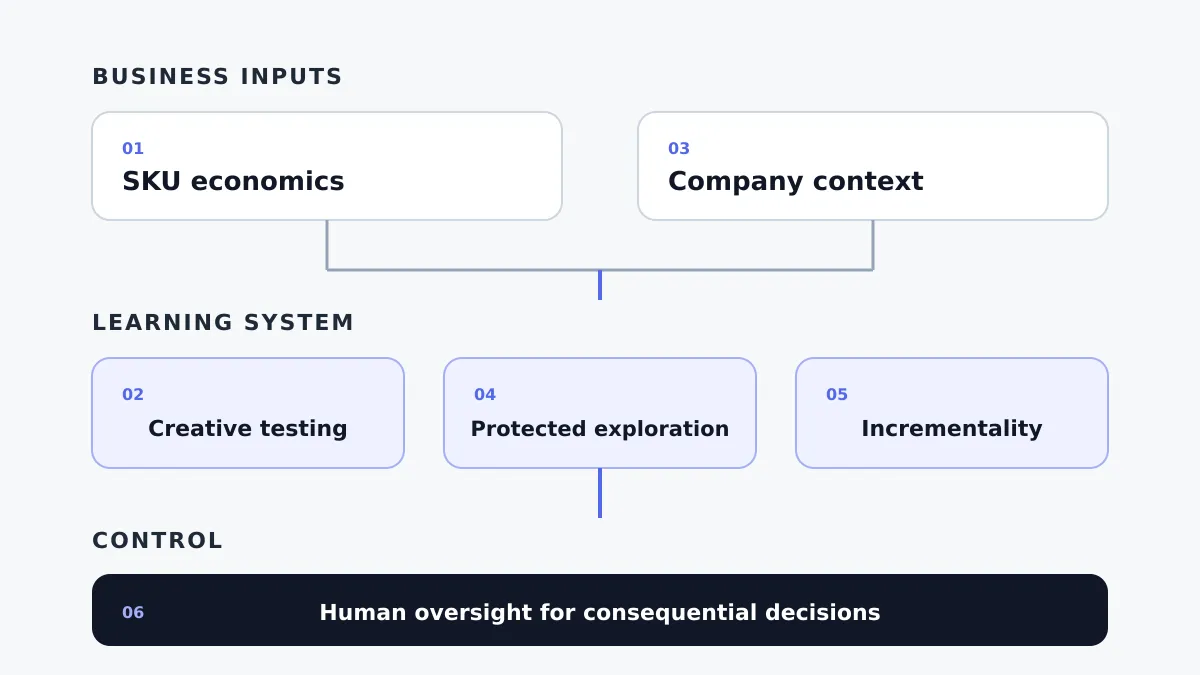
Figure 1 shows how the six plays connect. Product and company inputs change what the account should optimize. Creative testing, protected exploration, and incrementality generate evidence. Human-defined controls determine what can proceed automatically and what returns to the team.
Play 1: Run every SKU like its own business
Account-level ROAS can hide very different jobs and economics. A mature, high-margin product with healthy inventory can absorb more spend than a thin-margin item nearing a stockout. A new launch may need a learning period before it can be judged against a bestseller with years of conversion history.
Start by deciding which product inputs should change a media decision. Margin affects the value of a sale. Inventory affects whether additional demand is useful. Lifecycle stage affects how much uncertainty is reasonable. Promotions and business priorities can temporarily change all three.
In supported Google Shopping workflows, MAI can compare SKU-level advertising and commerce evidence, distinguish stronger, weaker, and still-uncertain products, and tune supported budgets or bidding targets within a Shopping Media Plan. Promising products can enter testing, while weaker SKUs can be constrained behind a budget cap. The exact action depends on the campaign structure, Media Plan, and current configuration.
This play takes business-aware media buying down to the product level: which SKU should receive the next unit of spend, and why?
Play 2: Treat creative like inventory
A strong Meta ad eventually fatigues. New creative still needs enough delivery to show whether it can perform. When those two facts are handled through ad hoc weekly reviews, teams often keep a declining winner live too long or pull a promising test before it has enough evidence.
A controlled testing structure gives new assets a defined route into the account. Eligible creative can enter a test cell, collect delivery, and then graduate, continue testing, or retire as the evidence develops. MAI’s Meta workflows can propose new ads and test cells, adjust budgets across supported testing and winning structures, pause weaker ads, and scale stronger ones. New-ad creation is a sensible place to retain manual review so the team can check copy and brand fit.
The output should also help the creative team decide what to make next. Patterns across hooks, formats, products, offers, and landing pages are more useful than a list of winning ad IDs. The team continues to own the creative idea; the operating loop makes creative learning faster and more consistent.
Play 3: Put company knowledge into the media decision
Much of the context that changes a DTC decision lives outside the ad account. The merchandising team knows a promotion starts on Thursday. Operations knows a popular SKU may stock out. Finance knows that two products with similar revenue have very different contribution margins. A growth lead may want to prioritize new-customer acquisition even when retargeting reports a stronger short-term ROAS.
The practical work is deciding which inputs should be available, how current they need to be, and which decisions they are allowed to affect. Margin might change a Shopping target. Inventory might constrain a product. Promotion timing might change a budget or landing-page plan. Conversion quality or customer value might change which campaign receives more room.
MAI can use supplied business context such as margin, LTV, inventory, promotions, product priority, and operating constraints when those inputs are available through a supported source or provided by the team. The value comes from applying information the company already has before the next bid, budget, product, or campaign decision is made.
Play 4: Protect testing without destabilizing proven performance
DTC accounts need a steady source of new growth. If nearly all spend stays with established winners, new products, search terms, audiences, landing pages, and creative may never collect enough evidence. If testing is mixed into every campaign without clear limits, it becomes harder to tell whether the core account is weakening or exploration is simply costing money.
Define the exploration envelope in advance: what is eligible, how much exposure is acceptable, which evidence supports scaling, and when a person should review the decision. This lets the account continue learning without giving every uncertain idea unlimited runway.
MAI’s tuning logic distinguishes stronger, weaker, and still-uncertain opportunities. Depending on the platform and setup, that can mean protecting spend for a creative test, introducing a promising search term, moving a product into testing, or pulling back when weak performance persists. The team still owns the size of the test budget and the consequences it is willing to accept.
Play 5: Use incrementality evidence in allocation
Platform reporting becomes less decisive when several channels claim credit for the same customer. Branded search is the familiar example: strong reported ROAS does not reveal how many purchases would have happened through organic search or direct traffic without the ad.
Incrementality testing can estimate the lift caused by advertising. MMM can provide another view of channel contribution, diminishing returns, and allocation scenarios. Both are more useful when they feed a budget decision rather than ending as a presentation.
For a DTC team, the operating question is concrete: should this evidence change what receives the next dollar? MAI’s MMM and Cross-Media-Plan capabilities can support contribution estimates, scenario planning, and cross-channel recommendations. Automatic cross-channel execution is not the default and depends on the customer’s workflow and configuration. Larger allocation changes should remain reviewable when the evidence, business context, or authority is incomplete.
Play 6: Keep judgment with the team and delegate the mechanics
More of the recurring work can move to an agent without turning over the strategy of the account. The team continues to set the budget, targets, campaign scope, eligible products and assets, and the operating constraints that matter to the business.
Media Plans give that authority a concrete boundary. Supported actions can run automatically, require approval, or remain paused. Proposal status, Tuning history, changelogs, alerts, and external-change detection help the team see what happened and intervene when needed. If someone changes a managed campaign directly in the platform, MAI may pause the affected workflow or remove it from active management until the conflict is reviewed.
Authority can expand after the team has seen how a workflow behaves, or contract when the risk changes. The right setting depends on the consequence of the decision and the context available to make it. The autonomy framework goes deeper on that judgment.
Turn the first play into an operating loop
Once the starting play is chosen, define how it will run. A broad goal such as “optimize Shopping” is difficult to evaluate. A recurring decision—such as which SKUs receive incremental budget—creates a much clearer operating unit.
| Operating choice | What to define |
|---|---|
| Recurring decision | The specific account decision the agent should carry, such as which SKUs receive incremental budget. |
| Relevant inputs | Performance history plus the margins, inventory, promotions, targets, or other context that can change the answer. |
| Permission boundary | Which supported actions may run automatically and which require review. |
| Work log | What the agent noticed, why it acted or held back, and what happened afterward. |
| Adjustment | How the inputs, threshold, approval rule, or exploration budget should change. |
Review the resulting work log, not only the performance chart. You should be able to see what the agent noticed, which evidence it used, why it acted or held back, whether a proposal required review, and what happened afterward. That record is what allows the team to refine the inputs, permission boundary, or test budget over time.
What this looks like in MAI
MAIOS keeps connected account data, history, business context, goals, and controls available across the operating loop. Media Plans define the campaign type, budget, target, eligible inputs, and tuning settings for a specific scope. Tuning handles supported recurring work for MAI-labeled campaigns, with automatic, manual-review, or paused modes depending on the workflow and configuration.
For a DTC brand, that operating context can connect several types of work. Google Shopping workflows can use SKU-level evidence and supplied product economics. Meta and Demand Gen workflows can bring eligible creative into structured testing. Monitoring can surface performance or configuration issues. Analytics and Execution can investigate likely causes and turn the result into a recommendation, proposal, or supported campaign action.
Single-platform Budget Allocation can recommend how an approved pool should be distributed across compatible Media Plans and, when Agent managed mode is enabled, can manage future allocations toward the pool objective. Cross-channel allocation remains a separate decision layer supported through MMM and Cross-Media-Plan analysis, with the path from recommendation to execution confirmed for the customer’s setup.
Start with one recurring decision
The most useful first deployment is usually visible in the team’s backlog. It may be the Shopping review that keeps getting postponed, the creative test that never receives a fair budget, or the allocation discussion that repeatedly ends with conflicting platform reports.
Choose one of those decisions. Define the inputs, authority, and evidence standard. Then evaluate whether the system handles the work consistently enough to earn a larger role in the account.
See how MAI could take on a recurring media-buying decision inside your account’s goals and controls
Similar articles
What Should an AI Media Buyer Actually Do Every Day?
- AI Media Buying
- AI Agents
- Performance Marketing
- Media Buying
- Marketing Automation
What should an AI media buyer do every day? Use this operating loop and weekly work-log test to evaluate monitoring, investigation, optimization, controls, and escalation.
How Much Autonomy Should You Give an AI Media Buyer?
- AI Media Buying
- AI Agents
- Marketing Automation
- Media Buying
- Performance Marketing
The right level of AI autonomy depends on a decision’s consequence and the business context available to the agent.
When Everyone Has the Same Algorithms, Creative Matters More
- Creative Strategy
- Performance Marketing
- AI Advertising
- Creative Optimization
- Paid Media
As media-buying mechanics become automated, the advantage moves to creative judgment and how quickly teams learn what works.
Incrementality Testing in Practice: From Investment Case to Proof
- Incrementality Testing
- Geo-Lift Testing
- Brand Search
- Media Budget Allocation
- Performance Marketing
See how a conservative Brand Search investment case was validated with A/A and geo-lift incrementality testing before additional budget was funded.