
Why Your Best-Performing Ad Channel May Be Getting Too Much Budget
The channel that earned its current budget may still be the wrong place for the next increase. Allocate on incremental opportunity, not reputation.
The easiest channel to overfund is often the one everyone trusts.
Maybe Google Search has delivered the strongest ROAS for two quarters. When more budget becomes available, putting it into Search feels like the safe decision. The channel has earned that confidence.
But historical performance explains the budget already spent. It does not necessarily identify where the next $10,000 or $50,000 will work hardest.
A channel can remain your best performer after it has stopped being your best place to add spend.
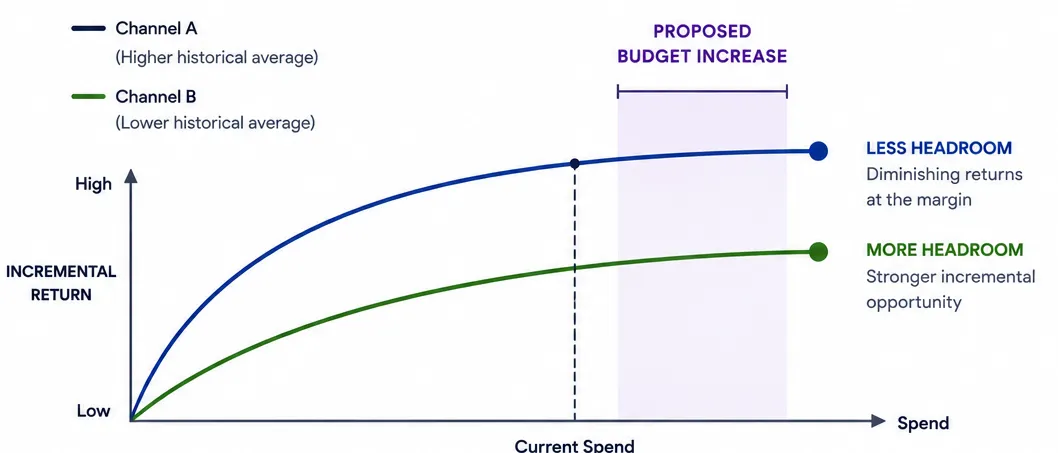
Look at the next dollar, not the historical average
Start with what happened after the most recent budget increases.
Spend rose, then rose again. Revenue may have continued growing, but each increase produced a smaller lift and efficiency moved closer to the edge of the acceptable range.
The channel can still look healthy because earlier spend was highly productive. Search may fully deserve its present budget. The next increase still has to justify itself based on what the additional spend is likely to produce.
Separate three questions:
- Was the existing investment productive? Historical average performance can help answer this.
- Did the latest increase remain productive? Recent marginal performance is more useful here.
- Where will the next increase create the most business value? Compare incremental opportunity across eligible channels.
How good accounts overfund their winners
The pattern is familiar. A channel builds a strong performance history. The team uses that history to justify the next increase. More budget flows to the same place. Incremental performance starts to deteriorate as the channel becomes more saturated, while the blended average stays strong enough to hide what is happening at the margin.
Funding a winner is not the mistake. The problem is using the winner’s reputation as the allocation rule after the response curve has changed.
Run a controlled headroom test
One way to test the assumption is to give a weaker-looking channel a modest amount of room.
Meta may have a lower average ROAS, but a controlled increase could absorb spend with less deterioration than Search. You do not need a large reallocation to learn something useful.
Design the test around four questions:
- What incremental amount is large enough to produce a signal but small enough to limit downside?
- Which business outcome and efficiency threshold will be used across channels?
- How long will the test run before the result is judged?
- What will count as evidence to scale, hold, or reverse the change?
The goal is to find out whether one channel is crowded while another still has useful headroom. A short test should inform the next decision, not crown a permanent winner.
Check what is driving the reported performance
A channel’s reported ROAS can remain strong while the case for more budget weakens. Before increasing spend, look at what is producing that performance.
Demand capture versus demand creation
Branded search is the clearest example. Search may continue reporting the better ROAS while non-brand query volume stops expanding and a larger share of efficiency comes from branded or very high-intent traffic.
Search may still be doing an important job. But part of its apparent strength may come from capturing demand that already exists rather than creating additional demand.
Conversion economics
A promotion can raise conversion rate while compressing margin. A product category can convert efficiently while producing weaker business economics. Customer quality can deteriorate even when platform ROAS remains stable.
Incrementality and attribution
A reported conversion does not, by itself, establish that the spend caused the outcome. That distinction matters most when high-intent, repeat, or demand-capture activity receives credit inside the channel.
None of these signals automatically means the channel should lose budget. Together, they tell you how much confidence to place in reported performance when deciding whether to fund the next increase.
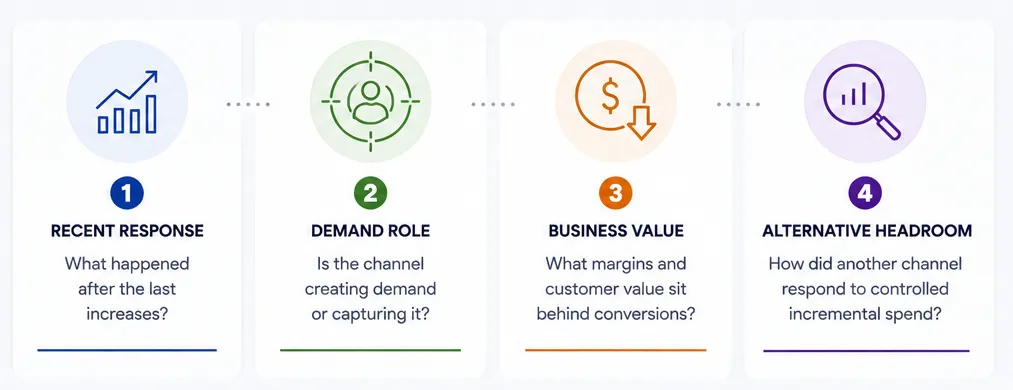
Separate the current budget from the next increase
A mature Search program can remain one of the strongest channels and still be the wrong place for the next $50,000.
Its current budget may be well justified. Awarding the next increase solely because it has the best trailing ROAS is a separate decision and requires separate evidence.
The case to reconsider the allocation becomes stronger when several signals align:
- Recent increases are producing smaller incremental gains.
- Reported performance is increasingly concentrated in demand capture.
- Another channel responds better to controlled incremental spend.
- Margin, customer quality, or another underlying business outcome is weakening.
- The channel is approaching an agreed efficiency or saturation threshold.
You do not need every signal to run a test. But when several appear together, historical ROAS becomes a weaker argument for automatically funding the winner again.
A practical budget-review sequence
Before allocating the next increase:
- Confirm the business outcome and efficiency threshold being optimized.
- Review the response to the channel’s latest spend increases.
- Separate branded, high-intent, repeat, or other demand-capture activity where relevant.
- Check margin, customer value, and other economics behind the conversions.
- Estimate or test marginal headroom in credible alternatives.
- Make a staged allocation and observe what happens next.
Where MAI fits
MAI can help teams evaluate allocation decisions with more context than platform-reported averages alone. Within a single advertising platform, its Budget Allocation skill can use available evidence and marginal-return curves to recommend how an approved budget pool should be distributed across compatible Media Plans. Teams can inspect the proposal, adjust the budget or target, and approve it; after initial approval, supported pools can remain recommendation-only or use Agent managed mode for future allocation changes. Exact controls depend on the platform and configuration.
For cross-channel decisions, MAI’s MMM and Cross-Media-Plan capabilities can estimate channel contribution, show diminishing returns, and support scenario planning. They can help compare opportunities across channels without relying only on platform-reported attribution. Automatic cross-channel application is not the default and should be confirmed for the current workflow and configuration.
MAI can also use business context such as margin, LTV, inventory, promotions, conversion quality, growth targets, and operating constraints when those inputs are supplied through a supported source or by the team. The team still owns goals, priorities, budgets, scope, and higher-consequence tradeoffs.
The decision standard
When a channel has earned a strong reputation, inspect what happened after the most recent increases before giving it more.
The quarterly average can show that the existing investment worked. It says much less about how productive the next increase will be.
The channel may still deserve every dollar it has today. The next increase should be evaluated on the evidence for that increase.
See how MAI helps evaluate where the next dollar should go
Similar articles
Where Should the Next Dollar Go?
- Budget Allocation
- Marketing Mix Modeling
- Marginal ROAS
Measure what your spend drives, compare the return on the next dollar, and validate the decision with incrementality experiments.
When Should You Let AI Change Your Ad Budgets?
- AI Media Buying
- Budget Allocation
- AI Agents
- Performance Marketing
- Paid Media
Learn which budget changes AI can automate, when human review is needed, and how to set practical guardrails.
Your Ad Platforms Don't Talk to Each Other. Your AI Agent Should.
- AI Media Buying
- Cross-Channel Marketing
- Paid Media
- Media Buying
- AI Agents
Google and Meta optimize their own ecosystems. An AI agent connects cross-channel signals to better creative and budget decisions.
Ad Platforms Solve for Volume. Who Solves for Your Margin?
- Performance Marketing
- Paid Media
- AI Media Buying
- Media Buying
- Profitability
Google and Meta optimize advertising performance at scale. Profitable growth requires bringing business economics into each media decision.