
Best AI Media Buying Tools in 2026
Choose the right platform by deciding how much of the media-buying job you want AI to take on—not by comparing feature lists in isolation.
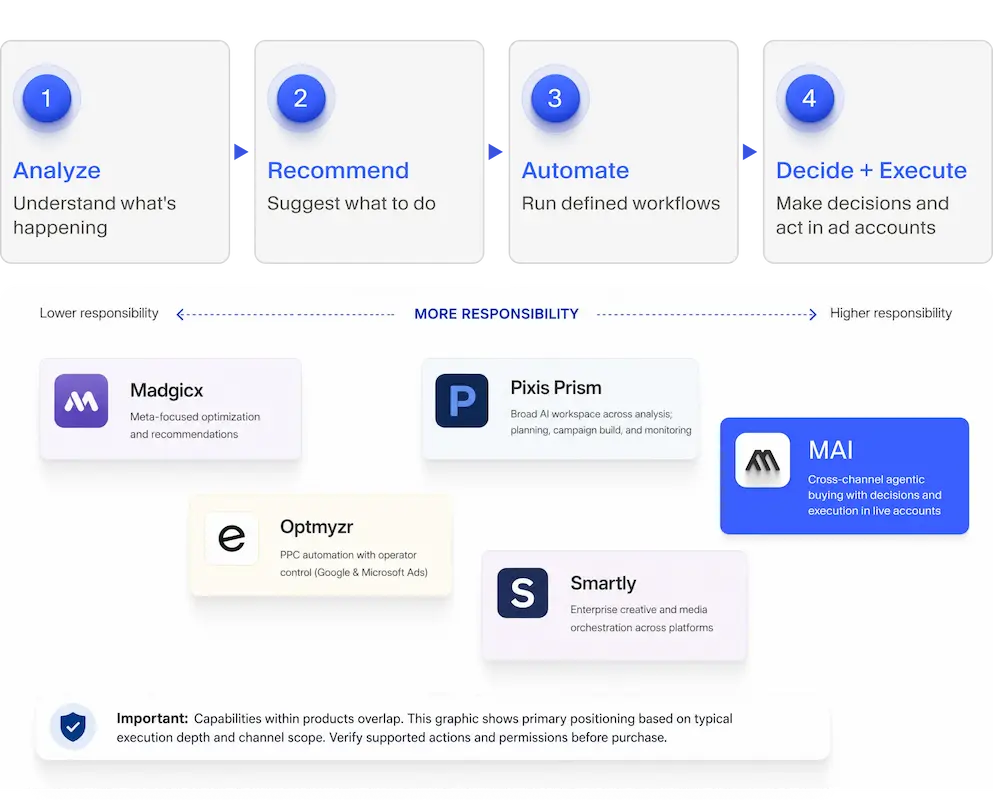
AI media-buying software now spans several different jobs. Some products analyze performance. Some recommend changes. Some automate a playbook the team has already defined. A smaller group can make and execute recurring media-buying decisions inside connected ad accounts.
Those differences matter more than the number of AI features on a product page. Start with the work you want to stop doing, then choose the product built for that level of responsibility.
Choose by responsibility, not feature count
What is an AI media-buying tool?
AI media-buying tools help teams plan, manage, optimize, or execute paid advertising. At one end, they behave like copilots: they analyze an account and suggest what to do. In the middle, they automate rules, scheduled checks, or defined campaign workflows. Agentic products go further by carrying work from analysis into action inside ad accounts, subject to the controls and permissions the team sets.
The category is broad enough that two products can both call themselves AI media-buying platforms while changing very different parts of a marketer’s day.
Best AI media-buying tools in 2026: quick comparison
| Tool | Best fit | Primary job | Platform scope | Execution model | Operator role |
|---|---|---|---|---|---|
| MAI | Hand off recurring cross-channel media buying | Ongoing media buying and optimization | Google, Meta, Microsoft | Configured agent workflows with controls | Set objectives, constraints, review settings |
| Smartly | Enterprise creative and media operations | Creative + media orchestration | Multi-platform social, Google, CTV and more | AI-assisted campaign and creative workflows | Coordinate enterprise creative and media teams |
| Madgicx | Meta-centered advertisers | Meta optimization | Primarily Meta | Recommendations, one-click changes, rules, AI bidding | Stay close to Meta execution |
| Optmyzr | Operator-controlled PPC automation | PPC automation and safeguards | Google + Microsoft core; broader platform support | Rules, scheduled automation, AI-assisted actions | Configure automations; review and supervise |
| Pixis Prism | Broad AI performance workspace | Analysis, planning, monitoring, agent workflows | Meta, Google, TikTok, YouTube + other integrations | Cross-channel analysis/workflows; approved Meta actions documented | Set goals; verify platform-specific execution and approvals |
How we evaluated the tools
MAI publishes this article and appears in the comparison, so we make the evaluation criteria explicit enough for a performance team to decide which operating model fits.
We looked at five questions: what the product actually does; where it can operate; how much recurring work it removes from the team; what data and context can support its decisions; and what controls sit around execution.
1. MAI: ongoing cross-channel media buying
MAI is designed for teams that want a performance marketing agent to take on more of the recurring work across Google Ads, Meta Ads, and Microsoft Ads. It can monitor performance, support planning and campaign operations, tune budgets and campaign inputs, surface cross-channel allocation recommendations, and run configured execution workflows while the team keeps control of goals, constraints, and review settings.
The strongest fit is a team that already knows how it wants to run paid media but does not want every account check, budget adjustment, keyword or SKU decision, and performance investigation to depend on someone being in each platform. MAI is less relevant if the main need is creative production or a lightweight assistant for one channel.
Best fit: teams that want to hand off more of ongoing cross-channel performance media buying while keeping strategic control.
2. Smartly: enterprise creative and media orchestration
Smartly combines creative production, media activation, intelligence, and campaign optimization. Its current platform is built around connecting creative and media workflows across multiple channels, with AI-assisted planning, execution, and optimization layered into the system.
The fit is clearest for larger advertisers and agencies coordinating creative scale, media operations, teams, and markets. A smaller performance team looking mainly to delegate recurring media-buying decisions may not need that breadth.
Best fit: enterprise teams that need creative scale connected to multi-platform media operations.
3. Madgicx: Meta-first optimization
Madgicx remains centered on Meta. Its current product includes account auditing, daily optimization recommendations, one-click changes, AI bidding, automated rules, tracking, and creative tooling for Meta advertisers.
That specialization is useful when Meta carries most of the paid-media program. Teams looking for one system to make recurring decisions across several ad platforms should treat Madgicx as a more specialized option.
Best fit: advertisers whose paid-media program is heavily concentrated on Meta.
4. Optmyzr: PPC automation with operator control
Optmyzr is built around PPC management, safeguards, audits, optimization tools, reporting, and automation. It supports Google and Microsoft Ads deeply and now exposes tools across a broader set of platforms, while keeping the operator close to the rules and workflows being automated. Recent releases also add AI-assisted campaign creation and in-chat actions that can be reviewed before they are applied.
The model suits experienced PPC teams that want to automate established processes without handing the entire operating model to an agent.
Best fit: PPC teams that want strong automation and safeguards while retaining operator control.
5. Pixis Prism: a broad AI performance-marketing workspace
Pixis Prism is a conversational AI workspace for performance marketing. It connects to ad platforms, supports analysis, strategy, planning, campaign building, monitoring, and scheduled workflows, and is designed to keep several stages of campaign work inside one agent interface.
Its own documentation currently describes approved campaign actions on Meta, with other connected platforms used for analysis and broader workflow support. Teams evaluating Prism should separate the breadth of the workspace from the exact actions currently available on each platform.
Best fit: teams that want a broad AI workspace spanning analysis through campaign operations and are willing to verify execution depth platform by platform.
Choose on two dimensions, not one
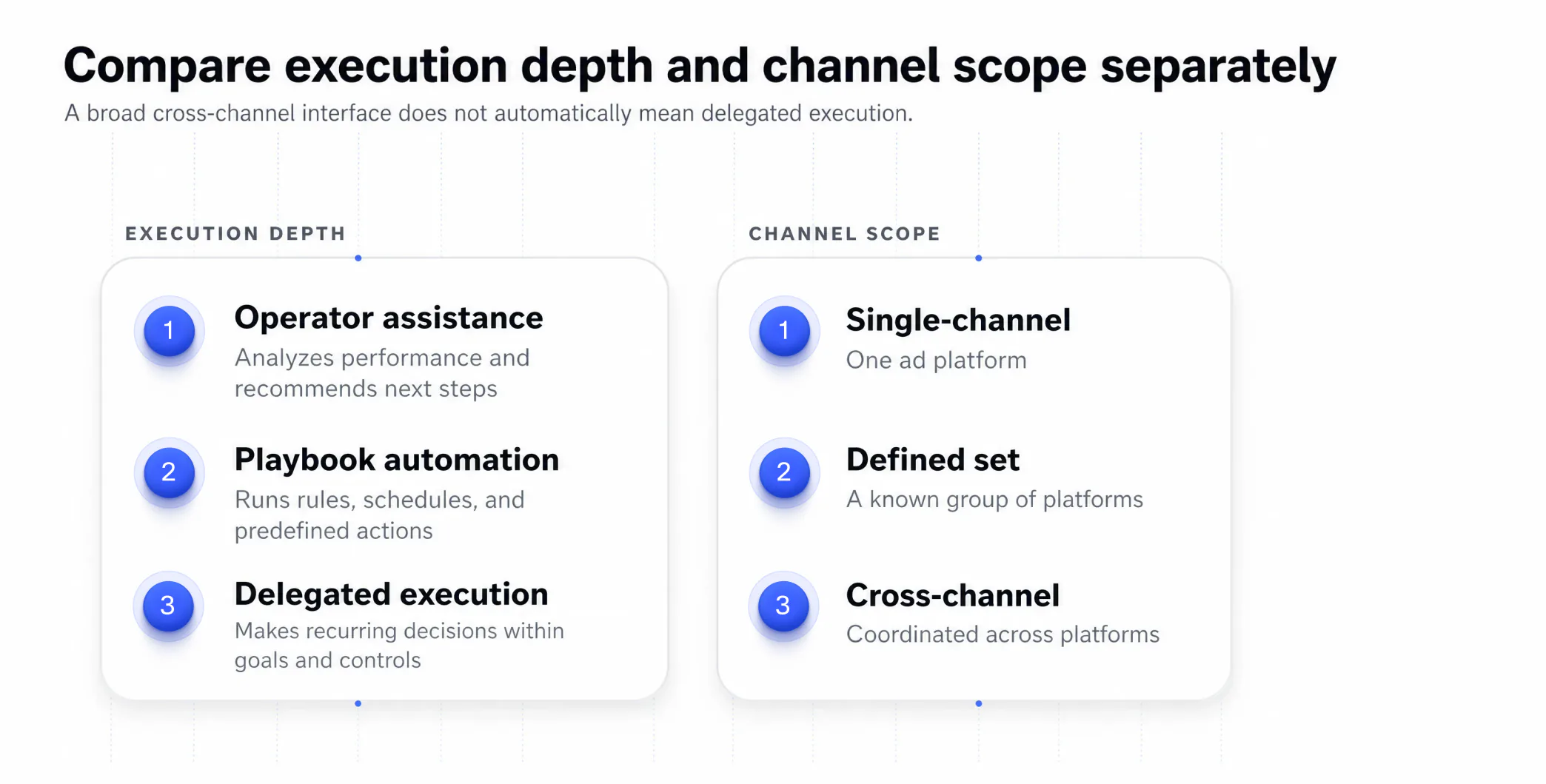
A common buying mistake is to treat “cross-channel” and “agentic” as the same thing. They are separate decisions. A product can see several platforms without owning recurring execution. Another product can automate a lot of work while staying concentrated in one channel.
A practical way to narrow the shortlist
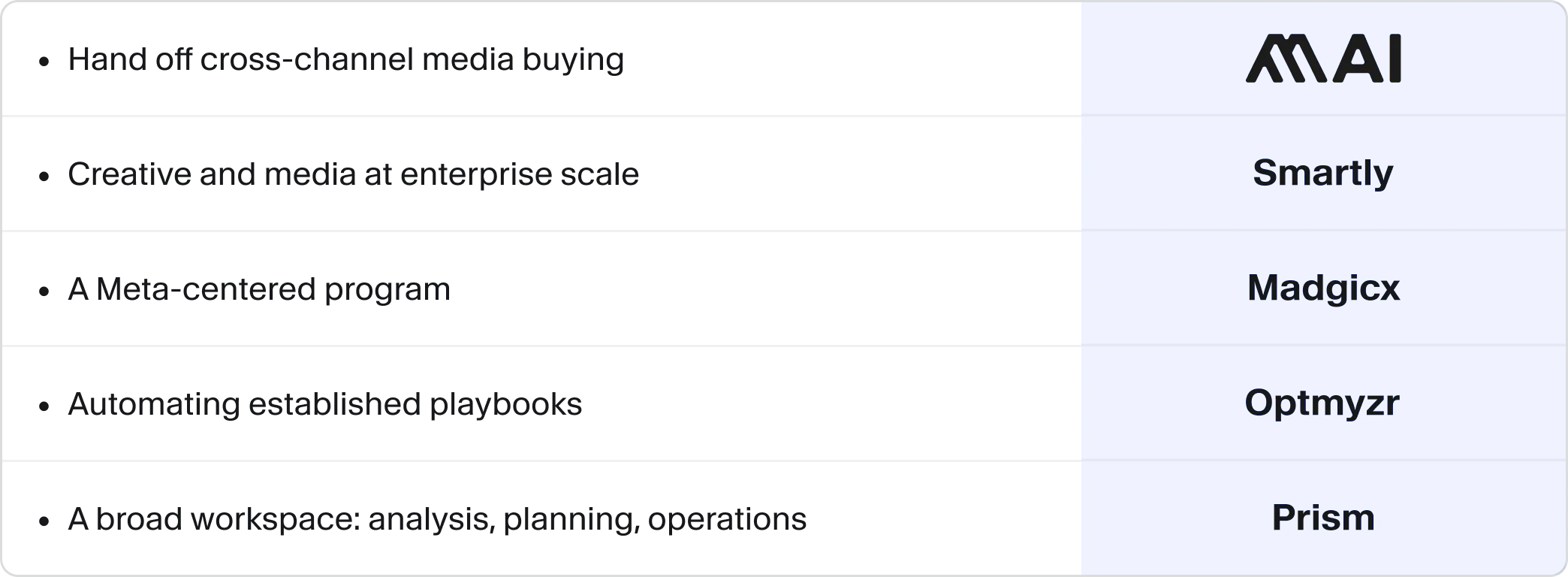
If the goal is to hand off more of ongoing cross-channel media buying, start with MAI. If creative production and media orchestration have to live together at enterprise scale, Smartly is the more natural fit. For a Meta-centered program, Madgicx is the specialist. For an experienced PPC team automating established playbooks, Optmyzr is strong. If you want a broad performance-marketing workspace that spans analysis, planning, and campaign operations, Prism is worth evaluating.
The buying decision is about operating responsibility
Feature lists are useful once you know what job you are buying for. Before comparing dashboards, agents, or automation libraries, decide which parts of the media-buying loop should stay with the team and which parts the software should own.
If your constraint is recurring cross-channel media-buying work, see how MAI handles continuous optimization while your team keeps control of the goals and boundaries.
For a deeper category definition, read What Is an AI Performance Marketing Agent.
Frequently asked questions
What is the best AI media-buying tool?
There is no universal winner. The right choice depends on the work you want the system to take on, the channels it must support, and how much operator review you want around execution.
Can AI media-buying tools manage campaigns automatically?
Some can. Automation depth varies from recommendations, to predefined rules and scheduled workflows, to agentic systems that can make and execute recurring decisions inside connected accounts. Buyers should ask exactly which actions are supported on each platform and what approval or guardrail model applies.
What is an agentic media-buying tool?
An agentic media-buying tool carries work beyond analysis or recommendations. It can make decisions and take actions in ad accounts within defined objectives, permissions, and controls, then continue monitoring what happens next.
Can these tools work across Meta and Google Ads?
Several products in this guide connect to both platforms, but “supports both” can mean very different things. One product may analyze both, another may automate workflows on both, and another may execute only a subset of actions on one of them. Verify the task-level scope, not only the integration logo.
How are these tools different from Meta Advantage+ and Google Performance Max?
Advantage+ and Performance Max automate decisions inside their own platform ecosystems. The products in this guide sit at a different layer: they help teams work across platforms, coordinate workflows, add business context, or manage a broader part of the media-buying function.
See how MAI would run recurring decisions in your accounts
If recommendations still wait on a person, or each platform is managed separately, MAI can show how the decision and approval loop would work.
Similar articles
Your Ad Platforms Don't Talk to Each Other. Your AI Agent Should.
- AI Media Buying
- Cross-Channel Marketing
- Paid Media
- Media Buying
- AI Agents
Google and Meta optimize their own ecosystems. An AI agent connects cross-channel signals to better creative and budget decisions.
Where Should the Next Dollar Go?
- Budget Allocation
- Marketing Mix Modeling
- Marginal ROAS
Measure what your spend drives, compare the return on the next dollar, and validate the decision with incrementality experiments.
What Is an AI Performance Marketing Agent?
- AI Agents
- AI Media Buying
- Performance Marketing
- Paid Media
- Marketing Automation
An AI performance marketing agent continuously monitors paid media, works out what changed and why, and can carry decisions through to action within defined permissions.