
How Promotions and LTV Should Change Media Buying
A promotion can make CPA look better while changing margin, product mix, payback, and the long-term value of the customers you acquire.
A 20% sale goes live and paid media immediately looks healthier. Conversion rate rises. CPA drops from $60 to $48. Branded search reports its best ROAS in months.
There may be room to spend more. But the discount has changed the economics behind every conversion. The business is collecting less revenue on the first order, some products may carry less margin than others, and the customers responding to the sale may behave differently after it ends.
The account may well have improved. The next spending decision depends on whether another customer is still worth acquiring at the new price and margin, under the conditions created by the promotion.
A lower CPA does not settle the economics
Suppose a campaign previously acquired customers for $60 on a $100 order. During the promotion, CPA falls to $48, but the customer now pays $80. The conversion is cheaper, but it is attached to a smaller first order.
That can still be an attractive trade. A stronger conversion rate may create enough additional contribution to offset the discount. The sale may also help clear inventory or bring in customers who return at full price. None of those outcomes can be inferred from CPA alone.
This is a specific application of margin-aware media buying. Before the promotion begins, set the acquisition economics that apply during the event: discounted price, expected product mix, variable margin, fulfillment costs, budget limits, and any willingness to accept lower first-order profit for a strategic reason.
Before and during the promotion
Lifetime value can expand the acquisition limit
Two promotion campaigns can acquire customers at the same $48 CPA and still create different value. Customers entering through one product or offer may buy once and disappear. Another group may replenish, subscribe, or return at full price. If that difference is real and persistent, the business can rationally pay more for the second customer.
The evidence needs to match the size of the decision. A small test budget can work with an early directional signal. Raising the allowable CPA across a large account requires a mature cohort, enough customers, and a value difference that survives longer observation.
Payback matters as much as the eventual total. A customer who produces $500 over three years may be valuable but difficult to acquire aggressively if the business pays for media today and waits 18 months to recover the cost. Promotion planning should state the acceptable payback period alongside the LTV assumption.
Do not borrow LTV from the wrong customers
Company-wide LTV is usually too broad for a promotion-period media decision. It averages customers acquired through different products, prices, offers, and channels. Promotion customers may not resemble the full-price customers who created the historical average.
Use the most relevant stable cohort available. If the decision concerns customers acquired through a discounted starter product, look at downstream behavior from comparable products and offers. If the difference appears only in one geography or acquisition source, keep the decision at that level.
Use a comparable cohort
When customer value cannot be tied back to something the media buyer can change, it still helps with planning. It should not be used to tune individual campaigns as though the mapping were precise.
The sale changes customer economics across three windows
- Selling price
- Discount and margin
- CPA and AOV
- Product and channel mix
- Inventory capacity
- Demand capture vs. creation
- Repeat purchase
- Payback period
- Observed customer value
During the promotion, watch where the lift is coming from
A promotion can improve many parts of the account at once. Meta conversion rate may rise because the offer removes hesitation. Shopping demand may shift toward the deepest discounts. Branded search may capture people prompted by email, affiliates, organic social, or prospecting media.
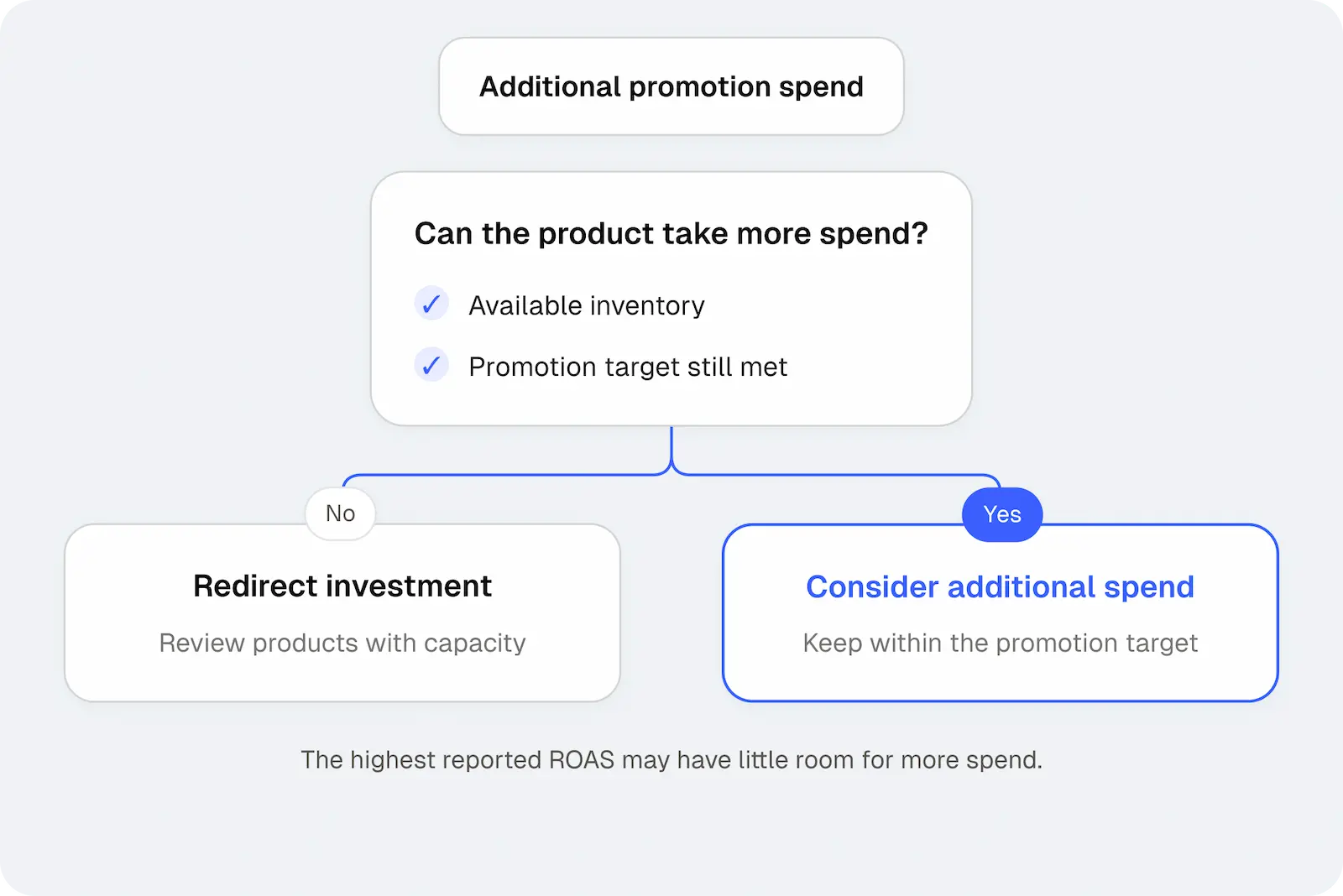
A channel with the highest reported ROAS may have little room to absorb the next dollar. Look for the campaigns and products that can take additional spend while still meeting the promotion-specific target. This requires a marginal allocation decision rather than a ranking of historical averages.
Inventory puts a practical ceiling on the answer. If a discounted SKU is close to selling out, continuing to push it may create fulfillment problems or displace demand the business could have captured without more media. Redirecting investment toward products with capacity may produce a better result even if their platform ROAS looks lower.
Where to allocate additional promotion spend
Separate demand creation from easier demand capture
A sale increases purchase urgency across channels. Brand Search often benefits because more people are already looking for the company. That does not mean every additional dollar in the branded campaign created the demand it converted.
Before expanding demand-capture campaigns aggressively, ask what would have happened without the extra spend. A controlled incrementality test can help distinguish additional demand from conversions that would have arrived anyway. During a short promotion, the practical answer may be to protect coverage while reserving the larger budget increases for places where evidence of incremental reach is stronger.
Evidence patterns and the likely response
| What the evidence shows | Likely media response | Why |
|---|---|---|
| Healthy promotional margin and sustained incremental volume | Scale within the promotion budget and inventory limits | The next customers still meet the promotion target |
| Lower CPA but weaker margin or lower-value product mix | Hold or redirect spend | Front-end efficiency is overstating business value |
| Strong repeat value in a mature, attributable cohort | Allow a higher acquisition tolerance where actionable | Downstream value supports paying more for that customer |
| High estimated LTV but long or uncertain payback | Scale cautiously or keep testing | Cash and forecast risk still constrain growth |
| Branded demand rises after broad promotion exposure | Test incrementality before funding capture aggressively | Reported return may include demand created elsewhere |
| Inventory tightens on the products absorbing demand | Shift product emphasis or reduce exposure | The business cannot profitably fulfill unlimited demand |
After the promotion, reset the account and study the cohort
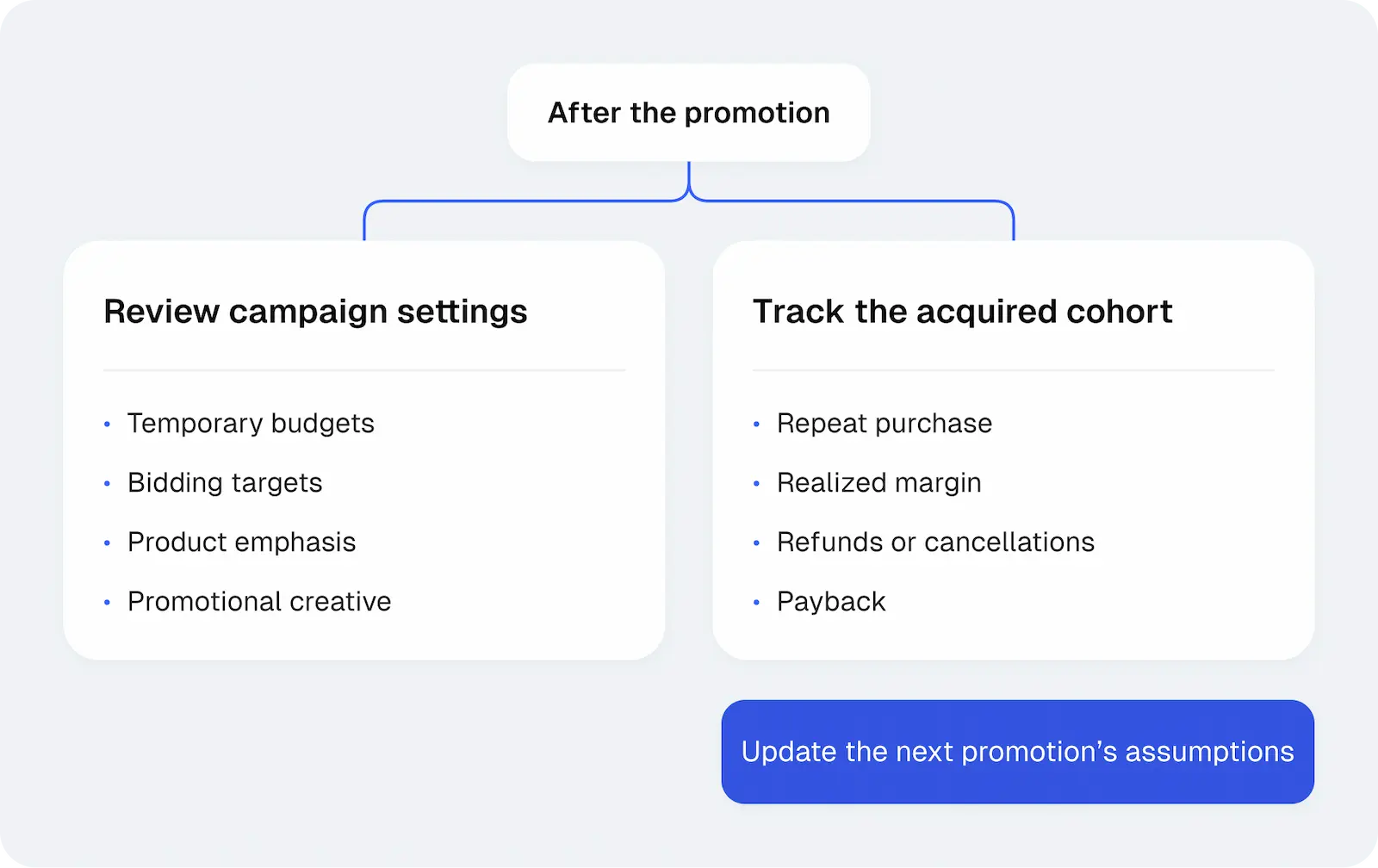
Promotional performance should not become the new baseline. Once the offer ends, conversion rate and branded demand can normalize quickly. Temporary budgets, bidding targets, product emphasis, and promotional creative need explicit review rather than being left in place by accident.
The promotion may also pull demand forward. Some customers who bought during the event would otherwise have purchased later at full price. That makes the immediate revenue lift a poor substitute for a longer view of incrementality and customer value.
Keep the acquired cohort visible after the campaign window closes. Compare repeat purchase, realized margin, refunds or cancellations where relevant, and payback with the assumptions used to justify the spend. The result should update the economics of the next promotion instead of disappearing into a post-sale deck.
How MAI can carry the context into media decisions
MAI can incorporate supplied context such as promotions, margins, inventory, customer value, business goals, efficiency targets, and account history alongside paid-media performance. That gives the agent a better basis for evaluating which campaigns or products deserve more or less investment during the promotion.
Customer story See how Fanka lifted peak-season Shopping ROAS 25% on stable spend.
Depending on the platform and account configuration, the output may be an investigation, a recommendation, a reviewable proposal, or a supported action. Teams set the commercial objective and operating constraints, including which changes require review. Higher-consequence budget decisions can remain reviewable.
The economics set before the promotion can remain attached to the day-to-day account work. As performance, inventory, and customer evidence changes, MAI can use that context in the next decision.
Context for MAI media decisions


 + more

Set the scaling rule before the promotion starts
Before the next promotion, decide which customers and products are worth acquiring, how much first-order margin the business can trade, what payback it will accept, where inventory creates a ceiling, and what evidence would justify more spend.
Then define the reset. Specify which budgets, targets, and creative should return to normal when the offer ends, and when the promotion cohort will be reviewed.
A lower CPA is useful evidence. The full customer economics determine whether it deserves more money.
Carry promotion economics into the account
Similar articles
Ad Platforms Solve for Volume. Who Solves for Your Margin?
- Performance Marketing
- Paid Media
- AI Media Buying
- Media Buying
- Profitability
Google and Meta optimize advertising performance at scale. Profitable growth requires bringing business economics into each media decision.
Where Should the Next Dollar Go?
- Budget Allocation
- Marketing Mix Modeling
- Marginal ROAS
Measure what your spend drives, compare the return on the next dollar, and validate the decision with incrementality experiments.