
How MAI's Microsoft Agent Keeps Microsoft Ads Current
Importing campaigns from Google gets Microsoft Ads running. It does not keep the account maintained as performance changes.
Most performance marketers do not ignore Microsoft Ads. They give it whatever attention remains after Google.
The account may have started with a Google import. It is live, spending, and producing conversions. Google still gets the daily checks, search-term work, budget adjustments, campaign maintenance, and product review. Microsoft gets opened when something looks wrong or someone finds time.
That tradeoff can be reasonable when Microsoft represents a small part of the media mix. It becomes expensive once the account has enough spend and complexity for delayed decisions to matter. Keywords drift. Product performance changes. Budgets remain fixed after the evidence has moved on.
MAI's Microsoft Agent is designed for this coverage gap. It applies a consistent operating process to Microsoft Search and Shopping while making decisions from the evidence inside Microsoft. The team sets the goals, budget, scope, and controls. The agent keeps the recurring work moving.
Why Microsoft falls behind, and how MAI keeps it current.
The same three changes: weeks of waiting with manual reviews, handled in the next cycle with MAI.
A Google import solves setup, not stewardship
Importing a campaign is useful because it removes a large amount of initial setup. Campaign structure, keywords, and product groups can reach Microsoft quickly. That starting point still reflects a decision made somewhere else, at an earlier moment.
Once the campaign begins running, Microsoft produces its own evidence. The audience mix, auction conditions, conversion volume, delivery, and product response may differ from Google. A keyword that deserves more budget in Google may still have too little Microsoft data to support the same move. A strong Google Shopping SKU may be ordinary on Microsoft.
Copying every subsequent Google decision would ignore those differences. Leaving the imported structure untouched creates another problem: the account slowly becomes a record of old assumptions. Microsoft needs the same standard of attention as the rest of the media program, even when it does not justify the same number of human hours.
Identical at setup, different after launch
The import copies the structure. After launch, Microsoft's own data points to different decisions.
The Microsoft Agent keeps a separate evidence loop running
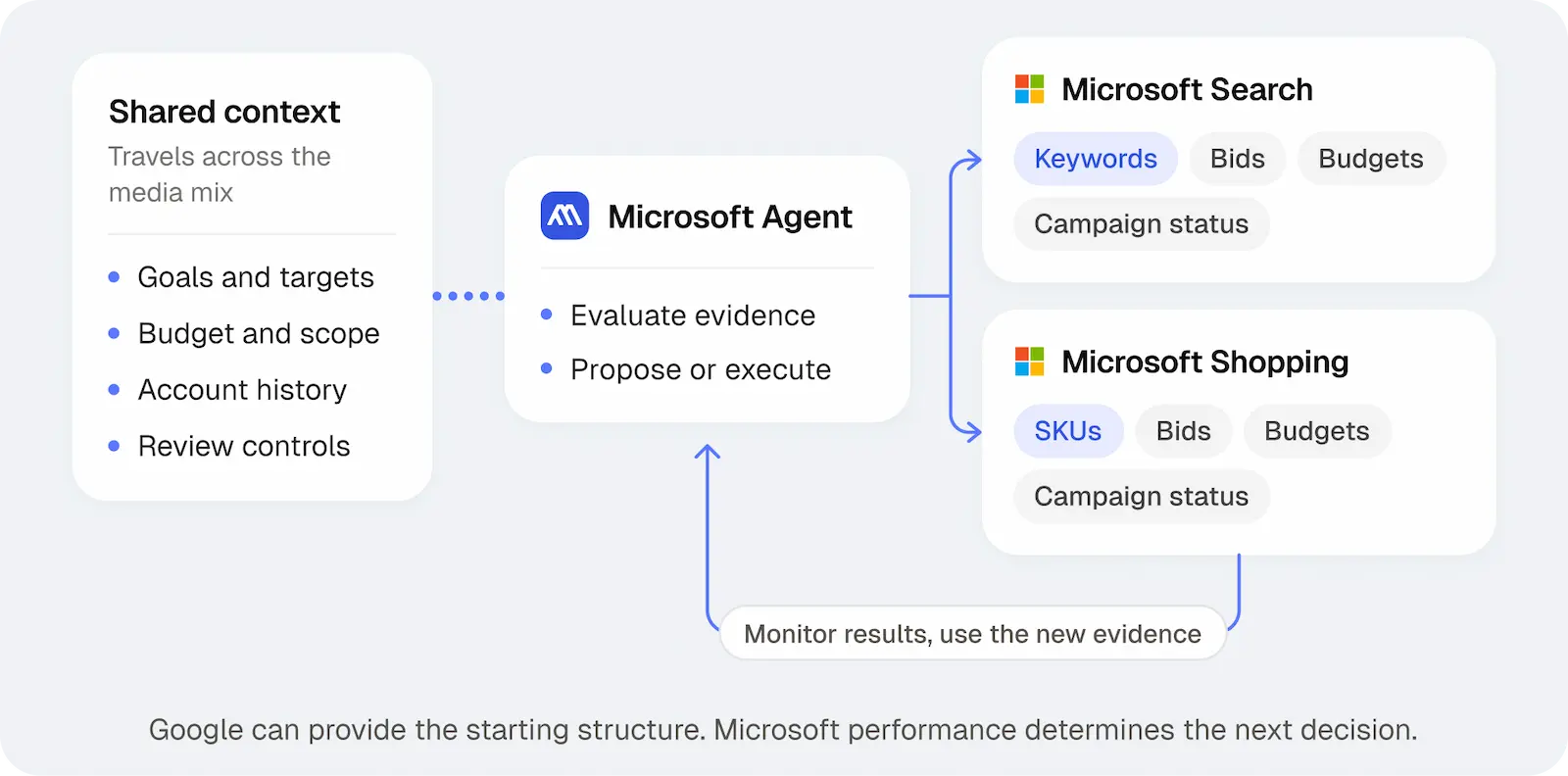
MAI carries the connected account history, business context, goals, and operating controls into its Microsoft workflows. It then evaluates Search and Shopping using the levers supported by each campaign type.
For Microsoft Search, supported work includes bid and budget tuning, adding or pausing keywords, and pausing or re-enabling campaigns. For Microsoft Shopping, the unit of work shifts to products: MAI can tune supported bids, budgets, and SKUs, and pause or re-enable campaigns.
The process is familiar: observe performance, evaluate the evidence against the Media Plan, prepare or apply a supported change, and monitor what happens next. The value comes from keeping that loop active when the team would otherwise review Microsoft only intermittently.
This fits a broader cross-channel operating model in which each platform contributes its own evidence. Shared business goals should travel across the media mix. Platform decisions should remain sensitive to the account where they will be executed.
One operating standard, two Microsoft workflows
Shared business context guides separate Search and Shopping decisions.
What continues after the Google import
| Operating job | Google import provides | Microsoft Agent continues |
|---|---|---|
| Campaign setup | A fast starting structure | Ongoing evaluation inside Microsoft |
| Search | Imported campaigns and keywords | Supported bid, budget, keyword, and campaign-status decisions |
| Shopping | Imported product campaigns | Supported bid, budget, SKU, and campaign-status decisions |
| Controls | Initial account configuration | Media Plan scope, review settings, and change history |
Search maintenance should not wait for a manual account sweep
Microsoft Search creates a steady queue of small decisions. A keyword begins absorbing spend without enough value. Another has built enough evidence to deserve more room. A campaign is underpacing, or its target no longer matches the current plan.
None of these moments necessarily calls for a new channel strategy. They call for attention. MAI can evaluate supported bids, budgets, keywords, and campaign status inside the Media Plan rather than waiting for the next time someone works through the account by hand.
Small changes can run on an approved schedule when the configuration allows it. Higher-consequence proposals can remain reviewable. This keeps routine maintenance moving without treating every adjustment as a fresh strategic decision.
Shopping needs product-level decisions
Microsoft Shopping has the same coverage problem at a different level. The account needs regular decisions about products and SKUs rather than keywords alone. A product that looked strong at launch may lose efficiency. A newer SKU may deserve more exposure. Another may continue spending long after its economics have weakened.
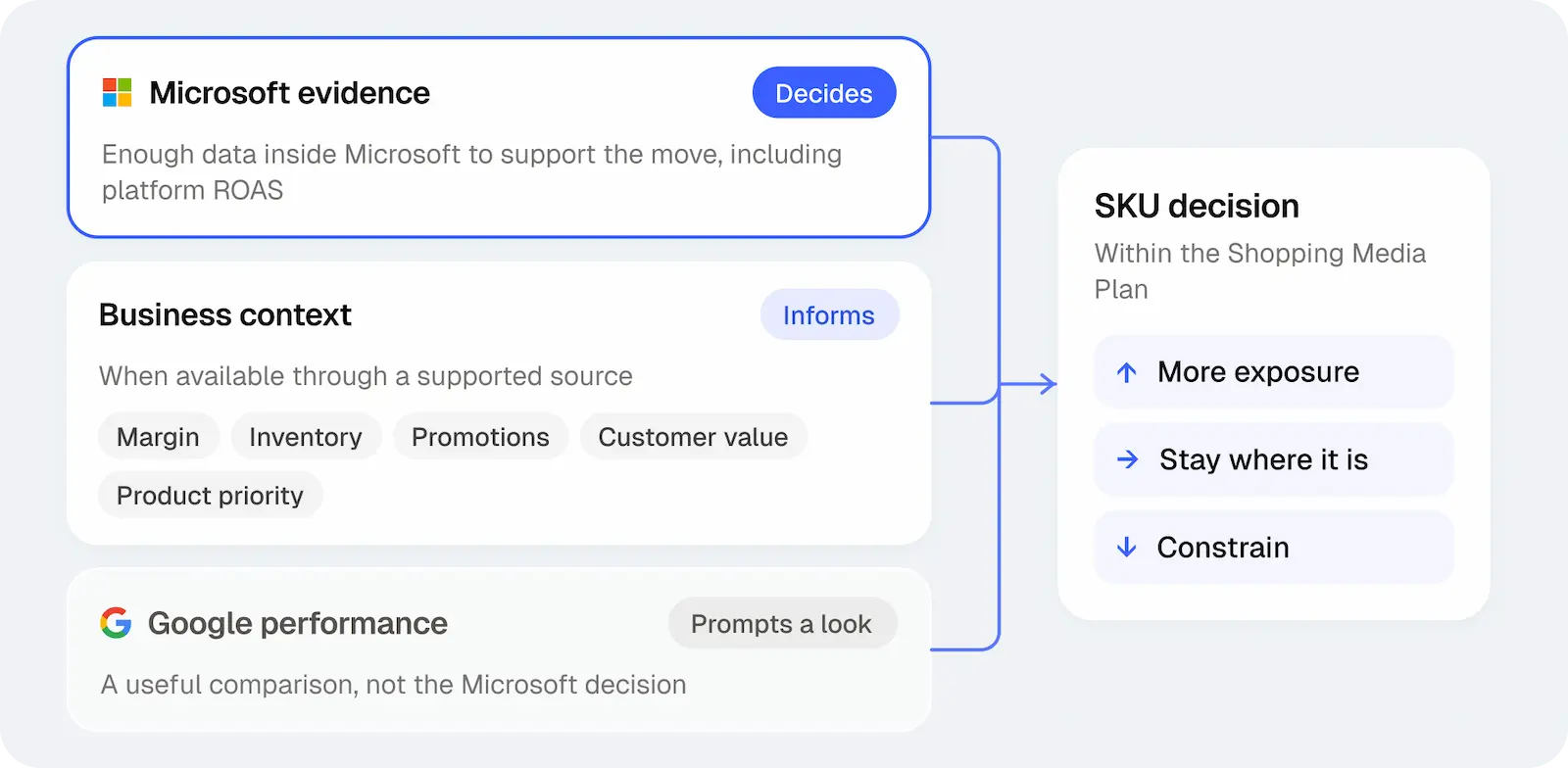
The Microsoft Agent can tune supported bids, budgets, and SKUs within the Shopping Media Plan. When margin, inventory, promotions, customer value, or product priority are available through a supported source, that business context can inform the recommendation or tuning decision. Platform ROAS remains useful, but it is not the only fact the business cares about.
Google performance can provide a useful comparison or prompt an investigation. It does not settle the Microsoft decision. The agent still needs enough evidence from Microsoft to decide whether the SKU should receive more exposure, stay where it is, or be constrained.
Microsoft evidence decides the SKU
Business context informs the call. Google performance only prompts a closer look.
Budget decisions stay inside an approved envelope
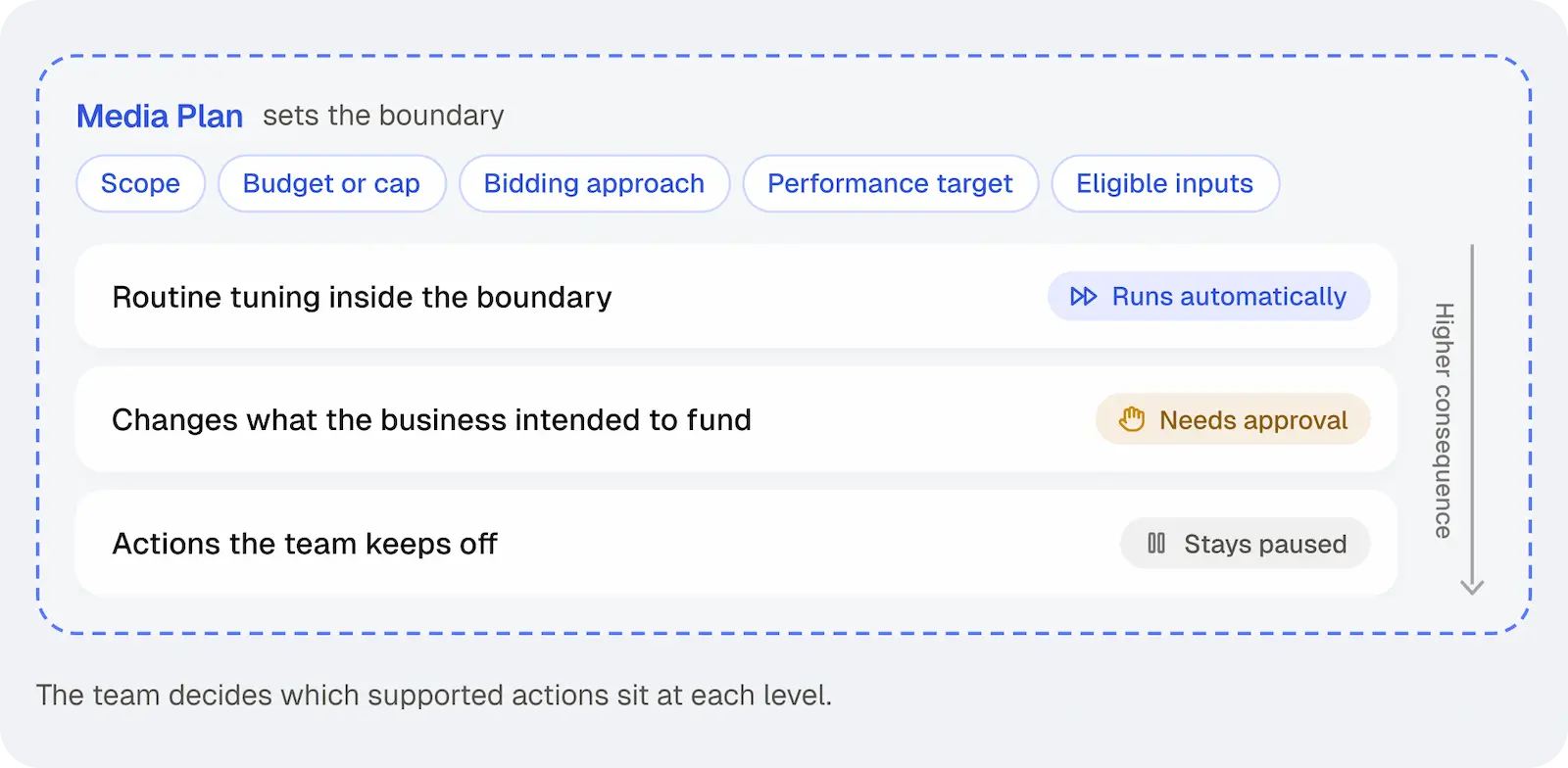
The Media Plan defines the account and campaign scope, budget or cap, bidding approach, performance target, and eligible inputs. Those settings create the boundary for ongoing Microsoft work.
Routine tuning inside that boundary is easier to delegate. A proposal that changes what the business intended to fund deserves more scrutiny. Teams can decide which supported actions run automatically, which require approval, and which remain paused. The appropriate level depends on the consequence of the change and the context available to the agent.
This is the same control principle described in When Should You Let AI Change Your Ad Budgets?. Microsoft may be a smaller channel, but its spend still belongs inside an explicit budget and authority structure.
The Media Plan is the boundary.
The Media Plan sets the boundary. The team decides which actions run automatically, need approval, or stay paused.
Consistency does not require identical decisions
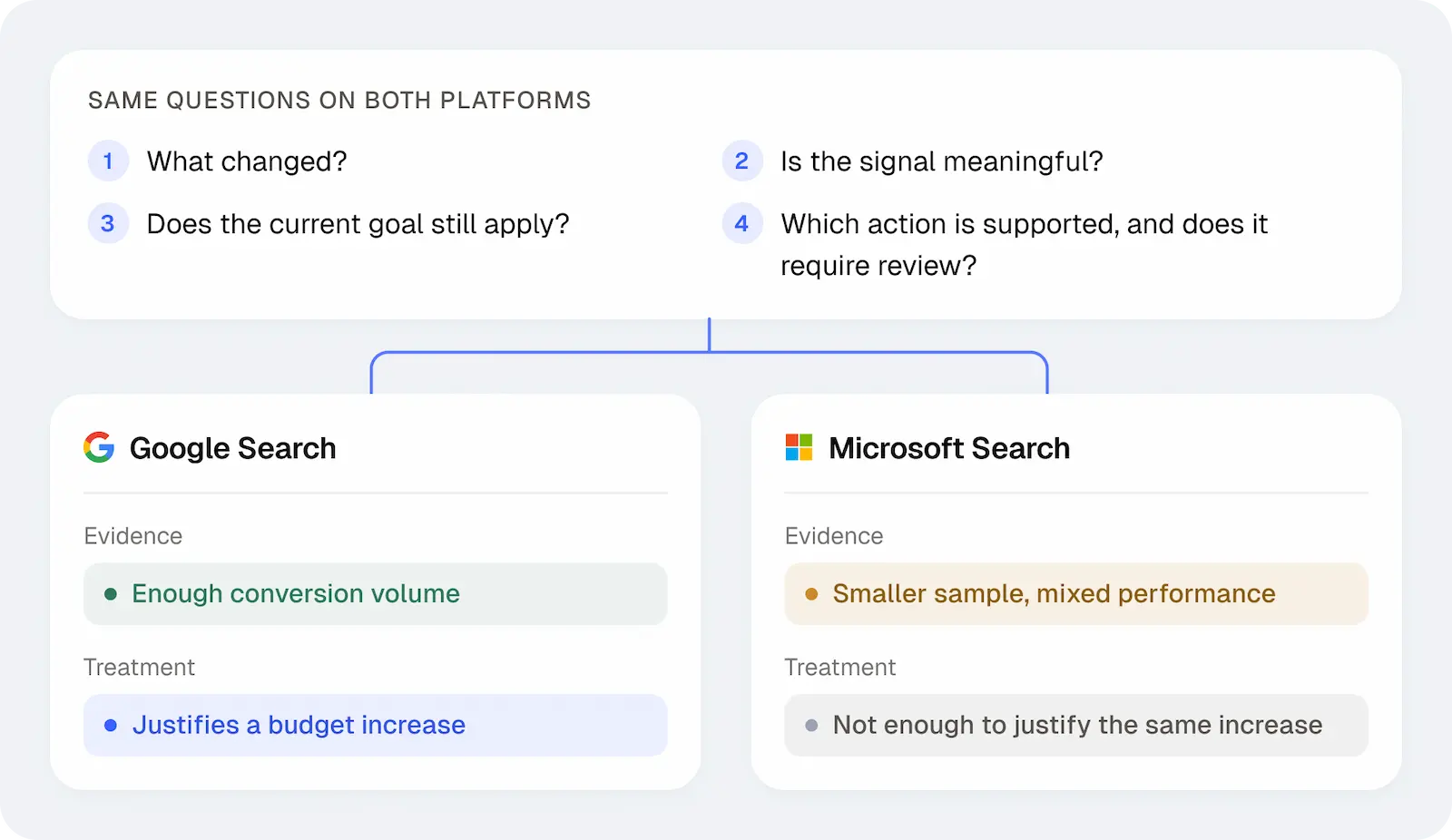
A shared operating model means the same questions are asked across platforms: What changed? Is the signal meaningful? Does the current goal still apply? Which action is supported, and does it require review? The answer can be different in every account.
Suppose similar Search campaigns run on Google and Microsoft. Google has enough conversion volume to justify a budget increase. Microsoft has a smaller sample and mixed performance. The process is consistent across both platforms; the evidence supports different treatments.
This distinction matters when teams use automation. Static rules often preserve an earlier judgment even after conditions change. An agent can evaluate the present context before choosing among the supported actions. The difference is explored more fully in Why AI Agents Are Replacing Rules-Based Media Buying.
Same four questions, different budget decisions
Google has enough conversion volume to justify an increase. Microsoft's smaller sample and mixed performance do not.
The team remains responsible for the channel strategy
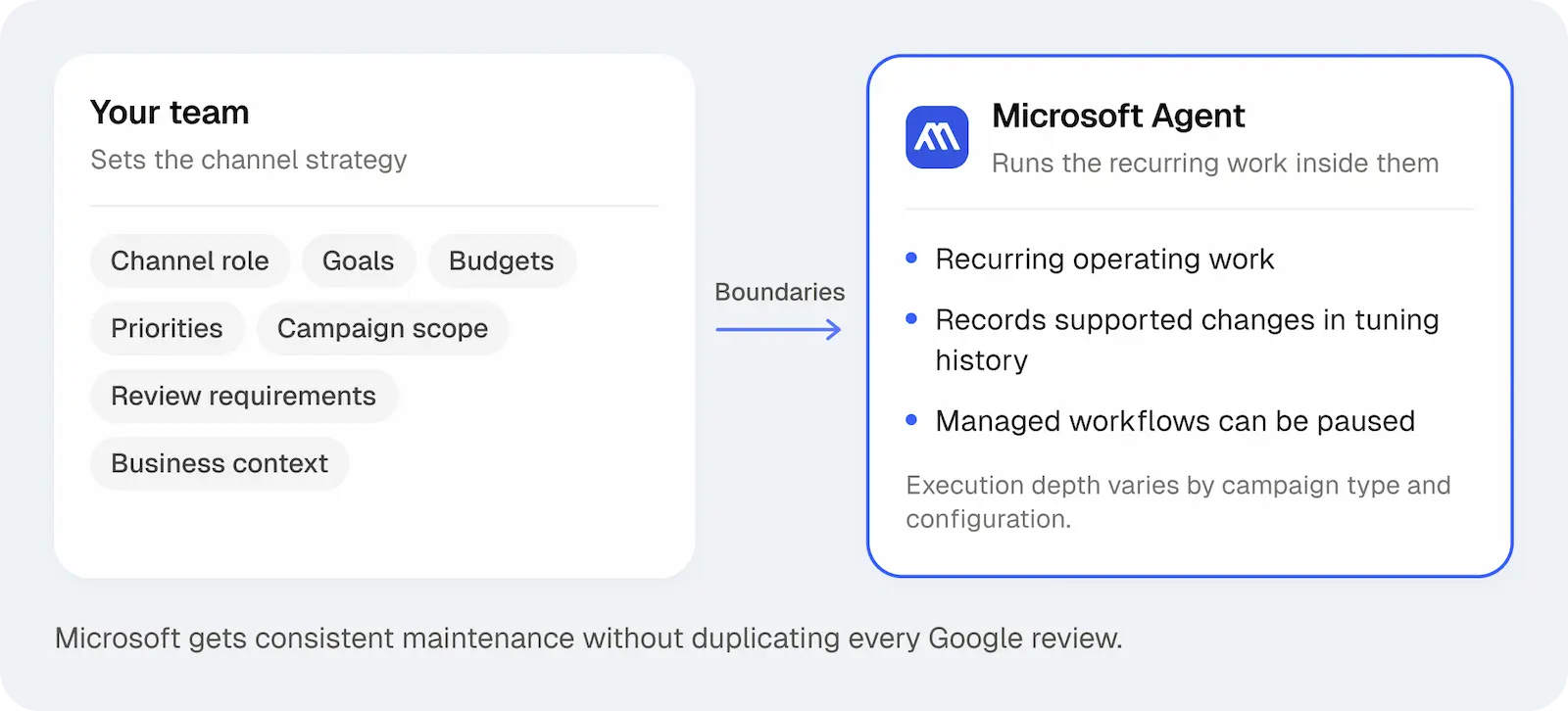
MAI does not decide how important Microsoft should be to the business. The team sets the channel role, goals, budgets, priorities, campaign scope, and review requirements. It also supplies the business context needed for decisions that go beyond platform metrics.
The agent handles more of the recurring operating work inside those boundaries. Supported changes are recorded in tuning history, and managed workflows can be paused when necessary. Execution depth varies by campaign type and configuration, so the intended Microsoft setup should be confirmed before launch.
That division is practical for a secondary channel. Microsoft receives consistent maintenance without requiring the team to duplicate every Google review manually or pretend the two platforms should make the same decision.
Start with one Microsoft workflow that is falling behind
Choose an existing Microsoft Search or Shopping campaign where maintenance is visibly inconsistent. Configure the Media Plan, define the target and budget, confirm the supported actions, and decide what should run automatically or require review.
Then judge the workflow on a simple standard: does Microsoft stay current as the evidence changes, without depending on someone remembering to check it after the Google work is done?
See how MAI's Microsoft Agent maintains the account
Similar articles
Your Ad Platforms Don't Talk to Each Other. Your AI Agent Should.
- AI Media Buying
- Cross-Channel Marketing
- Paid Media
- Media Buying
- AI Agents
Google and Meta optimize their own ecosystems. An AI agent connects cross-channel signals to better creative and budget decisions.
When Should You Let AI Change Your Ad Budgets?
- AI Media Buying
- Budget Allocation
- AI Agents
- Performance Marketing
- Paid Media
Learn which budget changes AI can automate, when human review is needed, and how to set practical guardrails.