
How MAI's Meta Agent Decides Which Ads Get More Budget
A new test, a proven winner, and a declining ad have earned different levels of investment. A well-run Meta account should treat them that way.
A new Meta ad and a proven winner have not earned the same budget. One has barely delivered. Another has held performance as spend grew. A third still converts, but its advantage is fading.
They may sit beside one another in Ads Manager, yet each needs a different operating decision. The new ad needs protected room to learn. The winner needs enough budget to matter. The declining ad needs to give up share before it quietly consumes another week of spend.
MAI’s Meta Agent manages those transitions inside a Media Plan. It can organize creative into test cells, move supported winners into higher-investment campaigns, reduce weaker ads, and bring fresh candidates into the workflow. Meta still controls delivery within its platform. MAI manages the operating decisions around what gets tested, promoted, reduced, or retired.
A Meta account is a portfolio, not a flat list of ads
Most teams already know they should test creative. The harder part is protecting the test while a proven ad is competing for the same budget. If every ad is treated equally, weak ideas can waste money. If budget follows only recent performance, incumbents can absorb delivery before a new concept has a useful chance to prove itself.
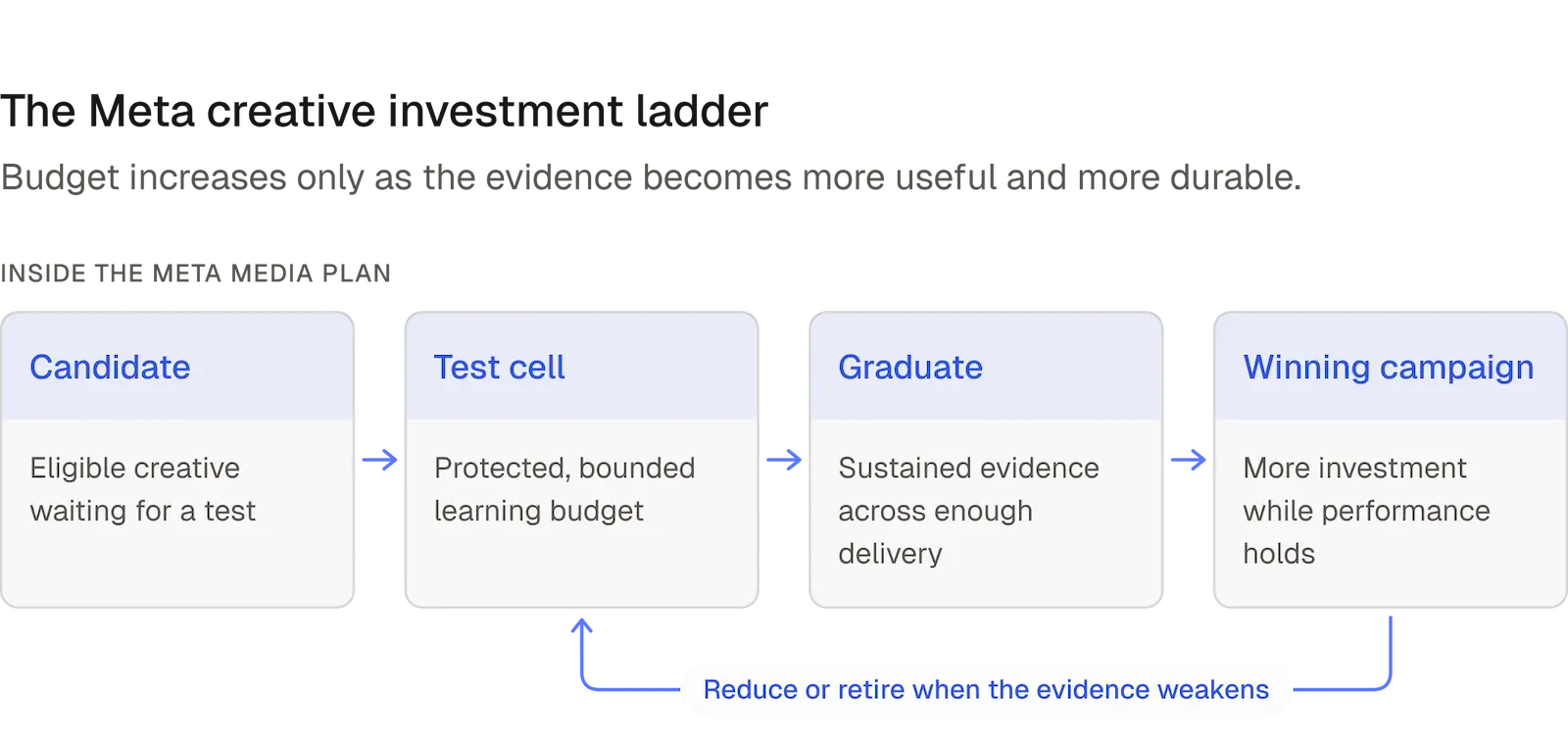
The practical answer is a creative hierarchy. Candidates wait for a defined test. Testing ads receive bounded learning spend. Graduated ads receive more investment because their evidence is stronger. Declining ads lose share or leave the active portfolio.
This is the account-level mechanism behind the broader idea that creative matters more when everyone has similar algorithms. The advantage does not come from producing more files alone. It comes from giving the right ideas a fair test and acting on the result.
Test cells protect learning without starving winners
A test cell is a controlled part of the Meta setup where eligible new ads can gather evidence without immediately competing for the full account budget. The spend is intentional and bounded: enough to learn, but not an open-ended subsidy for every new concept.
That middle state matters because early results are noisy. A new ad may look weak after limited delivery. Another may open with a handful of conversions and appear exceptional. Neither result is automatically durable. The Meta Agent can keep an uncertain ad in testing, graduate it when evidence holds, or reduce it after it has received a meaningful opportunity.
The team does not need one universal test budget or a rigid number of days. The Media Plan carries the account context: eligible creative, performance target, budget, campaign structure, and review settings. MAI uses that context to manage the workflow rather than applying the same threshold to every advertiser.
Graduation should be earned
Graduation is the point at which an ad moves from protected exploration into a higher-investment campaign or budget tier. It is not a prize for the best first-day result. It reflects evidence that is strong enough, consistent enough, and relevant to the Media Plan target.
The distinction helps the account avoid two common mistakes: scaling a lucky spike and underfunding a real winner. Once an ad graduates, MAI can increase its share while continuing to monitor it. The move can happen within supported campaign-budget or ad-set-budget structures, including CBO and ABO configurations.
How the Meta Agent changes an ad’s treatment
| State | What the evidence says | Budget treatment | Next decision |
|---|---|---|---|
| Candidate | Eligible, but not yet tested | No scale budget yet | Place in a controlled test |
| Testing | Promising, mixed, or still thin | Protect bounded learning spend | Graduate, continue, or reduce |
| Winner | Strong enough and sustained | Increase share while results hold | Keep monitoring for decline |
| Declining | Advantage is weakening | Reduce share or stop further spend | Retire or replace with a candidate |
Budget should follow confidence, not habit
Once the creative states are clear, budget allocation becomes easier to explain. Testing receives a protected allowance. Graduated creative receives more investment. Strong ads keep earning share while results hold. Declining ads release budget back to the portfolio.
This does not mean endlessly scaling anything that looks good. Every increase still sits inside the Media Plan budget and target. It also does not mean MAI replaces Meta’s auction or delivery system. Meta decides how impressions are delivered inside the platform; MAI decides how the advertiser’s approved operating structure should change as evidence accumulates.
The same principle applies whether the account uses campaign budget optimization or ad set budgets. The implementation changes, but the decision remains recognizable: invest more where the evidence is durable, reserve enough money to keep learning, and stop protecting weak creative out of habit. For a broader view of these controls, see When Should You Let AI Change Your Ad Budgets?
A winner should lose share before it collapses
Creative fatigue rarely arrives as a clean switch from “working” to “failed.” A strong ad may continue converting while its efficiency gradually softens. Teams often keep it running because it is still better than the alternatives, or because nobody has a clear replacement ready.
The portfolio model creates another option. A declining winner can surrender budget gradually while fresh candidates receive controlled tests. If a candidate builds stronger evidence, it can graduate. If none does, the current winner can remain active at an appropriate level while the next ideas enter the queue.
This turns replacement into an ongoing process rather than an emergency response. The account starts learning about the next creative before it urgently needs one.
Fresh creative can enter without rebuilding the plan
Creative enters MAI through the Asset Library. When an asset is available to Meta, tagged for the right client, and included by the Media Plan’s eligibility rules, it can become a candidate for testing. Tag-based eligibility can allow newly added creative to enter the pool without rebuilding the plan each time.
The Meta Agent can then create reviewable new-ad proposals, launch structured test cells, pause losing ads, scale supported winners, graduate or retire creative, and adjust budgets across testing, graduation, and winning campaigns. The workflow stays connected to the approved Media Plan, so a new file does not become an ungoverned campaign change.
The team still owns the consequential choices
MAI does not decide what the brand should say or which concept the team should produce next. Marketers define the eligible creative, budget, target, timing, and scope. They also decide which supported actions can run automatically, which require review, and which remain paused.
A practical starting point is to keep new-ad creation reviewable so the team can inspect the copy and setup before launch, while allowing lower-risk tuning within approved boundaries. As trust grows, the workflow can change. The control model is part of the Media Plan, not a blanket setting for the entire account.
This division keeps human judgment where it matters most: what to make, what the business needs, and how much consequence the agent may carry. MAI handles the repetitive account work required to move creative from candidate to test, from test to scale, and from decline to retirement.
Customer story See how Flamingo handed MAI a significant share of its Meta ads.
Start with one Meta creative workflow
Choose a part of the account where new ads arrive regularly but testing and budget movement still depend on manual follow-up. Define the eligible assets, campaign structure, budget, performance target, and review settings. Then look for a simple result: every active ad should have a clear state and a defensible next decision.
A better Meta account does not give every ad equal treatment. It gives each ad the investment its current evidence has earned, and keeps making room for the next idea to prove itself.
Similar articles
How an AI Agent Turns Creative Files Into Campaign Decisions
- Creative Optimization
- AI Agents
- AI Media Buying
- Campaign Optimization
- Paid Media
See how MAI's Asset Skill adds eligibility, landing-page, and performance context so creative can move into campaign workflows.
When Should You Let AI Change Your Ad Budgets?
- AI Media Buying
- Budget Allocation
- AI Agents
- Performance Marketing
- Paid Media
Learn which budget changes AI can automate, when human review is needed, and how to set practical guardrails.