
AI Media Buying for Home Decor Brands
How product economics, creative evidence, inventory, and long consideration cycles should change the next media decision.
Someone may discover a sofa on Meta, search the brand three days later, compare fabric options on a product page, and buy after a weekend promotion. By then, several campaigns have influenced the purchase, inventory may have changed, and the platform that receives the conversion credit may not be the one that created the demand.
That makes home decor a demanding category to manage through account-level ROAS alone. A $40 candle, a $250 rug, and a $2,000 sectional have different margins, buying cycles, fulfillment constraints, and tolerance for acquisition cost. The account still needs one operating system, but it cannot treat those products as interchangeable.
AI media buying is most useful here when it carries business context into recurring account decisions. The team sets the goals, budgets, product priorities, and limits. The agent monitors what changes, investigates the account, and handles supported work within those boundaries. The place to start is usually visible in last week’s backlog.
Start with a representative week of account work
Before choosing an AI workflow, look at what the team actually completed. The backlog shows whether the constraint is missing strategy or insufficient operating coverage.
| What showed up last week | Operating gap | First decision to delegate |
|---|---|---|
| Pacing issue found late | Monitoring coverage | Which supported campaign needs adjustment within the plan? |
| SKU decision waited on margin or inventory | Business context is disconnected | Which products receive more or less Shopping support? |
| Creative winner weakened without a replacement | Testing cadence is too slow | Which eligible assets receive protected test spend? |
| Meta and Google disagree on credit | Allocation relies on platform attribution | What evidence is required before changing channel spend? |
| Tests or investigations keep slipping | Recurring execution backlog | Which work can run, and which work needs review? |
A useful starting point has a specific decision, accessible evidence, and a clear permission boundary. “Optimize the account” is too broad. “Decide which eligible products should receive more Shopping support this week” is something the team can inspect and improve.
Four inputs can change the next media decision
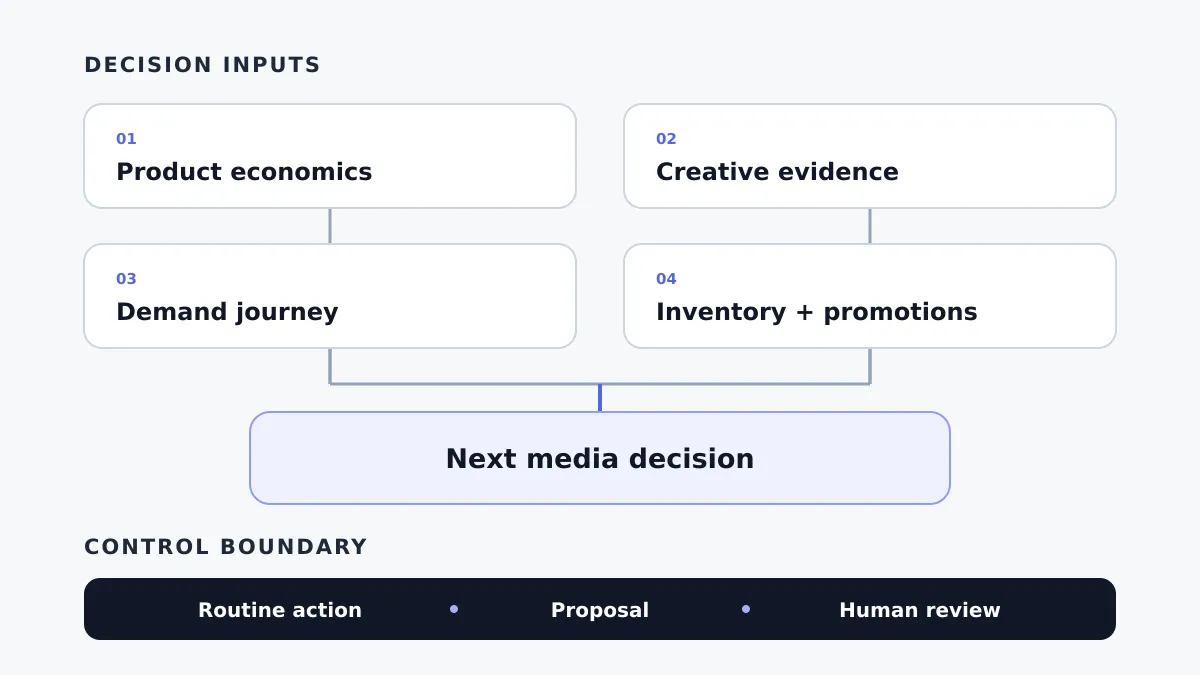
Figure 1 shows why platform-reported performance is only one input. The next move depends on what is being sold, how demand developed, what the business can fulfill, and whether the evidence is strong enough to act.
Treat each product like a different investment
The candle, rug, and sectional should not inherit the same logic simply because they sit in the same catalog. Margin changes the value of a sale. Inventory determines whether more demand is useful. Product role matters too: a hero product, a new collection, and clearance inventory may each need a different target.
Broad campaign averages can hide those differences. A Shopping campaign may look healthy while budget is leaning toward lower-margin products or a strong seller is approaching a stockout. The media decision has to reach the SKU level before those economics can change what happens in the account.
In supported Google Shopping workflows, MAI can compare SKU-level advertising and commerce evidence, distinguish stronger, weaker, and still-uncertain products, and tune supported budgets or bidding targets within a compatible Media Plan. The exact action depends on the campaign structure, approved budget, and current configuration. This is where business-aware media buying becomes operational rather than a reporting exercise.
Build the replacement before the creative winner fades
Home decor depends on visual persuasion, which makes creative fatigue expensive. A strong room setting, product demonstration, or creator-led video can carry an account for weeks. If the team waits for a clear collapse before testing replacements, the next asset begins learning after performance has already weakened.
A controlled test gives eligible creative enough delivery to generate evidence without forcing every new concept directly against established winners. The agent can watch sustained performance, help allocate test spend, and pause or scale supported assets as evidence develops. One weak day should not decide the fate of an asset, and an attractive click-through rate should not outweigh weak downstream behavior.
MAI’s Meta workflows can propose new ads and test cells, adjust budgets across supported testing and winning structures, and tune assets based on sustained trends. The creative team still owns the concept, copy, visual standard, and what to produce next. The workflow makes creative learning more consistent; it does not replace creative judgment.
Separate demand creation from conversion credit
A shopper who discovers a dining table on Meta and later converts through branded Search will often be recorded as a Search conversion. That tells the team where the transaction finished. It does not establish how much incremental demand each channel created.
This distinction matters before cutting discovery spend or moving more budget toward the channel receiving the cleanest conversion credit. Platform ROAS, attribution reports, incrementality testing, and marketing mix modeling answer different questions. Larger allocation decisions deserve evidence that matches the consequence of the move.
MAI can use MMM and Cross-Media-Plan analysis to support contribution estimates, scenario planning, and cross-channel recommendations. Automatic cross-channel execution is not the default and depends on the customer’s workflow and configuration. The resulting recommendation should remain reviewable when the evidence, business context, or authority is incomplete.
Let inventory and promotions override yesterday’s answer
Home decor catalogs move underneath the campaigns. A bestseller runs low in a popular finish. A promotion improves conversion for a week. A new collection needs enough traffic to learn. A bulky item becomes less attractive to push when fulfillment capacity tightens.
Those changes can reverse an otherwise sensible media decision. A product that deserved more budget yesterday may need a cap today. A new collection with limited history may need protected exploration rather than an immediate comparison with mature winners. A promotion may justify more room, but only while the economics and inventory support it.
MAI can use supplied business context such as margin, inventory, promotions, product lifecycle, customer value, and business priority when those inputs are available through a supported source or provided by the team. The value comes from applying current company information before the next bid, budget, SKU, or campaign decision is made.
Map every signal to a decision
Home decor teams often have the necessary information. The operational failure is that the signal arrives too late, reaches the wrong person, or never changes the account. The mapping below turns each input into a recurring decision.
| Signal or condition | Risk if ignored | Decision it should affect |
|---|---|---|
| Uneven SKU economics | Budget favors products with weaker business value | Product targets, caps, and Shopping support |
| Sustained creative fatigue | The account leans on a winner after performance softens | Test spend, scaling, and asset retirement |
| Discovery-to-Search journey | Demand capture receives too much credit | Evidence required before a channel-budget change |
| Inventory or promotion change | Spend follows yesterday’s economics | Product priority and allowable spend |
| New collection or audience | A promising idea is judged before it can learn | Protected exploration budget and review timing |
The table also makes review easier. The team can see which input mattered, what the workflow changed or proposed, and whether the result supports the same rule next time.
Turn one decision into an operating loop
Once the first use case is chosen, define how it should run. Keep the initial scope narrow enough that the team can inspect the work and adjust the boundary without destabilizing the account.
| Operating choice | What to define |
|---|---|
| Recurring decision | The specific account decision the agent should carry. |
| Relevant inputs | Performance history plus the business context that can change the answer. |
| Permission boundary | Which supported actions may run, require approval, or remain paused. |
| Work log | What the agent noticed, why it acted or held back, and what followed. |
| Adjustment | How the inputs, threshold, test budget, or approval rule should change. |
Review the work log, not only the performance chart. The team should be able to see what the agent noticed, which evidence it used, why it acted or held back, and what happened afterward. That record is what allows trust and authority to expand carefully.
What this looks like in MAI
MAIOS keeps connected account data, history, supplied business context, goals, and controls available across the operating loop. Media Plans define campaign type, budget, target, eligible inputs, and tuning settings for a specific scope. Tuning supports recurring work for MAI-managed campaigns, with automatic, manual-review, or paused modes depending on the workflow and configuration.
For a home decor brand, that context can connect several types of work. Google Shopping workflows can use SKU-level evidence and supplied product economics. Meta and Demand Gen workflows can bring eligible creative into structured testing. Monitoring can surface performance or configuration issues. Analytics and Execution can investigate likely causes and turn the result into a recommendation, proposal, or supported campaign action.
Single-platform Budget Allocation can recommend how an approved budget pool should be distributed across compatible Media Plans and, when Agent managed mode is enabled, can manage future allocations toward the pool objective. Cross-channel allocation remains a separate decision layer supported through MMM and Cross-Media-Plan analysis, with the path from recommendation to execution confirmed for the customer’s setup.
Start with the decision that keeps slipping
The best first deployment is usually not a new strategy project. It is the Shopping review that keeps getting postponed, the creative test that never receives a fair budget, or the allocation discussion that repeatedly ends with conflicting platform reports.
Choose one of those decisions. Define the inputs, authority, and evidence standard. Then evaluate whether the system carries the work consistently enough to earn a larger role in the account.
See how MAI could run one recurring media-buying decision inside your home decor account’s goals, economics, and controls
Similar articles
The Agentic Media Buying Playbook for DTC Brands
- AI Media Buying
- DTC
- Performance Marketing
- Creative Optimization
- Incrementality
A practical agentic media buying playbook for DTC brands covering SKU economics, creative testing, exploration, incrementality, and controls.
Ad Platforms Solve for Volume. Who Solves for Your Margin?
- Performance Marketing
- Paid Media
- AI Media Buying
- Media Buying
- Profitability
Google and Meta optimize advertising performance at scale. Profitable growth requires bringing business economics into each media decision.
When Everyone Has the Same Algorithms, Creative Matters More
- Creative Strategy
- Performance Marketing
- AI Advertising
- Creative Optimization
- Paid Media
As media-buying mechanics become automated, the advantage moves to creative judgment and how quickly teams learn what works.
Incrementality Testing in Practice: From Investment Case to Proof
- Incrementality Testing
- Geo-Lift Testing
- Brand Search
- Media Budget Allocation
- Performance Marketing
See how a conservative Brand Search investment case was validated with A/A and geo-lift incrementality testing before additional budget was funded.