
Your CPA Spiked Overnight. What Should You Check First?
A higher CPA is a symptom. Before changing bids or budgets, verify the conversion signal, split the movement into traffic cost and conversion rate, and find where the deterioration is concentrated.
You open Google Ads on Monday morning and CPA is up 28% from the week before.
The first instinct is to change something. Lower a bid. Pull budget from a campaign. Pause the keyword that suddenly looks expensive. One of those actions may eventually be right, but the CPA increase does not tell you which one.
The same top-line movement can come from an auction getting more expensive, a landing page converting worse, a tracking problem, or one campaign absorbing more spend than it can use efficiently. Those situations need different responses. Cutting bids because checkout broke can compound the problem. Increasing budget because reported conversion volume fell can be just as premature when the measurement itself is wrong.
Before touching the account, work out what changed underneath the CPA. The fastest reliable path starts with the conversion signal.
First verify the conversion signal
A tracking problem can look exactly like a performance problem. If purchases stopped firing correctly, a conversion action changed, or reporting is delayed, CPA can jump while customer behavior remains roughly the same.
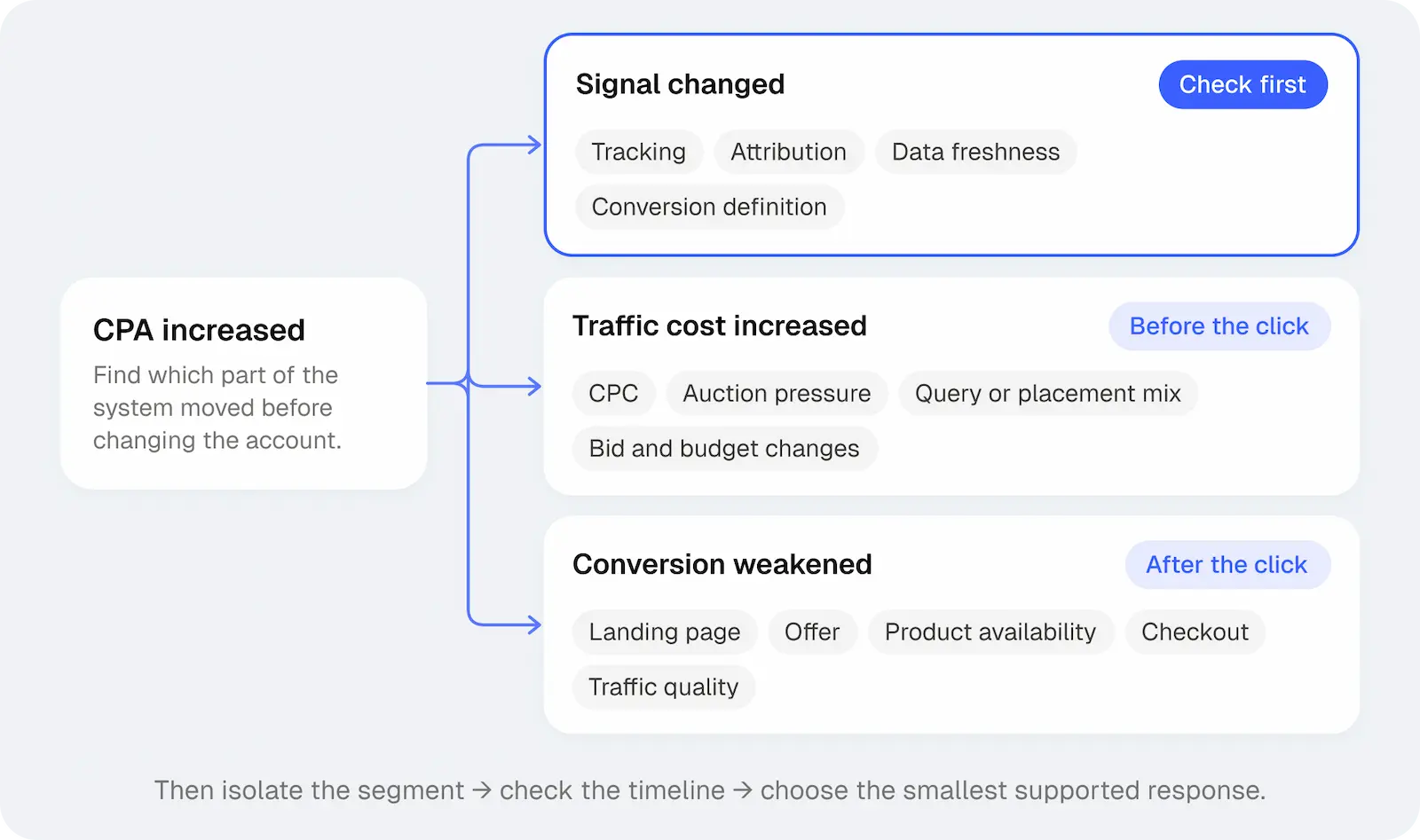
Compare the ad-platform result with first-party orders or another dependable source. Look for abrupt changes across many campaigns at the same time. Check recent edits to tags, conversion definitions, consent flows, checkout, and attribution settings. Data freshness matters too: some accounts simply have not received enough conversions to make today comparable with a fully matured period.
Timing is often the quickest clue. A sharp reporting drop at 2 p.m., while clicks, spend, and actual orders continue normally, deserves a measurement investigation. A gradual decline in conversion rate over several days points elsewhere.
You do not need perfect measurement before continuing. You need enough confidence that the CPA increase represents a real performance change rather than a reporting artifact.
Split CPA into traffic cost and conversion rate
Once the signal checks out, decompose the metric. CPA rises when traffic becomes more expensive, conversion rate weakens, or both happen together.
If CPC increased while conversion rate stayed stable, look upstream. Auction pressure may have changed. Query, placement, device, or geography mix may have shifted. A budget or bidding change may have moved the campaign into more expensive inventory.
If CPC is stable but conversion rate dropped, look after the click. Check the landing page, site speed, checkout, offer, product availability, and traffic quality. A promotion ending or a popular SKU going out of stock can hurt conversion without anything being wrong with the campaign setup.
Sometimes both move. A campaign begins buying more expensive traffic and that traffic converts worse. The account-level CPA then hides a concentrated problem that becomes obvious only after the metric is split apart.
Find where the deterioration is concentrated
Next, stop looking at the account average. Break the movement down by campaign, then by the dimensions that matter for that campaign type.
For Search, inspect search terms, match types, keywords, devices, geographies, and landing pages. For Shopping, inspect products and product groups. For Meta, inspect campaigns, ad sets, audiences, placements, and creative.
You are looking for contribution, not merely the worst CPA. A small campaign with a terrible CPA may have added little to the account-level increase. A large campaign that became moderately less efficient may explain most of it. Compare how much each segment contributed to the change in spend and conversions.
If most of the deterioration comes from one campaign, product, audience, or destination, a broad account change is hard to justify. Concentration gives you a smaller surface area to investigate and a safer place to intervene.
Build a short timeline around the change
Once you have isolated the affected segment, check what changed around the same time. Review budget and bid-strategy edits, new keywords or search-term mix, creative launches, targeting adjustments, landing-page changes, promotions, inventory, and pricing.
Suppose CPA rose the day after a campaign budget increased 30%. The timing does not prove causation, but it gives you a useful starting point. Did the additional spend enter more expensive auctions? Did CPC rise? Did the campaign begin reaching lower-converting traffic?
Keep the timeline short and specific. The goal is to reduce a long list of possible explanations to the few changes that could plausibly produce the pattern in the data.
Match the response to the evidence
By this point, you should know whether the increase is real, where it is concentrated, and which changes deserve investigation. That still does not mean the account needs a large intervention.
| Evidence | Likely response | Why |
|---|---|---|
| Abrupt platform-only conversion drop | Investigate tracking and data freshness before changing media | The reported CPA may not reflect customer behavior |
| CPC rose; conversion rate held | Inspect auction and traffic-mix changes | The problem begins before the click |
| CPC held; conversion rate fell | Inspect landing page, offer, inventory, checkout, and traffic quality | The problem begins after the click |
| Deterioration is concentrated | Make the smallest targeted change the evidence supports | A broad pullback would affect healthy parts of the account |
| Low volume or conflicting signals | Keep watching and define the next review trigger | More intervention would exceed the confidence available |
| Clear, reversible pocket of waste | Reduce or pause the affected traffic within approved controls | The downside is contained and the action is easy to evaluate |
Table 1. The action should match both the pattern in the data and the confidence behind the diagnosis.
A tracking or landing-page failure should usually be fixed before changing media. A campaign with two weak days and thin conversion volume may need more observation. A well-isolated pocket of inefficient spend may justify a contained bid, budget, or traffic change.
For the broader framework covering confidence, consequence, escalation, and follow-up, use the ad-account incident-response guide. This article stays focused on the CPA-specific diagnosis that comes before that decision.
How MAI supports the investigation
This diagnosis is straightforward to perform once. Repeating it across active accounts, campaigns, products, audiences, and funnel steps is where the operating burden grows.
MAI can monitor connected campaign and funnel performance for unusual changes, then investigate likely causes using account history and supplied business context. That investigation can include spend, CPC, conversion rate, campaign configuration, tracking, landing-page performance, creative fatigue, audience saturation, promotions, and inventory.
Customer story See how Vintage Tub & Bath found 45 SKUs below 1x ROAS and cut their spend.
The useful output is not simply “CPA increased 28%.” It should narrow the problem: where the movement is concentrated, what changed around it, which explanations fit the evidence, and what response that evidence supports.
Depending on the platform, workflow, and configured permissions, the next step may remain a recommendation, become a reviewable proposal, or move into a supported account action. Changes are recorded so the team can review what happened and continue watching the result.
This is the same operating principle behind giving an AI media buyer bounded authority: the evidence and consequence of the decision determine how much the system should do on its own.
Use the spike to improve the next decision
A higher CPA deserves attention. It does not tell you what to change.
Verify the conversion signal. Separate traffic cost from conversion rate. Find the campaign, product, audience, query, creative, or landing page responsible for most of the movement. Check the timeline. Then choose the smallest response the evidence can support and define when you will review the result.
Sometimes that means changing a budget or cutting inefficient traffic. Sometimes it means fixing measurement, inventory, or a landing page. Sometimes the right decision is to leave the account alone until the signal becomes clearer.
The account improves when the investigation produces a better next decision, not when every alert produces an edit.
Turn a CPA alert into a useful investigation
Connect an ad account and see how MAI can monitor performance, investigate likely causes, and support the next appropriate action within your controls.
Similar articles
Something Changed in Your Ad Account. Now What?
- Ad Account Monitoring
- AI Media Buying
- Performance Marketing
- Anomaly Detection
- Paid Media Optimization
Ad performance changed. Learn how to validate the signal, investigate what happened, choose an evidence-matched response, and keep monitoring.
Your Conversion Rate Dropped. Is It the Ads, the Landing Page, or Tracking?
- Performance Marketing
- Paid Media
- AI Agents
- Marketing Measurement
Use this diagnostic framework to determine whether a conversion-rate drop comes from weaker ad traffic, the landing experience, or broken tracking.