
Your Conversion Rate Dropped. Is It the Ads, the Landing Page, or Tracking?
A practical way to separate weaker traffic, a broken customer experience, and a bad conversion signal before changing the account.
CPA is up. CPC is roughly flat. The problem is easy to locate in the formula: fewer of the people who click are converting.
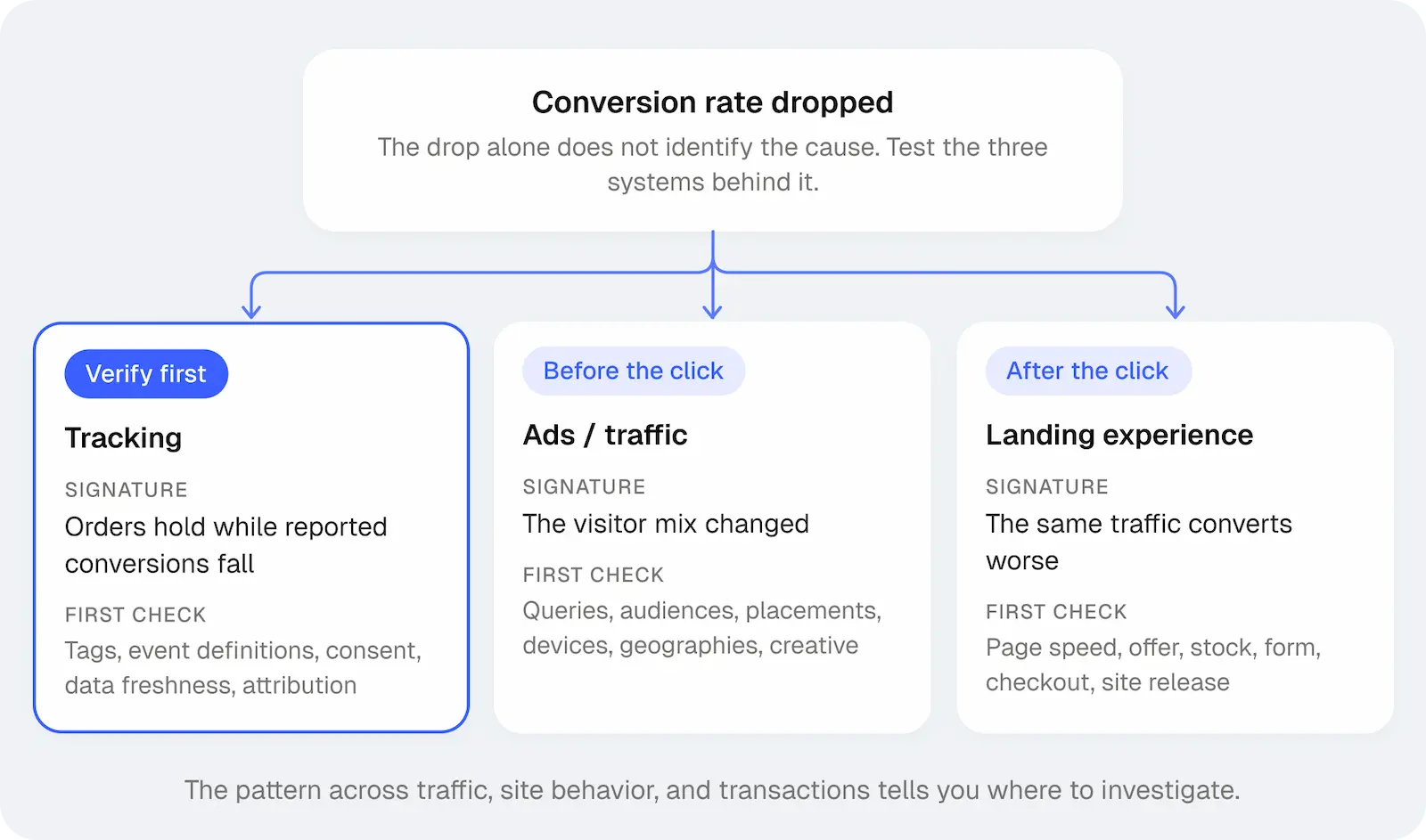
The formula does not tell you what failed. The campaign may be buying different traffic. The same visitors may be hitting a weaker page or checkout. Or customers may still be converting while the event arrives late, fires incorrectly, or disappears from the ad platform.
Those diagnoses lead to different work. Tightening targeting will not repair checkout. Cutting spend because a tag broke teaches the bidding system from incomplete data. Fixing a page will not help if a new query mix is bringing in the wrong visitors.
Before changing bids, budgets, or audiences, test the three systems that sit behind conversion rate: traffic, landing experience, and measurement.
First verify that the drop is real
A reporting problem can look exactly like a customer-behavior problem. Compare the ad-platform conversion count with a source closer to the transaction: ecommerce orders, CRM records, booked calls, or another dependable first-party outcome.
If reported conversions fall 25% while completed orders remain steady, pause the campaign diagnosis. Check conversion actions, tags, consent behavior, attribution settings, event deduplication, and data freshness. Look at timing. A clean break after a site release or tag edit is different from a gradual decline in purchase behavior.
Conversion lag can create the same false alarm. Yesterday’s clicks may not have matured, particularly with longer consideration cycles. Compare periods at the same level of maturity before treating the latest result as final.
You do not need perfect measurement to continue. You need enough confidence that the decline exists outside the reporting layer.
Map where the decline appears
Once the outcome signal checks out, find the footprint of the problem. Break conversion rate down by the dimensions most likely to separate the possible causes: platform, campaign, audience, query, creative, device, geography, product, and landing page.
Concentration is useful. If one campaign accounts for most of the decline while others remain stable, keep the investigation close to its traffic and destination. If every campaign sending users to one page deteriorated at the same time, the page moves to the top of the list. If multiple platforms and pages fall together, look for a sitewide, measurement, offer, or business change.
Do not begin with a tour of every segment. Rank the contributors to the lost conversions. The smallest common surface usually gives you the fastest route to a plausible diagnosis.
When the ads or traffic mix changed
The media is the likely cause when the visitors arriving now are materially different from the visitors who converted before.
For Search, compare query mix, match types, campaign contribution, device, geography, and brand versus non-brand traffic. A campaign can hold CPC steady while expanding into broader queries that convert less often. For Meta or Demand Gen, check whether delivery shifted across audiences, placements, creative, or devices. A new asset can improve click-through rate by attracting more curiosity without improving purchase intent.
Use a stable destination as a control when possible. If conversion rate falls for one traffic source while the same page converts normally for other sources, the evidence points upstream. Then narrow the media change rather than pulling back the entire account.
The response should match the segment: constrain a weak query pattern, adjust a placement or audience, separate a new creative test, or restore the intended traffic mix. Keep the change reversible and define what recovery should look like.
When the landing experience changed
The site is the stronger diagnosis when comparable traffic starts converting worse after the click. Look beyond the first page. The failure can sit in page speed, form completion, cart, payment, shipping, stock availability, pricing, or the offer itself.
Patterns across destinations help. If several campaigns using the same page decline together while campaigns using other pages hold steady, investigate that page and its funnel. Device splits can be equally revealing: a mobile-only drop often points to rendering, speed, form, or checkout behavior rather than account-wide traffic quality.
Check the release and business timeline. A site deployment, promotion ending, price change, or popular product going out of stock can all lower conversion rate without any media edit. If the affected products are also low on inventory, cutting otherwise productive traffic may hide the symptom without fixing the constraint.
Protect spend if the issue is severe, but route the repair to the owner who can solve it. The media team can limit exposure to a broken destination; it cannot fix the destination by changing bids.
When tracking or attribution changed
Tracking is the leading diagnosis when customer outcomes remain steady but reported conversions fall, or when the break aligns with a technical or configuration change.
Compare several signals. Are purchases missing while add-to-cart events continue? Did the decline occur in one platform but not in first-party orders? Did one conversion action disappear while another remained stable? Did consent, attribution, or deduplication behavior change?
Avoid major optimization changes until the signal is trustworthy. Automated bidding responds to the data it receives. Feeding it an incomplete conversion stream can turn a measurement failure into a media failure.
A broader performance marketing measurement system should make the source, definition, freshness, and decision role of each metric explicit. This incident is where that discipline becomes practical.
Use the pattern to choose the next check
| Observed pattern | Leading diagnosis | Next check |
|---|---|---|
| One campaign or audience declines; the same destination works elsewhere | Ads or traffic mix | Queries, audience, placements, creative, device, geography |
| Several campaigns to one page decline together | Landing experience | Page release, speed, form, offer, stock, checkout |
| Multiple platforms and pages decline at the same time | Sitewide, business, or tracking issue | Orders, event health, site release, promotion, pricing, demand |
| Reported conversions fall while first-party outcomes hold | Tracking or attribution | Tags, actions, consent, deduplication, freshness |
| The drop is concentrated in immature recent data | Conversion lag | Recheck after the normal reporting window |
These are starting hypotheses, not proof. Use the pattern to choose the next check, then ask what evidence would disconfirm the diagnosis. That prevents the investigation from becoming a search for facts that support the first explanation someone suggested.
Match the response to the diagnosis
Once the evidence points to a system, take the smallest action that addresses that system and preserves learning. Tighten the traffic segment that deteriorated. Protect a broken page while it is repaired. Restore the conversion signal before asking the account to learn from it. If the data is thin, set a review threshold and wait.
Every response needs a follow-up. Record what changed, what you expect to recover, and when you will check again. Conversion rate improving after a page fix strengthens the diagnosis. No improvement means the investigation continues.
This is a specific incident class inside the broader ad account monitoring and investigation workflow. The alert starts the work; the diagnosis determines whether the next owner sits in media, growth, engineering, or analytics.
How MAI supports conversion rate investigations
MAI can monitor connected campaign performance, landing pages, funnel metrics, account history, and supplied business context for unusual behavior. For a conversion-rate drop, it can help identify where the decline is concentrated, check which account or funnel changes line up with it, investigate likely causes, and recommend the next appropriate action.
Customer story See how Vintage Tub & Bath raised overall conversion rate 34%.
The output may be an alert, a reviewable recommendation, a supported account action, or an escalation to another owner. What happens automatically depends on the configured workflow, permissions, and execution mode. The marketer continues to own targets, business constraints, and consequential decisions.
The standard is the same one applied to an AI media buyer’s daily work: notice the change, investigate it, act within the agreed boundary, and observe what happens next.
Fix the failing system
A lower conversion rate is a symptom shared by three systems. The quickest useful investigation verifies the outcome signal, maps the footprint of the decline, and compares the evidence for traffic, experience, and measurement.
That sequence prevents a common mistake: changing the ad account because it is the easiest system to edit. Sometimes the right response is a campaign adjustment. Sometimes it is a page repair, a tracking fix, or a deliberate decision to wait for the data to mature.
Frequently asked questions
What should I check first when conversion rate drops?
Compare reported conversions with a dependable first-party outcome. If the drop is not present there, investigate measurement before changing the campaigns.
How can I tell whether the ads or landing page caused the drop?
Look for a control. If one traffic source declines while the same page works elsewhere, inspect the traffic. If several sources to one page decline together, inspect the page and downstream funnel.
Should I pause campaigns while investigating?
Only when the exposure or customer impact justifies protection. Prefer a contained, reversible response and define when the account will be reviewed again.
Can MAI fix a landing page or tracking issue?
MAI can help detect and investigate the issue and route the next action. A site or tracking repair may still require the appropriate growth, analytics, or engineering owner.
Find the cause before changing the account
See how MAI can connect campaign, funnel, landing-page, and business signals to narrow a conversion-rate decline and surface the next supported action.
Similar articles
Your CPA Spiked Overnight. What Should You Check First?
- Ad Account Monitoring
- Paid Media Optimization
- Performance Marketing
- AI Media Buying
- Google Ads
CPA jumped overnight? Verify tracking, separate CPC from conversion rate, isolate where performance changed, and match the response to the evidence.
How to Choose a Performance Marketing Measurement System (2026)
- Performance Marketing
- Marketing Measurement
- Attribution
- Incrementality
- Marketing Mix Modeling (MMM)
Compare operational analytics, attribution, incrementality, MMM, and performance marketing agents using a practical decision framework for 2026.