
AI Media Buying vs. Hiring Another Media Buyer
Diagnose the backlog before choosing the investment. Missing judgment, missing operating coverage, and mixed capacity problems require different answers.
When a paid-media team starts missing things, opening another role feels like the obvious answer. Reports take longer. Search terms go untouched. Creative tests wait. A landing-page problem is found only after spend has already passed through it.
Sometimes another person is exactly what the team needs. But missing human judgment and missing operating capacity can look almost identical from the outside. Before choosing another media buyer or an AI media buyer, look at the work that is actually waiting.
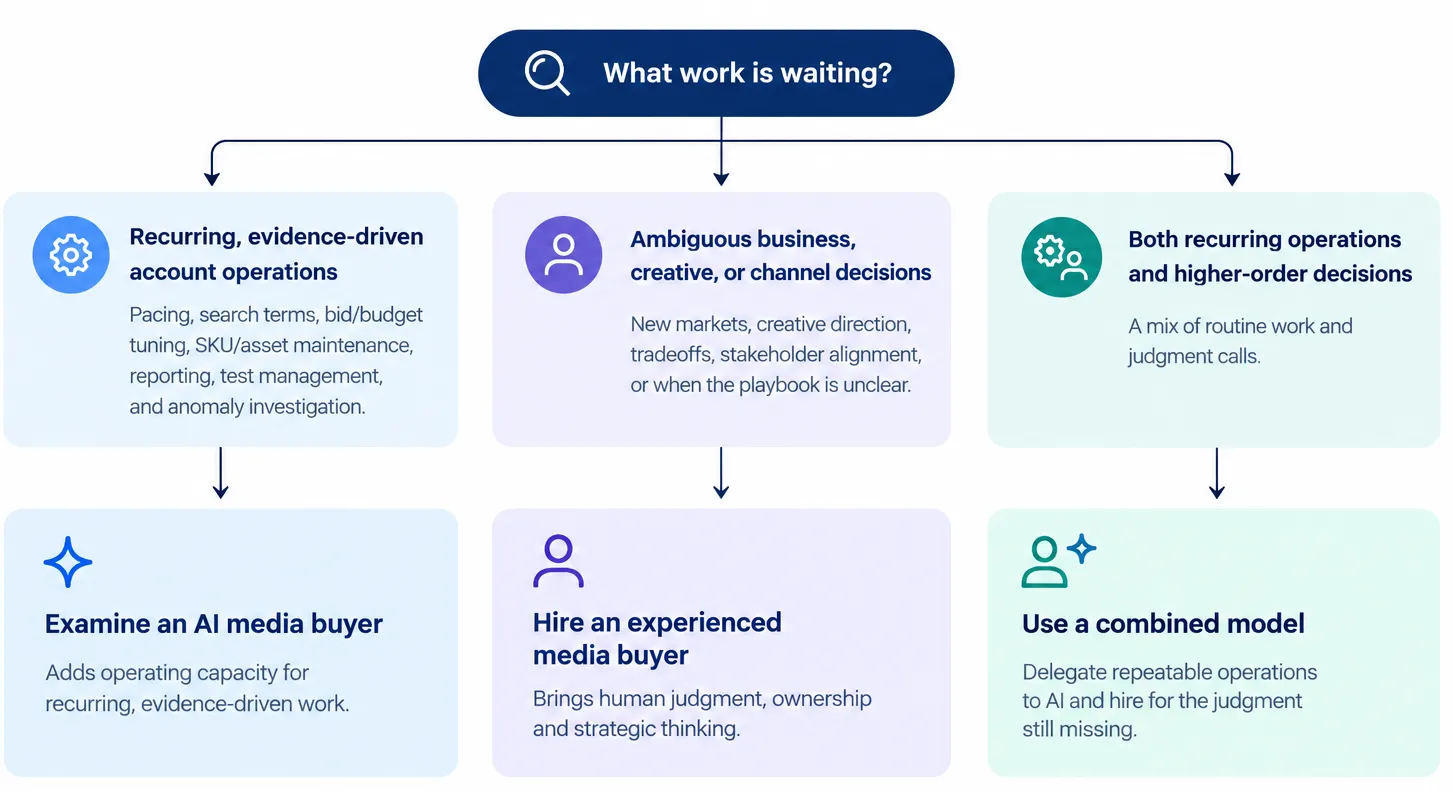
Start with the backlog, not the org chart
Take a representative week and record what the next media buyer would actually inherit. Use the queue, not the job description.
If most of the backlog is pacing, search-term review, bid and budget tuning, SKU or asset maintenance, reporting, recurring tests, and anomaly investigation, the team may be short on operating coverage. The next action is usually understood; it just is not happening often enough.
If the backlog is dominated by new-market decisions, creative direction, unresolved business tradeoffs, stakeholder alignment, or situations where the playbook itself is unclear, the constraint is different. The team needs judgment and ownership.
Quick diagnostic
| What is waiting | What the team is short on | Direction to examine first |
|---|---|---|
| Routine checks, pacing, tuning, reporting, recurring tests | Operating coverage and execution throughput | Examine AI operating capacity |
| New-market decisions, ambiguous tradeoffs, creative direction, stakeholder alignment | Judgment and ownership | Hire experienced human judgment |
| Recurring debugging, anomaly monitoring, and established playbooks | Continuous attention | Examine AI operating capacity |
| Major changes to objectives, economics, offers, or risk tolerance | Business context plus judgment | Human-led decision, with AI supporting analysis or execution |
| Recurring operations plus higher-order decisions | Both kinds of capacity | Delegate recurring operations and hire for the remaining judgment gap |
When another media buyer is the better hire
A strong media buyer contributes much more than account execution. They notice when reported performance does not fit what is happening in the business, challenge assumptions, coordinate with creative and merchandising, and decide how much evidence is enough when the answer remains genuinely uncertain.
Another person is especially valuable when the team is missing an owner or a capability:
- A channel where the company has no internal expertise.
- A major change in acquisition economics or business strategy.
- A measurement transition that requires judgment and organizational alignment.
- Growing cross-functional complexity across creative, finance, product, or merchandising.
- A playbook that has not yet been defined.
Automating account mechanics will not remove those bottlenecks. Someone still has to own the problem, build the playbook, and align the people around it.
When an AI media buyer is the better fit
The other pattern appears in otherwise strong teams. The strategy is sound and the account structure is understood, but there is more recurring work than the team can cover consistently.
Search keeps generating keyword and landing-page questions. Shopping produces SKU-level decisions. Meta needs ongoing creative testing and monitoring. Budgets, reports, tracking issues, broken pages, fatigue, and audience saturation all compete for attention.
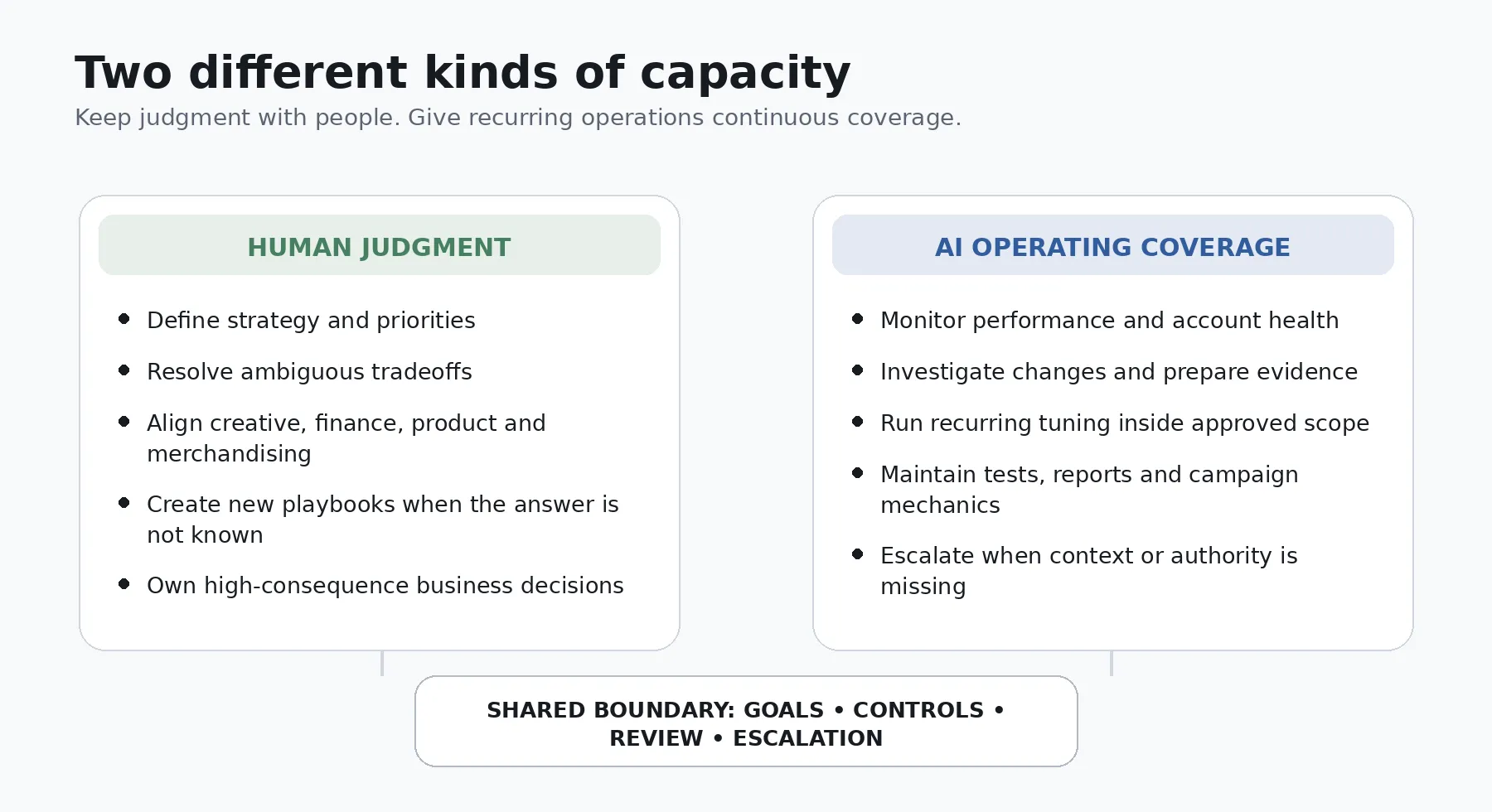
An AI media buyer is useful when the recurring queue is the bottleneck. MAI, for example, is designed to monitor performance and account health, investigate changes, prepare reports, maintain campaigns, and make supported optimizations inside configured goals and controls. Its current workflows can include keyword and landing-page tuning, SKU-level optimization, creative testing, bid and budget changes, reporting, and account-health monitoring, with the exact execution depth depending on platform, campaign type, and configuration.
The team still decides the goals, budgets, targets, scope, and operating constraints. Supported actions can remain recommendations, become reviewable proposals, or move into controlled execution where the workflow allows it. That division of work is more useful than asking whether AI can perform every task a media buyer performs.
Customer story See how Flamingo's team got its time back for product and creative.
For a deeper view of the recurring account mechanics an agent can take on, see How AI Agents Simplify Google Ads Management.
Run a one-week capacity audit
Before opening a role, classify one or two representative weeks of work into four buckets:
- Recurring platform operations
- Analysis and investigation
- Business or creative judgment
- Coordination with other people
For every delayed item, record why it waited:
- No one had time, even though the next action was understood.
- The evidence was incomplete or required investigation.
- The decision depended on unresolved business or creative judgment.
- The work required coordination, approval, or ownership across teams.
A budget adjustment waiting while the buyer is in meetings, a promising keyword sitting in a report, or a prepared creative test that never launches are operating-capacity signals. A stalled margin decision, inventory tradeoff, new positioning choice, or unresolved measurement result points to missing judgment or context.
Capacity-audit output
At the end of the audit, summarize the work in three numbers or proportions: recurring work that could move, decisions that still require human ownership, and mixed workflows where AI can prepare evidence but a person should decide.
Do not treat this as a time-and-motion exercise alone. Include the cost of work arriving late, work being skipped, and senior attention being consumed by routine account mechanics. A ten-minute task that repeatedly fails to happen may matter more than a larger task that is already well covered.
AI may change who you hire next
Moving recurring media operations to an agent does not mean the team stops hiring. It can change the profile of the next hire.
Once monitoring, tuning, recurring testing, reporting, and routine execution receive more coverage, the scarce capability may be a stronger channel lead, a measurement specialist, someone closer to creative and merchandising, or a senior performance marketer focused on allocation and business tradeoffs.
That can change the next role from more hands on the same queue to a capability the team does not already have. The capacity audit makes the remaining talent gap easier to see.
Where MAI fits
MAI is most relevant when valuable operating work is being deferred because there are not enough hours to cover it. MAIOS keeps connected marketing data, account history, business context, goals, and controls available across ongoing workflows so the system can monitor, investigate, recommend, execute supported actions, and log what happened over time.
A Media Plan acts as the operating boundary for supported automation. It can define scope, budget, bidding approach, performance targets, eligible landing pages, products, assets, audiences, and tuning settings. The team chooses which actions require review, which can run automatically where supported, and when a workflow should remain paused.
That makes MAI a better fit for recurring, evidence-driven work than for ambiguous strategy. If a decision needs more business judgment, MAI can support the analysis, but the team still owns the call. If you are evaluating how much authority to delegate, How Much Autonomy Should You Give an AI Media Buyer? lays out a decision-by-decision framework.
The practical test
If most of the unmet need is judgment, hire for judgment.
If strong marketers are spending their week keeping up with recurring mechanics, test how much of that operating load can move to an AI media buyer before designing the next role.
If both are true, do both deliberately: use AI for repeatable operations and hire the person whose judgment, expertise, or ownership is still missing.
A capacity audit turns a vague headcount question into a concrete operating decision. Once the recurring queue is visible, you can see what an agent could own and what the next person must be hired to do.
See what an AI media buyer could take off your team’s plate. Book a demo
See what an AI media buyer could take off your team’s plate
Similar articles
What Is an AI Performance Marketing Agent?
- AI Agents
- AI Media Buying
- Performance Marketing
- Paid Media
- Marketing Automation
An AI performance marketing agent continuously monitors paid media, works out what changed and why, and can carry decisions through to action within defined permissions.
How AI Agents Simplify Google Ads Management for Performance Marketers
- Google Ads
- AI Agents
- Campaign Optimization
See how AI agents coordinate Google Ads campaigns around the business signals that platforms cannot see on their own.
How Much Autonomy Should You Give an AI Media Buyer?
- AI Media Buying
- AI Agents
- Marketing Automation
- Media Buying
- Performance Marketing
The right level of AI autonomy depends on a decision’s consequence and the business context available to the agent.
Why AI Agents Are Replacing Rules-Based Media Buying
- AI Agents
- Media Buying
- Automation
- Performance Marketing
Use rules when the action is already known. Use an agent when the situation requires interpretation across signals and business context.