How One-Person Companies Can Run Performance Marketing With AI Employees
A practical operating model for handing recurring paid-media work to an AI employee while keeping the decisions that belong with the founder.
A one-person company can now produce work that once required a small team. A founder can write product copy, build a landing page, create video, answer support questions, and reconcile expenses with help from AI.
Paid media is harder to compress because the work does not end when the campaign launches.
Google and Meta keep spending while the founder is talking to customers, shipping product, or fixing onboarding. Search terms drift. A promotion changes the economics of a campaign. New creative waits for a fair test. CPA moves, but the reason is not obvious. By Friday, someone still has to explain what happened and decide what to do next.
None of those jobs necessarily justifies a full-time hire. Together, they can consume the attention of one.
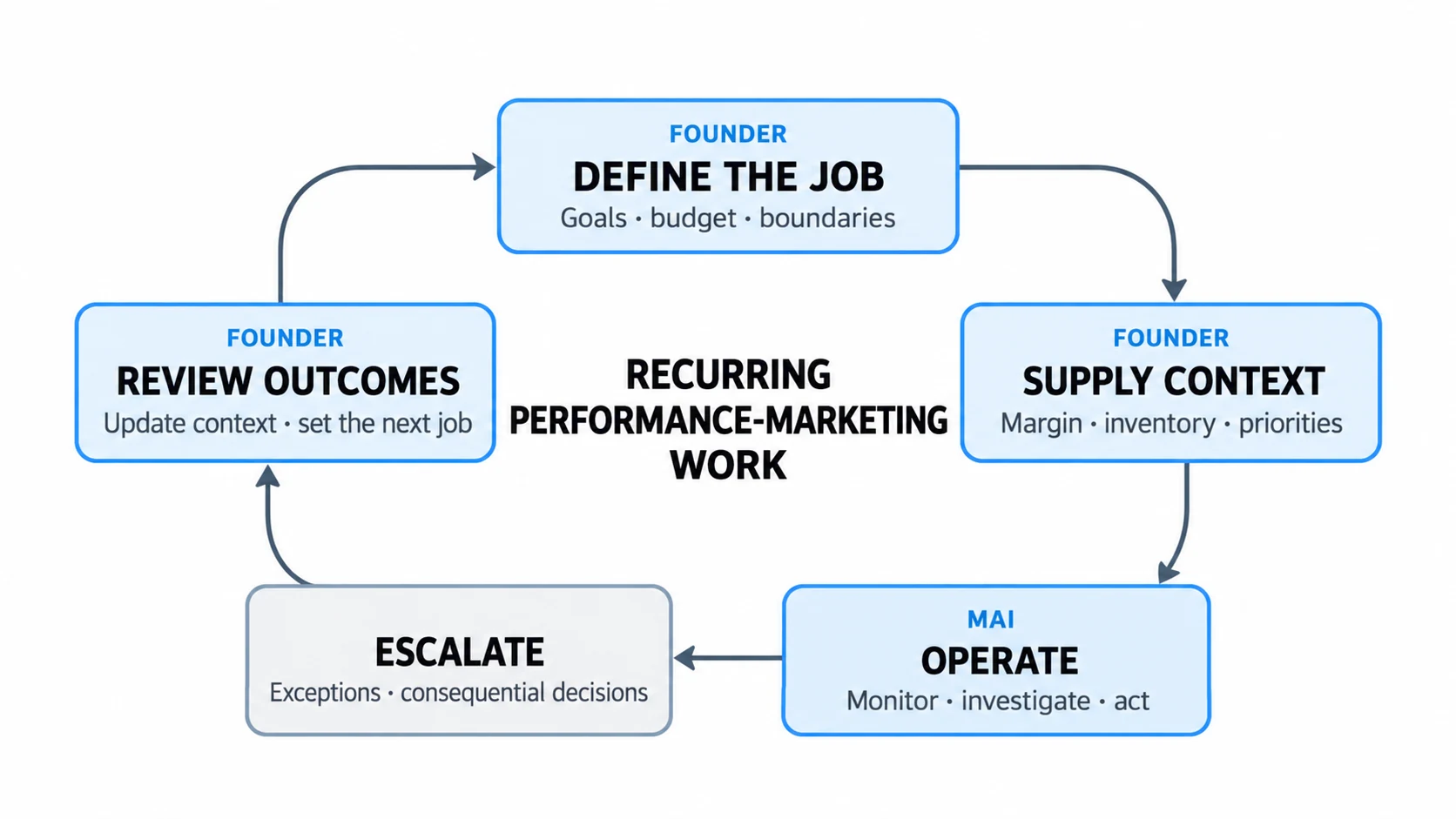
The useful role for a performance-marketing AI employee is to take ownership of recurring account work: keep watch, investigate changes, prepare or carry out supported actions inside defined controls, and preserve enough history for the next decision. The founder still owns the business judgment behind the account.
Paid media creates a standing workload
Consider a normal week for a solo ecommerce founder. On Monday, Google CPA is 25% over target. On Tuesday, three new Meta videos need testing. By Thursday, one product is on promotion while another is nearly out of stock. On Friday, the founder still needs to explain what changed and decide where next week’s budget should go.
The work arrives on its own schedule. Campaigns do not wait for the founder to finish the rest of the company.
An occasional analysis from a general-purpose AI model only solves part of this problem. Tomorrow, the founder must assemble the new data and context again. Running the account continuously requires connected data, account history, business inputs, controls and a way to follow each decision through.
Treat the AI employee as a set of standing jobs
“Run performance marketing” is too broad to delegate safely. “Monitor pacing every day and investigate material changes” is a job. So is “prepare Friday’s performance report” or “keep eligible creative moving through the test queue.”
The best first jobs share three qualities: they recur, the required inputs can be made available, and the founder can define what the system may do without asking each time.
| Standing job | Cadence | AI authority | Escalate when |
|---|---|---|---|
| Monitor performance | Ongoing | Surface and investigate material changes | Cause is unclear or business impact is high |
| Maintain supported campaigns | Daily / scheduled | Tune inside the Media Plan | Action changes the approved plan |
| Operate eligible creative tests | As assets arrive | Introduce, evaluate, and propose supported changes | New concept or meaningful spend is required |
| Prepare performance reporting | Weekly | Assemble a reviewable report | Interpretation needs business context |
| Assess budget opportunities | Weekly / as needed | Analyze and recommend | Capital commitment or channel mix changes |
This framing is more useful than a feature list. It forces a founder to identify the actual bottleneck: attention, investigation, execution, or judgment.
Keep watch, then investigate before acting
A founder should not need Google Ads, Meta, analytics and the storefront open all day just to know whether something deserves attention.
MAI can monitor campaign performance, landing pages, funnel metrics, account-health issues and configuration changes over time. If CPA rises briefly and recovers, no response may be needed. If CPA rises while conversion rate falls and spend keeps increasing, the account deserves a closer look.
From there, MAI can use connected advertising and analytics data, account history and supported structured inputs to investigate whether CPC, creative fatigue, search intent, tracking, or product mix may be responsible. Depending on the platform, permission and workflow, the result can remain an analysis, become a proposal for review or move into supported execution.
The time saved is not the few minutes required to read a dashboard. It is the investigation that follows.
Let routine work operate inside a defined boundary
Paid accounts accumulate maintenance: search terms need evaluation, budgets and bidding targets need tuning, weak campaigns need limits, and promising products or ads need room to prove themselves.
A Media Plan gives that work a boundary. It defines the relevant campaigns, budgets, targets, eligible inputs, and tuning settings. Within supported workflows, actions can run automatically, require review, or remain paused.
The founder does not hand the account an unlimited mandate. They decide which recurring actions can proceed, which need confirmation, and when the system should stop. That decision-by-decision approach to autonomy matters more than whether a vendor describes the whole product as “autonomous.”
Operate the creative queue, not just creative production
AI has made producing ten new ads much easier. It has not made those ads useful by default.
Each asset still needs to enter an eligible workflow, receive enough delivery to generate evidence, and be evaluated in context. A promising video may deserve more spend. A weak ad may need to be reduced or retired. A fresh concept should not sit in a Drive folder for three weeks because the founder never found time to rebuild the test.
MAI’s Asset Library and supported Meta and Demand Gen workflows can help organize eligible creative, introduce assets into supported campaign-creation or tuning workflows, evaluate performance, and propose or make supported changes. Available actions depend on the platform and configuration.
For a one-person company, this closes the gap between making more creative and actually learning from it.
Turn reporting into a review job
Friday reporting often means opening Google, checking Meta, comparing storefront revenue, tracing the campaigns behind the change and turning the result into a decision.
MAI can use connected marketing data and report templates to produce recurring briefings for review. The founder still checks the interpretation and adds business context, but starts with a structured account of what changed rather than a blank sheet and several browser tabs.
The founder still owns the business
An AI employee can only use the context available to it. The founder knows when cash needs to be conserved, why a promotion exists, whether inventory is about to arrive, and why a strategically important product may look weak in the current data.
Those inputs can materially change a media decision:
- The monthly paid-media budget is $25,000.
- Acquisition should stay near the agreed efficiency target.
- Product A is the priority because inventory just arrived; Product B has a lower margin.
- Up to $2,000 can be used to test a new creative direction.
MAI can incorporate goals, budgets, targets, supplied business context and operating constraints through supported workflows. The founder remains responsible for setting those priorities and handling decisions that require context the system does not have.
A practical division of labor looks like this:
| AI employee handles | Founder supplies | Founder decides |
|---|---|---|
| Monitoring and first-pass investigation | Targets, account access, and known events | Which outcomes matter enough to act on |
| Routine tuning in supported workflows | Media Plan scope and operating limits | Changes outside the approved boundary |
| Eligible creative workflow operations | Assets, product priorities, and test budget | Creative direction and brand judgment |
| Recurring reporting | Data connections and report questions | Business interpretation and stakeholder message |
| Budget analysis and recommendations | Cash limits, margin, inventory, and growth priorities | How much capital the business can risk |
This is the operating boundary that makes the “AI employee” idea credible. The system handles more of the repeatable work; the founder remains accountable for capital, positioning, risk, and the changing reality of the business.
Start with one job you want to stop doing
A one-person company does not need to hand over its entire paid-media operation on day one. Start with one recurring job that is already taking too much time: monitoring the account, investigating changes, preparing the weekly report, or maintaining campaigns inside a narrow Media Plan.
Define the inputs, cadence, permitted actions and escalation conditions. Then inspect the work log: what the AI employee noticed, what it checked, what it changed or proposed, and what happened afterward.
That is a better test than asking whether AI can “run marketing.” The useful question is whether it can reliably remove one recurring job without separating execution from the founder’s business judgment.