
Google Ads Says ROAS Is Up. Should You Actually Spend More?
Before you increase the budget, work out whether Google became more productive or the reported average simply became more flattering.
You open Google Ads and ROAS has moved from 3.1x to 4.0x. The campaign is above target, conversions are coming in, and the budget has room to move.
That looks like permission to spend more. It may be. But the same 4.0x can be produced by cheaper clicks, a stronger landing page, higher order values, more branded search, a few unusually large orders, or a shift toward customers who were already likely to buy. Each explanation changes the budget decision.
Start with diagnosis, not allocation. Find the source of the ROAS improvement, check whether it represents useful business value, and only then ask whether the campaign can absorb more spend. This article covers that diagnostic. The separate campaign-scaling process begins after the signal passes these checks.
A higher ROAS can come from very different changes
Diagnose the source of the improvement before treating it as new capacity.
- 1 Cheaper traffic CPC falls Useful if quality holds
- 2 Better conversion CVR rises Check landing page, offer, and tracking
- 3 Larger orders AOV rises Check product and order concentration
- 4 Favorable mix Mix shifts Reported return may improve without more demand
Then test business value and room to scale
Build the ROAS bridge
ROAS is conversion value divided by spend. That makes it useful as a summary, but poor at explaining its own movement. Rebuild the change from the account mechanics underneath it.
First look at traffic cost. If CPC fell while conversion rate and order value held, Google bought similar traffic more cheaply. That can be a durable improvement, but check whether the cheaper traffic came from a temporary auction change, a different device or geography mix, or a move toward brand terms.
Next look at conversion rate. A genuine rise may reflect better traffic, a stronger offer, a landing-page improvement, or a cleaner path to purchase. It may also reflect a tracking change. Compare the timing of the lift with site releases, consent changes, conversion-action settings, attribution windows, and any imported offline outcomes.
Then inspect average order value or conversion value. One large order can materially improve ROAS in a campaign with modest volume. Break the lift down by order, product, campaign, query, location, device, and customer type. You need to know whether the result is broad or concentrated before assuming it will repeat at a higher budget.
What moved ROAS?
Rebuild the lift from the mechanics underneath it.
The driver determines what to check next.
Separate improvement from mix
An account can report higher ROAS even when none of its underlying components became better. The mix simply changed.
Suppose branded Search grows from 20% to 35% of spend while non-brand performance is flat. Account ROAS rises because more money moved toward people already looking for the company. The result is real in the dashboard, but it does not prove that Google found more incremental demand.
The same pattern appears when remarketing gains share, one high-margin-looking SKU dominates conversion value, returning customers become more common, or a promotion pulls forward orders. Review the contribution of each campaign and segment to the total change. Ask which parts improved inside themselves and which parts merely became a larger share of the average.
This distinction matters because mix-driven gains often have limited room to scale. A small, efficient pocket can make the account look healthier while being close to saturation.
Check whether the attributed value is valuable
Google reports the conversion value assigned to Google Ads under the account’s measurement setup. That is not automatically the same as value created for the business.
Use attribution, incrementality, and MMM for the questions they actually answer. Attribution tells you where credit was recorded. Incrementality asks whether advertising caused the outcome. MMM can help estimate contribution and allocation at a broader level.
You do not need a new experiment before every budget adjustment. You should be more demanding when the proposed move is large, when brand or remarketing explains much of the lift, or when the account has a history of platform return diverging from business results.
Then translate attributed revenue into the economics you manage. Margin, discounts, refunds, repeat purchase behavior, lead quality, inventory, and fulfillment constraints can all change what a conversion is worth. A 4.0x ROAS on discounted, low-margin inventory may be less useful than a 3.2x return on products or customers with stronger economics.
Higher ROAS ≠ higher business value when margins are thin.
- Discounted products
- Low margins
Higher ROAS, but each conversion may be worth less
Lower ROAS, but each conversion may be worth more
Use a Google ROAS review card
| Check | Question | Evidence | Budget implication |
|---|---|---|---|
| Measurement | Did tracking or attribution change? | Conversion settings, site releases, consent, offline imports | Do not scale until the comparison is trustworthy |
| Mechanics | Did CPC, CVR, or AOV drive the lift? | Metric bridge over comparable periods | Identify the component that must persist |
| Mix | Did brand, remarketing, one SKU, or returning customers gain share? | Campaign, query, product, and customer contribution | Treat concentrated gains as limited evidence |
| Business value | Are the conversions profitable and useful? | Margin, LTV, lead quality, inventory, refunds | Replace platform target with the business threshold |
| Capacity | Can more spend find additional valuable demand? | Lost impression share, query coverage, prior spend response | Move to a staged scale test only if headroom exists |
The card is intentionally short. Its job is to keep the team from jumping from one green metric to a budget increase without recording the evidence in between.
Only then ask what the next spend band can produce
Once the improvement survives the diagnostic, the next question is forward-looking.
The 4.0x describes spend already delivered. It does not estimate the return from the next $1,000.
Look for evidence of capacity: profitable queries limited by budget, eligible Shopping inventory with room to grow, campaign coverage that is still selective, or prior budget increases that produced additional conversion value without an immediate collapse in efficiency. Set the minimum marginal return or maximum marginal CPA that the added spend must meet.
For the allocation theory behind that threshold, use Where Should the Next Dollar Go?. For this Google-specific decision, keep the handoff simple: diagnose the ROAS lift first, then run a bounded campaign-scale test with a baseline, hypothesis, success condition, stop condition, and review window.
Before increasing the budget
1. Check room to grow
- Profitable queries limited by budget
- Shopping products with room to grow
- Previous budget increases that held efficiency
2. Set the threshold
- Minimum return on added spend
- Or maximum cost per additional acquisition
3. Define the scale test
- Baseline and hypothesis
- Success and stop conditions
- Review date
Google may still be the best place for the money. The decision is stronger because the team can explain which signal improved, why it matters to the business, and what the added spend is expected to do.
How MAI supports the review
Google’s bidding systems are effective inside the signals and targets available to them. MAI adds the wider operating context described in How AI Agents Simplify Google Ads Management.
MAI can use connected Google Ads performance, account history, efficiency targets, and supplied business context to investigate a change in ROAS. Depending on the available data and supported workflow, that context can include margin, LTV, inventory, promotions, growth targets, conversion quality, and measurement inputs such as incrementality or MMM.
Customer story See how Healf earned 19% more gross profit at similar ad spend.
The output can remain an explanation or recommendation, become a reviewable proposal, or move into controlled execution when the relevant permissions and operating mode support it. The marketer still sets the objective, budget, targets, constraints, and approval requirements.
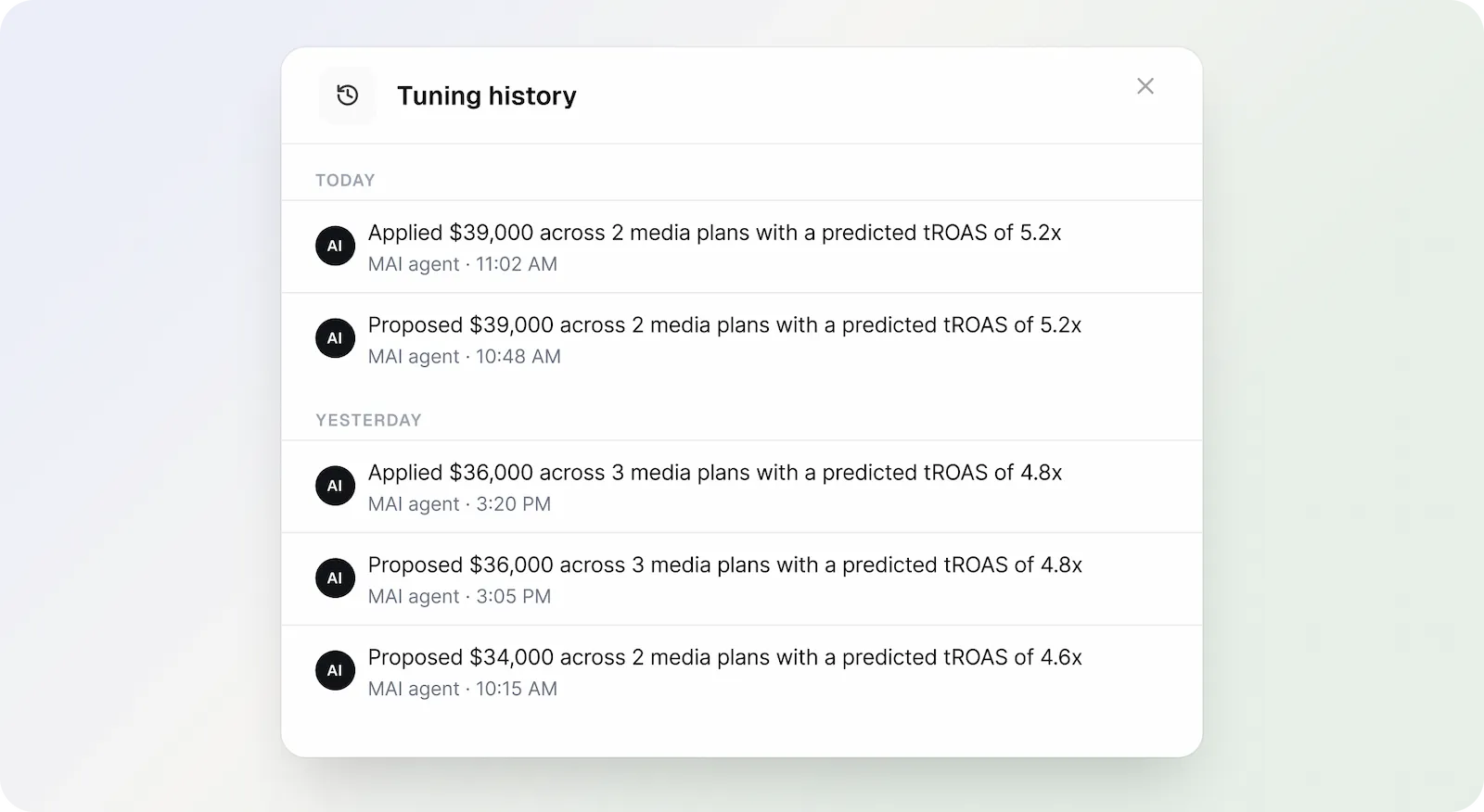
After a supported change, MAI can continue monitoring spend, volume, and efficiency and record the result in tuning history. That closes the loop: the team does not only know that ROAS rose; it builds evidence about why it rose and whether additional Google spend held up.
Treat higher ROAS as a claim to investigate
A higher Google Ads ROAS is useful evidence. It is not a complete budget recommendation.
Rebuild the movement from CPC, conversion rate, and order value. Separate genuine improvement from a favorable shift in campaign, query, product, or customer mix. Check measurement integrity and business economics. If the lift still holds, estimate whether more valuable demand is available and define the threshold for the next spend band.
Sometimes the answer will be a larger Google budget. Sometimes the investigation will show that the account became better at claiming credit, not creating value. The diagnostic tells you which situation you are in before more money moves.
Frequently asked questions
Why can Google Ads ROAS rise without performance improving?
ROAS can rise because spend shifts toward brand, remarketing, returning customers, one product, or a few large orders. The account average improves even if the underlying campaigns did not become more productive.
What should I check first when ROAS increases?
Confirm measurement consistency, then identify whether CPC, conversion rate, average order value, or mix drove the change. That diagnosis determines the next check.
Does higher ROAS mean I should increase the budget?
No. It means the campaign deserves review. Increase budget only after the improvement appears reliable, the conversions meet the business threshold, and evidence suggests additional valuable demand is available.
Can an AI agent make this decision automatically?
Supported changes can remain recommendations, require approval, or execute inside an approved range. The appropriate mode depends on the evidence, size and reversibility of the move, platform support, and the controls the marketer sets.
Find out what changed before more budget moves
Similar articles
How AI Agents Simplify Google Ads Management for Performance Marketers
- Google Ads
- AI Agents
- Campaign Optimization
See how AI agents coordinate Google Ads campaigns around the business signals that platforms cannot see on their own.
When Should You Increase Budget on a Campaign That Is Working?
- Budget Allocation
- Performance Marketing
- Paid Media
- AI Agents
Use this four-gate scale test to decide when a working campaign can absorb more budget, how much to add, and when to stop.