
What We Learned Scaling Google Ads With Delayed Conversions
Field Note: How faster behavioral signals and delay-adjusted projected ROAS supported account tuning while purchase data matured.
We recently worked on a six-figure-per-month Google Ads account for a consumer home-goods brand that wanted to scale. The account had enough demand to spend more, but reported ROAS became increasingly volatile as spend rose.
The underlying problem was conversion lag. Depending on the product, a purchase could arrive days or even weeks after the click. Today’s reported ROAS could therefore make today’s spend look weaker than it would after the data matured. Waiting for every purchase was not practical either; bids, budgets, and product allocation still needed attention in the meantime.
The account needed faster evidence without confusing an early signal for the final result.
Purchase remained the outcome that mattered
The operating model used a hierarchy of evidence. Observed purchases and mature revenue remained the evaluation outcome. Delay-adjusted projected ROAS, add-to-cart activity, and trending SKU data helped the team make interim decisions while that outcome developed.
| Signal | Role | How it was used |
|---|---|---|
| Observed purchases and mature revenue | Final evaluation outcome | Judge whether earlier decisions held up |
| Delay-adjusted projected ROAS | Interim efficiency estimate | Adjust the early view while conversions matured |
| GA4 add-to-cart activity and SKU trends | Faster behavioral evidence | Add context to bid, budget, and product decisions |
| Account context | Decision constraint | Interpret signals within the Media Plan, geography, history, and conversion maturity |
No single interim signal was treated as a substitute for purchases. Its value depended on the conversion delay, the product cluster, account history, geography, and the Media Plan already governing the campaigns.
Operate the account while revenue matures
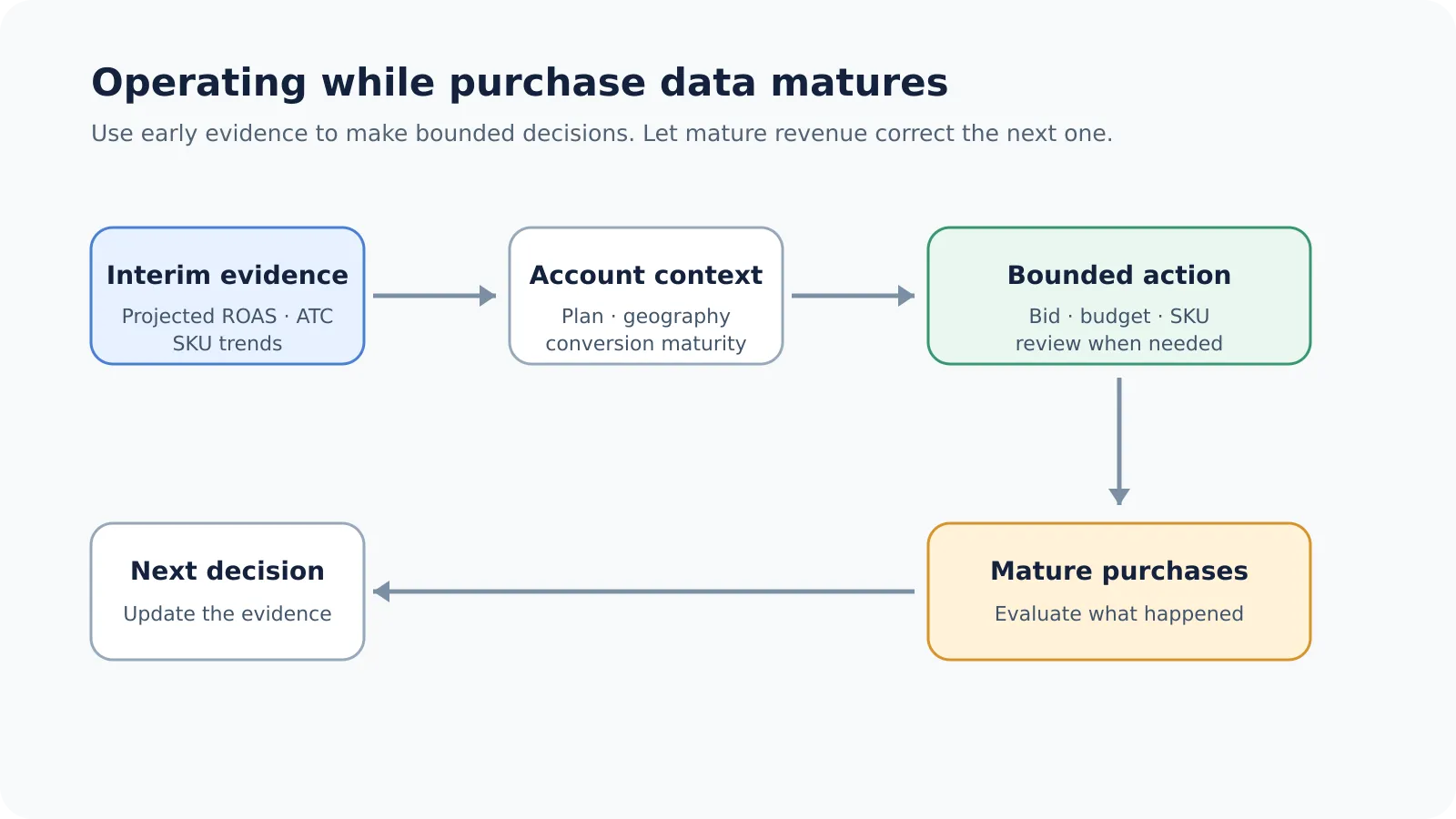
The faster signals filled the time between spend and a mature revenue outcome. They were useful because the account still had decisions to make during that interval, not because they were more important than purchases.
How the account used the evidence
The account was organized around category and performance-based clusters, with separate Media Plans by geography. MAI read current spend, bids, product performance, geography, and the maturity of the conversion data before deciding whether the latest movement was actionable.
Delay-adjusted projected ROAS provided an interim view of expected efficiency. Add-to-cart activity from GA4 supplied a faster behavioral signal. SKU trends showed which products were gaining or losing momentum. The system compared those inputs with the account structure and existing plan rather than reacting to any one metric in isolation.
During the period, MAI made multiple intraday bid changes and reallocated budget toward higher-performing SKUs. These were account-management decisions made while purchase data was still developing. Mature purchases continued to update the evidence used for subsequent decisions.
The operating sequence
The process can be summarized as a recurring loop:
| Step | Account work |
|---|---|
| 1. Read the current state | Spend, bids, geography, product performance, and conversion maturity |
| 2. Add interim evidence | Projected ROAS, add-to-cart activity, and SKU trends |
| 3. Compare with context | Account structure, performance clusters, and the Media Plan |
| 4. Act or propose | A supported, reversible bid, budget, or SKU action |
| 5. Measure the mature outcome | Observed purchases update the next decision |
The sequence matters. Reacting directly to incomplete day-zero ROAS can cause an account to pull back too early. Acting directly on add-to-cart volume can reward activity that never becomes revenue. Combining the signals with account context makes the decision more informed, but it does not eliminate uncertainty.
What changed over the four-week comparison
Across the most recent four weeks, compared with the previous four, the account recorded the following changes:
| Metric | Observed change |
|---|---|
| Google Ads spend | +32.8% |
| Revenue | +54.95% |
| ROAS | Remained above target |
Observed comparison; not a controlled test isolating any signal, action, or product effect.
Spend increased while ROAS remained above the target level. Revenue grew faster than spend during the comparison window. Those are useful observations about the account while the full operating system was in use.
They do not identify the cause of the change.
What the comparison does not prove
We would not attribute the result to projected ROAS, add-to-cart activity, SKU trends, account structure, or any individual bid or budget change. This was not a controlled test that isolated those inputs. They operated together during the period.
The comparison also does not establish that the same signal mix will behave identically in another account. Product mix, spend level, conversion lag, seasonality, and measurement quality can all change the predictive value of an interim signal.
This distinction is important in performance reporting. A consecutive-period comparison can describe what happened. It cannot, by itself, establish incrementality or assign causal credit to one part of the system. Stronger causal questions require a measurement design built for that purpose.
What we learned
Faster signals are most useful when they support reversible decisions. A bid adjustment or SKU-level budget move can be observed and corrected as purchase data matures. A larger change to the plan should require more evidence and, where appropriate, human review.
Projected ROAS was useful because it adjusted the early view for conversion delay. Add-to-cart activity and SKU trends added context about current demand. Their role was to make the waiting period more manageable, not to replace revenue as the standard.
The work log matters as much as the signal. The team should be able to see which inputs supported a change, what action was taken, and how the eventual purchase outcome compared with the interim expectation. That history is how the system learns whether a signal remains useful as conditions change.
The next useful test
We have not isolated how much each signal contributed. The next step is to test whether the interim evidence remains predictive as spend, product mix, and conversion lag change.
| Question | What to examine |
|---|---|
| Projected versus mature ROAS | Accuracy by performance cluster and geography |
| Add-to-cart predictive value | Whether the relationship holds as spend scales |
| Product mix | How much of the movement reflects a mix shift |
| Decision log | Which actions followed each combination of evidence |
Where feasible, the test design should separate the effect of the signal from changes in product mix, seasonality, and account structure. Until then, the field note should be read as an observed operating result with a clearly defined inference boundary.
What this looks like in MAI
MAIOS keeps connected Google Ads data, account history, supplied business context, goals, and controls available across the operating loop. Media Plans define scope, budget, targets, and tuning settings. Monitoring and Analytics can investigate changes, while Tuning and Execution support recurring account work through automatic, manual-review, or paused modes depending on the workflow and configuration.
For delayed-conversion accounts, the practical value is continuity. Faster evidence can inform supported bid, budget, and SKU decisions while purchases mature. Changelogs and work history preserve what the system saw and did, so the eventual outcome can update the next decision rather than sitting in a separate report.
The final conversion signal still matters
Teams with delayed conversions cannot leave the account untouched while revenue matures. They also should not treat the fastest available metric as the truth.
A better operating model uses interim evidence for bounded, reviewable decisions and lets mature purchase outcomes correct the system. That is the discipline this account used while scaling.
See how MAI can support Google Ads decisions while your final conversion data is still developing
Similar articles
How AI Agents Simplify Google Ads Management for Performance Marketers
- Google Ads
- AI Agents
- Campaign Optimization
See how AI agents coordinate Google Ads campaigns around the business signals that platforms cannot see on their own.
How to Choose a Performance Marketing Measurement System (2026)
- Performance Marketing
- Marketing Measurement
- Attribution
- Incrementality
- Marketing Mix Modeling (MMM)
Compare operational analytics, attribution, incrementality, MMM, and performance marketing agents using a practical decision framework for 2026.
Incrementality Testing in Practice: From Investment Case to Proof
- Incrementality Testing
- Geo-Lift Testing
- Brand Search
- Media Budget Allocation
- Performance Marketing
See how a conservative Brand Search investment case was validated with A/A and geo-lift incrementality testing before additional budget was funded.
What Should an AI Media Buyer Actually Do Every Day?
- AI Media Buying
- AI Agents
- Performance Marketing
- Media Buying
- Marketing Automation
What should an AI media buyer do every day? Use this operating loop and weekly work-log test to evaluate monitoring, investigation, optimization, controls, and escalation.