
What We Heard at eTail Boston and GROW NY
We spent time at eTail Boston and GROW NY in Aug 2026. Across the two events, a few themes kept coming up — in sessions, on the show floor, and in conversations with marketers.
AI dominated, unsurprisingly. But the more useful observations were around what companies are actually doing with it, where the limits are starting to show, and what marketers are worried about as adoption accelerates.
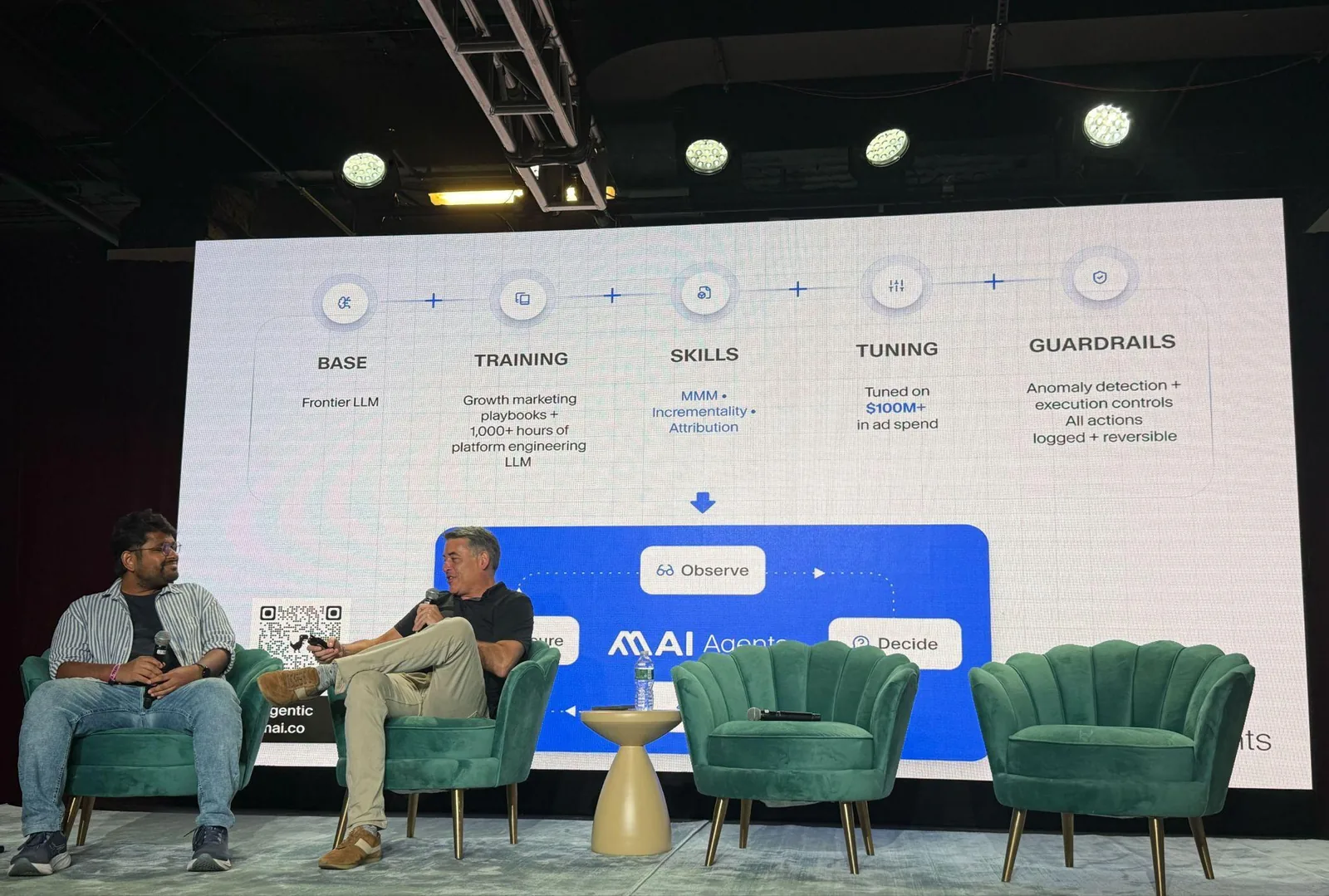
AI dominated the content, but in two very different flavors
By our estimate, 70%+ of the session content at both events was AI-themed, split between narrow point solutions built for specific enterprise use cases and broader workflows built on general-purpose LLMs.
The saturation was heavy enough that speakers were openly joking about it. One panel at eTail was framed around bringing back the “human element” as a counterweight.
The published agendas reflected the same shift. GROW NY had sessions on the AI experimentation stack, AI-powered CRO and agentic commerce, while coverage from eTail centered heavily on agentic AI, personalization and automation.
Most “agentic AI” on stage wasn't actually agentic
A lot of what was billed as agentic still required heavy human intervention.
The advice from speakers reflected that reality. Rather than jumping straight to complex end-to-end automation, the recommendation was often to start with low-risk, high-volume decisions like search relevance, pricing and inventory.
The broader trade press has started calling this “agent washing”: scripted workflows or chatbots being repositioned as autonomous agents. That lined up pretty closely with what we saw at both events. Real deployments were the exception, while “agentic” was being used much more broadly.
The retailers that seemed further along were also fairly deliberate about where humans should stay involved. David's Bridal trained its AI chatbot on human service language specifically to avoid sounding automated, while Warby Parker positioned AI as a way to free staff for in-person interaction rather than replace it.
Cost pressure was a running theme for brands
Brands at both events raised rising costs across media, vendor and technology spend, and staffing.
That showed up in conversations about where to put the next marketing dollar, but also in how companies are thinking about their technology stacks and internal capabilities. Teams were under pressure to get more from the systems and people they already have rather than simply adding another vendor layer.
The flip side of AI enthusiasm was career-proofing anxiety
Alongside the AI enthusiasm, there was real concern from individual marketers, particularly at the brand level, about career security.
The question came up repeatedly in hallway conversations and on stage: how does a marketer build the skills to orchestrate AI systems rather than be replaced by them? It landed with more urgency in person than it tends to in articles about whether AI will replace marketers.
More personalization isn't automatically better
There was also some pushback against the assumption that every customer interaction gets better as it becomes more personalized.
Michaels and others warned that over-personalizing product recommendations can limit discovery and start to feel restrictive rather than helpful.
A related issue came up around the customer journey itself. Individual AI touchpoints can work well while the overall experience still feels disjointed. The challenge increasingly becomes connecting what happens across AI discovery, service and human support rather than optimizing each interaction independently.
What we came away with
AI being everywhere was expected. What felt different was how quickly the conversation had moved toward harder questions: where AI actually works, how much responsibility to give it, where humans still matter, and whether all of these individual systems add up to a better customer experience.
Those questions felt much less theoretical at eTail and GROW than they did a year ago.
See how MAI approaches agentic media buying.